


Turning a startup idea into a working product is one of the most rewarding parts of building a company. It is also one of the most uncertain.
You might see the problem clearly and believe you have the solution, but moving from concept to something customers will actually use is where many teams hit a wall.
If you are a founder, an aspiring entrepreneur, or a non-technical partner looking to make your idea real, you are in good company. Countless others wrestle with the same questions.
There is no universal formula that guarantees success, but there are practical steps that can guide you from early concept to market-ready product with less risk and more clarity.
Here is how to do it.
Key Takeaways
Validation is about proving urgency, not just identifying problems.
Market research should be fast, specific, and grounded in user behavior.
An MVP is for learning, not impressing.
The right build model depends on budget, speed, and skill gaps.
Launching without a go-to-market plan is asking for trouble.
The first month post-launch is the most valuable for iteration.
What is Startup product development, defined
Startup product development is the process of turning an idea into a market-ready product through validation, prototyping, building, testing, launching, and iterating. It is tailored for the constraints and speed of early-stage companies.
Why startup product development is different
Large companies often have deep resources, dedicated research teams, and long timelines. Startups have limited capital, a small team, and a pressing need to prove that their idea solves a real problem. That means the process must be lean, iterative, and focused on learning before scaling. Decisions happen faster, risks are higher, and mistakes can be more costly.
The priority is to identify what to build first, validate that it matters to customers, and launch quickly enough to gather feedback without burning through your runway.
Stage 1: Validate Demand, Not Just Problems
****
****
A lot of people complain. That doesn’t mean they’ll pay for a solution.
Validation starts with finding a pain that is both real and urgent. Look for workarounds—spreadsheets, duct-taped integrations, manual labor. If people are already spending time or money to fix a problem, you have a shot.
Start narrow. Pick a single workflow, audience, or niche and understand it deeply. Broad, generic ideas rarely hit urgency. Narrow ones do.
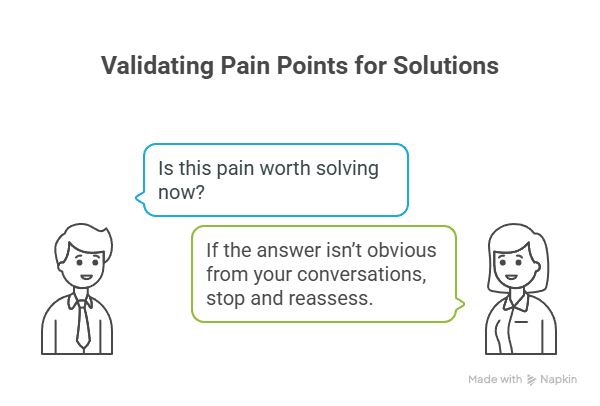
Your goal here is to answer one question: Is this pain worth solving now? If the answer isn’t obvious from your conversations, stop and reassess.
Read the full detailed breakdown here: How to Validate a SaaS Idea: A Practical Guide
Stage 2: Market Research That Moves Quickly
Market research is not about big reports or weeks of surveys. It is about clarity before you commit resources.
Start with secondary research. Read competitor websites, G2 reviews, Reddit threads, LinkedIn posts. Pay attention to what frustrates people and how they’re solving it now.
Write a short hypothesis. Who is your user? What’s their main pain? How might you solve it? Be specific. If your statement is vague, the rest of your process will be too.
Run a handful of interviews—five to ten people who match your target profile. Ask about their work, their frustrations, and how they try to solve them now. Do not pitch. Just listen.
If the patterns are consistent, run a quick survey to confirm interest. Follow it with a simple landing page that explains the problem and invites signups. See if people act, not just nod.
When you see the same pain repeated, measurable interest in your survey, and real clicks or signups, you’re ready to move forward.
Read the full tactical guide here: Market Research for MVP Development: A Tactical Guide
Stage 3: Build a Real MVP
An MVP is not a tiny version of your full product. It is the simplest way to prove your solution delivers value.
That might be a working prototype, a clickable mockup, or a stripped-down live product. It depends on what you need to learn. If you’re testing usability, a prototype works. If you’re testing whether someone will pay, you might need a functional product.
Build only what is essential for the user to experience the core value. If you add features to make it “look complete,” you are wasting time and making feedback harder to interpret.
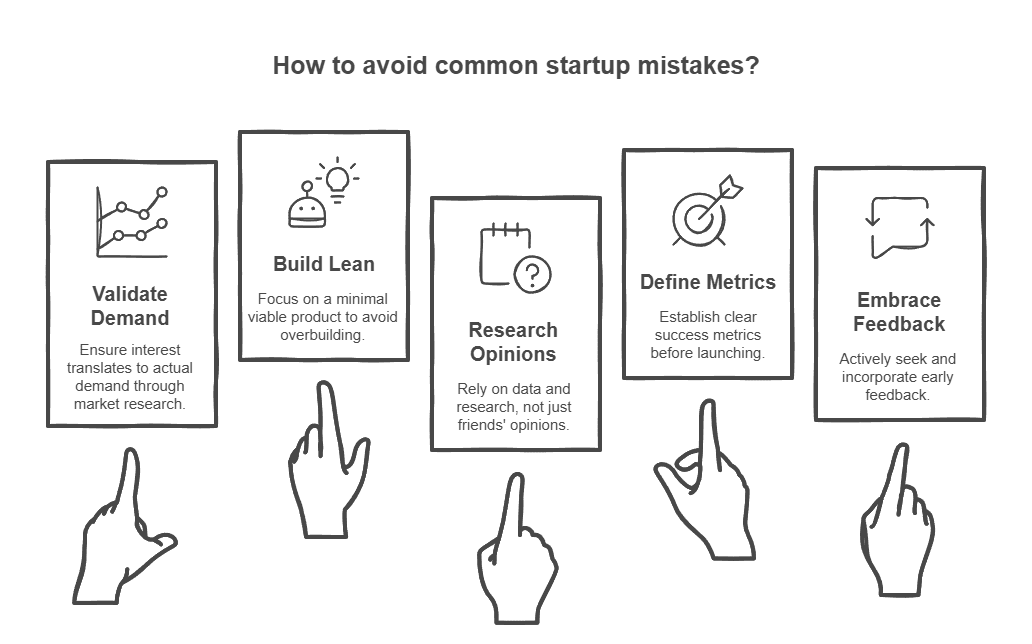
Avoid the big traps: too many features, ignoring feedback, skipping research, unclear success metrics, and choosing tech that will block you later.
Read The Complete Guide to MVP Development for Startups
Stage 4: Choose the Right Build Model
You have four main ways to build:
In-house team: Full control, but slower and expensive.
Agency or dev shop: Fast and experienced, but needs strong management.
Hybrid model: Keep strategy internal, outsource specific skills.
Low-code or AI tools: Quick for validation, but may need rebuilding later.
If speed is your priority, agencies and no-code can get you to market quickly. If control and long-term ownership matter most, start hiring early. Match the model to your budget, skills, and timeline.
Small, cross-functional teams, one PM, one designer, two or three developers, move far faster than large, siloed teams.
Stage 5: Launch and Learn
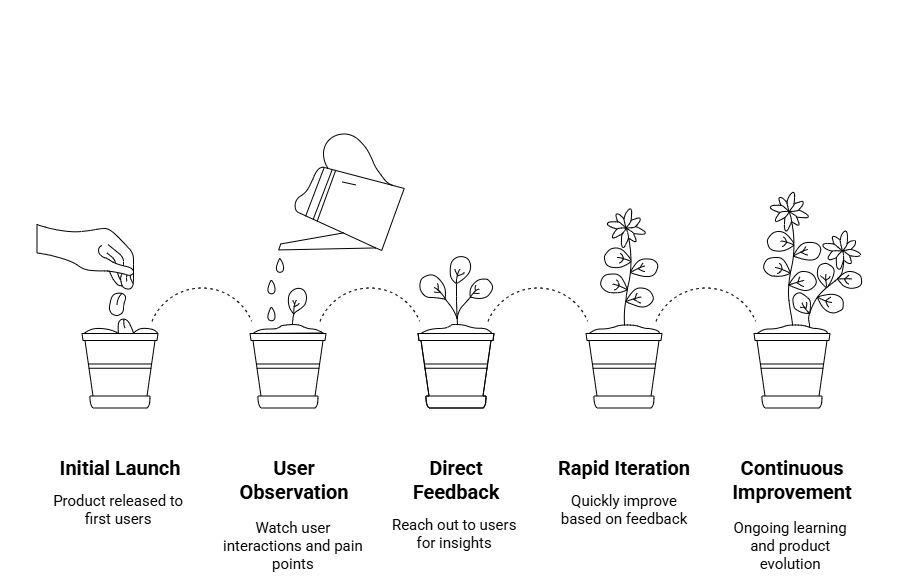
Launch is not the end of product development. It is the beginning of real learning.
Your first users are your richest source of insight. Watch how they use the product. Where do they get stuck? Where do they drop off? What did they expect that wasn’t there?
Reach out directly to early users. Ask what they were trying to accomplish and why they stopped short. Iterate fast while the feedback is fresh.
The first month after launch can tell you more than all your pre-launch planning.
Stage 6: Have a Real Go-to-Market Plan
Even the best product will fail without a way to reach the right buyers.
Define your ideal customer. Be specific. “Small businesses” is not a target. “Independent fitness studio owners with under 10 staff” is.
Choose channels where those buyers already spend time. Align product, marketing, and sales so you speak with one voice. Craft messaging that shows you understand their pain and can solve it better than anyone else.
Plan your GTM before launch so you are not scrambling for customers after the product is live.
You can read more about the Go-to-Market Plan here.
Common Startup Founder Mistakes
Need a Partner to Build Your Startup Product the Right Way?
Frequently Asked Questions
How long should validation take? If you’re full-time, one to three weeks is enough to run interviews, do desk research, and get signal. If you’re still getting weak responses after that, the problem may not be urgent enough.
Do I need to be technical to build an MVP? No. You can use no-code tools, hire freelancers, or partner with a developer. Your biggest value is in defining the problem, scoping the solution, and making sure it solves the right pain.
What if my MVP fails? A failed MVP is not a failed startup. It means you bought clarity cheaply. You can pivot, refine the audience, or change the solution before spending serious money.
How much should I budget for an MVP? For no-code or simple builds, $1k–$5k is common. For custom dev, $10k–$50k depending on complexity. Always start smaller than you think.
When should I hire my first developer? Hire when you have validated demand, a clear problem to solve, and enough work to keep them focused. Too early and they’ll be building on assumptions.
What’s the most common reason MVPs flop?
They solve a “nice-to-have” problem. If users don’t feel urgency, they won’t stick.

Need a Partner to Build Your Startup Product the Right Way?
Successful product development is not about racing to launch the most features. It is about proving demand, solving the right problem, and building with a clear, evidence-backed plan. We work with early-stage founders to take products from concept to launch. That means defining your target users, mapping the core experience, and choosing a build approach that balances speed, quality, and scalability. If your product involves AI, automation, or complex workflows, we help you make smart technical and strategic decisions from day one. Our team covers research, product strategy, design, development, and infrastructure so you move forward without wasted cycles. You will launch with a product built for traction, market fit, and rapid iteration.