


You have an idea that feels promising. You start sketching screens, talking to potential users, and thinking through features.
But one question remains. What if the market does not actually need it?
MVP development for startups offers a way to answer that question early. It helps you test the core of your idea with real users, gather feedback, and avoid building the wrong product.
Instead of investing months into a full build, founders can validate demand, attract early adopters, and stay focused on what matters most.
In this blog, we will explore what MVP development for startups involves, how to approach it effectively, and why it is one of the smartest steps a founder can take.
Let’s begin.
What is MVP Development for Startups?
MVP development for Startups is the process of building a minimal version of a product that includes only the core features required to deliver value to early users.
The goal is to test the product idea with real customers, validate market demand, and collect feedback before committing to full-scale development.
This helps teams avoid unnecessary complexity, reduce risk, and make faster, more informed decisions.
Early-stage founders often overbuild at this stage. They aim for completeness when what they actually need is clarity.
Many teams assume the MVP is just a smaller version of the final product. It isn’t.An MVP exists to answer a question. Does this solve a real problem for a real user?
The scope should be narrow. The outcome should be clear.
MVP development is the art of solving your customer’s biggest problem with the smallest, smartest solution.
It is not about building fast. It is not about building cheap. It is about building right.
MVP vs Prototype vs POC: Know the Difference
While MVPs help validate product ideas with real users, they are often confused with prototypes and proofs of concept (POCs). Each serves a different role in the product development process and is used at different stages.
A prototype is typically created early to explore design ideas. It is not functional, but it helps teams visualize workflows, user interfaces, and core interactions.
A proof of concept (POC) focuses on technical feasibility. It is often used to test whether a particular technology, integration, or approach will work, usually in a limited or internal setting.
An MVP, by contrast, is a functional product that is released to early users. It aims to solve a real problem, collect feedback, and guide future development based on actual user behavior.
Here’s a side-by-side comparison:
| Term | Goal | Fidelity | When to Use |
|---|---|---|---|
| Prototype | Visual exploration | Low | Early design validation |
| POC | Prove technical feasibility | Variable | Internal testing or investor demonstration |
| MVP | Solve a real problem for real users | Functional | Early market validation and learning |
How to Define Core Problems Your MVP Should Solve?
Once you understand what an MVP is and how it differs from other early-stage tools, the next step is defining the right problem to solve.
Most MVPs fail not because of poor code or design, but because they target problems that users do not care about. Avoiding that mistake starts with structured discovery.
Here is how to approach it:
1. Talk to Users the Right Way
User interviews are essential, but only if you ask the right questions. According to The Mom Test, founders often seek validation instead of insight.
Instead:
Ask about past behavior, not hypothetical scenarios.
Focus on how they currently try to solve the problem.
Look for patterns in what frustrates them or costs them time or money.
Ask this: "Can you walk me through the last time this happened?"
Avoid this: "Would you use a product that solves this?"
2. Run a Quick Problem Discovery Sprint
You don’t need months of research. A well-run 5–10 day sprint can help you:
List your assumptions
Interview 5–10 real users
Group recurring patterns and frustrations
Identify problems that are frequent, urgent, and costly
3. Estimate the Size of the Opportunity
Not all problems are worth solving. Focus on those that affect a large segment of users or are tied to measurable pain.
Ask yourself:
How often does this happen?
How painful is it?
What are people already doing to solve it?
4. Stay in the Problem Space
Do not rush into building solutions. Spend enough time understanding the problem in depth. This helps you avoid building features that look good on paper but do not matter to users.
Tools that can help:
Jobs-to-be-Done framework to uncover the real motivations behind user actions.
Problem–Solution Fit Canvas to map out what users need and how your MVP should respond.
What to Validate During Your MVP Discovery Phase
After defining the core problem your MVP should solve, the next step is to validate whether the market actually cares.
This is where the discovery phase begins. It involves a focused 2 to 4-week sprint designed to test your assumptions through real-world signals before you commit to building.
If you have already spoken to users, this phase builds on those insights. It shifts the focus from problem understanding to solution testing.
How to Run an Effective Discovery Sprint
Research existing solutions Use platforms like Google, Product Hunt, G2, or Reddit to study what tools users currently rely on. Take note of what competitors offer, how they position themselves, and what customers are praising or complaining about. Insight from YC’s Startup School: If a solution already exists, your product needs a clear reason to be chosen. This could be speed, simplicity, cost, or niche fit.
Set up a landing page or waitlist Build a simple page that explains your product’s core value. Include a clear call to action, such as “Join the waitlist” or “Get early access.” Drive traffic through email lists, social posts, or small paid campaigns. Advice from Brian Balfour (Reforge): A landing page is not just for marketing. It reveals how well your messaging converts attention into action.
Test mockups with real users Use low-fidelity mockups built in tools like Figma or InVision. Show users the flow and ask what they expect at each step. Capture confusion points and note whether the value is immediately clear. Tip from Jake Knapp (Sprint): Let users interact without over-explaining. If they cannot understand the mockup on their own, the design needs work.
Run small-scale experiments Try simple tests like different headlines or pricing plans. Measure click-through rates, signup interest, or engagement. These are early indicators of what users value most. From Testing Business Ideas by David Bland: Use real behavior, not opinions, to measure interest. Focus on what people do, not what they say they will do.
Signals to Look For
Email signups or demo requests
High interest in specific features or promises
Gaps in the current solutions that your product fills
Messaging that triggers action, not compliments
Red Flags
Users show polite interest but no intent
Conversion rates are low despite the traffic
There’s no clear indication of urgency
Defining the Core Functionality of Your MVP
Once you’ve validated the problem and gathered early user signals, the next challenge is deciding what features your MVP should actually include.
This is where many startups lose focus. They try to build too much too soon, or they add features based on internal opinions rather than user needs.
A successful MVP is not the smallest version of your full product. It is the simplest product that delivers a complete, valuable outcome for one user and one use case.
1. Focus on One Core User Flow
Before you think about screens or features, map the journey a user takes to solve their problem. Identify the trigger, the action they want to complete, and what success looks like in their eyes.
Ask yourself:
What specific problem are we helping the user solve?
What is the starting point, and what is the outcome?
What is the smallest set of steps required to deliver that outcome?
If your product helps restaurant owners manage staff shifts, the MVP should only cover one flow, for example, assigning shifts, rather than scheduling, payroll, analytics, and notifications.
2. Separate What Is Essential from What Can Wait
A strong MVP includes only what is critical to delivering the outcome. Everything else can wait.
Use a filtering question: If we remove this feature, does the product still solve the core problem?
You can also apply prioritization frameworks like:
MoSCoW: Must have, Should have, Could have, Will not have (for now)
RICE: Reach, Impact, Confidence, Effort
3. Build Actions, Not Screens
Many teams get caught up designing interfaces before they are sure what needs to happen. Focus first on what the user must be able to do. These are your critical actions.
For example:
Can a user request a quote?
Can they complete a basic transaction?
Can they view a result or get confirmation?
Each of these is a sign that the product is doing something useful, even if the interface is basic.
4. Keep the Scope Tight
Your MVP should focus on solving one problem for one user. Avoid trying to serve multiple segments or building for too many edge cases.
When you narrow your scope, it becomes easier to build, easier to test, and easier to learn from early users.
You can always expand later. For now, aim to prove that your product can deliver value in one clear situation.
Quick Checklist
Use this checklist before finalizing your MVP scope:
Have we defined one specific user and one primary use case?
Does the MVP support a full flow from problem to resolution?
Are we only building what is necessary to unlock feedback?
Can a user experience value within minutes?
If you can answer yes to these, you are ready to move forward.
Lean MVP Development Frameworks That Work
There are many ways to build an MVP. The right approach depends on your goal, timeline, and how much you need to learn before scaling. The most effective frameworks help you move quickly, reduce cost, and test assumptions in the real world.
Below are five proven MVP development methods used by successful startups. Each one is designed to maximize learning with minimal resources.
1. Wizard of Oz MVP
In a Wizard of Oz MVP, the user interacts with what looks like a working product, but behind the scenes, the operations are manual.
This approach helps you test user experience and demand before building any real technology.
Use this when:
You want to validate how users behave inside the product
You want to test core workflows before writing code
You can simulate the backend with internal effort
Example: An AI copywriting tool where users receive content quickly, but a human is actually writing and sending the results.
2. Riskiest Assumption Testing (RAT)
Every startup makes assumptions. Some are minor. Others, if wrong, can break the business.
RAT helps you identify the assumption most likely to fail and test it directly with the smallest possible experiment.
Use this when:
You are unsure if users trust the product
You want to test willingness to pay or switching behavior
You are early and need directional proof before building anything
Example: Before building a new onboarding flow, test whether users actually care about self-serve onboarding or prefer guided setup.
3. Concierge MVP
A Concierge MVP involves manually delivering your product or service to each user. You walk them through the process step-by-step, often via direct interaction.
This helps you observe behavior, ask questions, and adjust in real-time.
Use this when:
Your product is personalized or service-heavy
You want to learn deeply about user preferences
You are still shaping your solution and want real-world input
Example: A meal planning app that begins by sending meal suggestions over WhatsApp based on one-on-one calls.
4. No-Code MVPs
No-code tools let you build a working version of your product using visual platforms instead of custom code. These tools are fast, affordable, and ideal for testing user workflows.
Use this when:
You want to launch quickly
You have limited technical resources
You are testing product-market fit or UX flows
Popular tools: Bubble, Glide, Webflow, Tally, Airtable, Zapier
Example: A marketplace MVP built on Webflow and Airtable with Zapier automation behind the scenes.
5. Build–Measure–Learn Loop
This framework, introduced in The Lean Startup, treats product development as an experiment. You build the smallest version of a feature, measure how users engage with it, and use those insights to decide what to improve next.
It creates a feedback loop that helps you iterate quickly.
Use this when:
Your MVP is in users’ hands
You want continuous learning from real behavior
You are making decisions based on usage, not assumptions
Example: A team adds a new feature to test engagement. If usage is low, they remove or rework it based on feedback.
How to Choose the Right MVP Build Approach
Once you know what your MVP needs to do, the next decision is how to build it. Your choice affects how fast you launch, how much you spend, and how easily you can test and iterate.
There is no single right answer, but there is a right fit depending on your current resources, goals, and team setup.
Step 1: Start With Your Constraints
Start with your current situation. Your answers to these questions will guide what is realistic.
Do you have a technical cofounder or dev team?
Do you need to launch within 2 to 4 weeks?
Are you working with a limited budget (under $5K)?
Is your MVP mostly form-based, workflow-based, or custom logic?
Step 2: Match Your Needs to the Right Toolset
Once you know your constraints, pick the tool category that aligns best.
Use No-Code Tools If You Need to Launch Fast
Platforms like Webflow, Bubble, Glide, and Softr allow you to build and ship without writing code.
Best for:
Testing demand with early adopters
Building simple marketplaces, CRMs, dashboards, or portals
Founders without engineering support
Considerations:
Limited customization
Less control over performance
Works best for lean, validated flows
Use Low-Code Platforms If You Need Flexibility
Low-code platforms like FlutterFlow or Xano give you the speed of visual development with the ability to insert custom code and APIs when needed.
Best for:
Founders with some dev experience
MVPs with backend logic or automation
Projects that need fast iterations with some customization
Considerations:
May still require light engineering support
Some tools limit long-term scalability
Use Full Stack Development If You Need Full Control
If you are building something complex, with custom workflows, data handling, or integrations, a traditional full-stack build gives you maximum flexibility.
Best for:
Tech-heavy products that rely on custom infrastructure
Founders with access to engineers
MVPs are expected to scale quickly into robust platforms
Considerations:
Higher cost and longer build time
Best used after some problem–solution validation
Step 3: Prioritize Learning Over Perfection
Whichever path you choose, keep your focus on speed to insight. The goal of your MVP is not to build the final product. It is to learn what users want, how they behave, and whether your core value holds up in the real world.
Choose the method that gets you there with the least waste.
Scope Creep: The Most Common Way MVPs Fail
Many MVPs fail not because of bad ideas or poor execution, but because teams try to build too much too early. This problem is known as scope creep.
Scope creep happens when extra features or improvements are added to the MVP during development. These additions may seem small, but they increase complexity, delay launches, and reduce focus. Instead of a sharp solution to a clear problem, you end up with an unfocused product that does not deliver early insight.
Why Scope Creep Happens
The team tries to match everything competitors offer
Founders or stakeholders keep adding new ideas
Product scope grows to meet future needs instead of current goals
There is no clear definition of what the MVP must include
How to Keep Scope Under Control
1. Define a Clear Goal for Your MVP Write down what your MVP is supposed to prove. For example, you may want to learn if users will complete a booking without support. Any feature that does not help you answer that question can wait.
2. Use a Feature Filter Apply a method like MoSCoW (Must have, Should have, Could have, Will not have) or ICE (Impact, Confidence, Effort) to decide what stays in scope.
3. Appoint One Person to Own the Scope This could be the founder or product lead. Their job is to protect the build from new ideas that dilute focus.
4. Build in Short, Testable Cycles Break your MVP into two-week or weekly chunks. Test and learn after each cycle. This creates discipline and keeps complexity low.
Three Questions to Ask Before Adding Anything
Does this feature help us validate the core problem or solution?
Will the user be blocked without it?
Can we test this with a manual workaround or a future version?
Timelines and Budgets: What to Expect When Building an MVP
Founders often underestimate how long and how much it takes to build even a simple MVP. While lean development is efficient, there are still time and budget requirements you need to plan for.
Here’s what to expect based on your chosen build path.
Typical MVP Budgets
| Build Type | Estimated Budget | Timeline | Inclusions |
|---|---|---|---|
| Lean Studio / Agency | $15,000 – $40,000 | 8 – 10 weeks | Single platform (web or mobile), 3–4 core features, basic design, payment integration |
| Mid-Tier Product Studio | $40,000 – $100,000 | 10 – 14 weeks | Web + mobile, 5–8 features, custom design, 2–3 third-party integrations |
| Full-Service Agency | $100,000 – $250,000+ | 14 – 20 weeks | Web + mobile + admin panel, 10+ features, premium design, complex integrations |
What Drives Time and Cost
| Factor | Impact on Budget and Timeline |
|---|---|
| Scope and Features | More features increase design, development, and QA effort. Focus on essentials early. |
| Design Depth | Premium branding/UI work adds 2–4+ weeks vs. simple UIs. |
| Tech Stack Choices | Choosing modern, developer-friendly tools accelerates builds (e.g., Firebase, Supabase). |
| Team Experience | Senior teams deliver faster and cleaner builds but at a higher rate. |
| Team Structure | Compact, cross-functional teams (PM, designer, 2–3 devs) move faster than siloed teams. |
| Feedback Loops | Iterative testing with users ensures faster pivots and reduces wasted development cycles. |
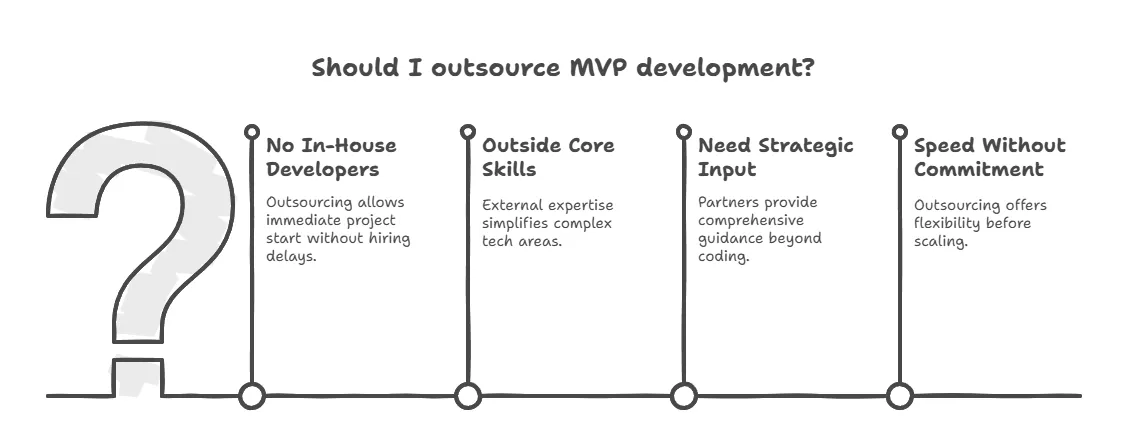
When Should I Outsource MVP Development
Building an MVP requires speed, clarity, and execution. If your internal team lacks the skills or time to deliver all three, outsourcing can be the right move.
Outsourcing is not just about writing code. A good partner helps you clarify your product, avoid technical waste, and launch faster with fewer mistakes.
Need a Partner to Build Your MVP the Right Way?
A successful MVP is not about launching a feature-packed product. It is about learning what works, validating the right problem, and building just enough to move forward with clarity.
Ellenox works with early-stage founders to take ideas from concept to product. We help you define the core user journey, choose the right tech approach, and build lean systems that get real results.
If your product involves AI, automation, or custom workflows, we help you make smart build decisions from day one. Our team supports everything from scoping and wireframes to development and infrastructure.
You will get a working MVP focused on traction, speed, and real-world feedback.
Contact us to see how we can support your next build.