


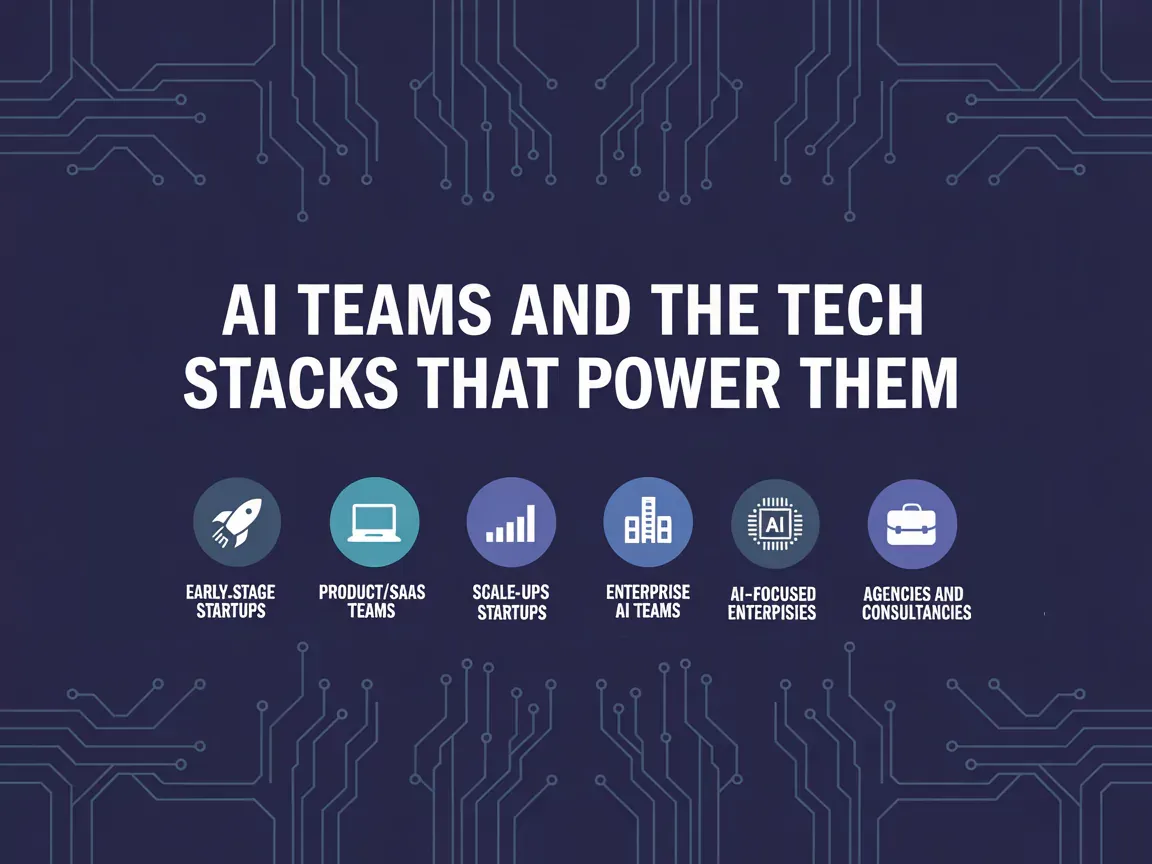
Lean AI teams move faster when the stack aligns with how they work. The best infrastructure stack for lean AI teams improves delivery speed, reduces friction, and supports long-term growth.
But many teams run into the same problem. It is not the model. It is the infrastructure. Time is lost fixing pipelines, managing tool conflicts, or waiting on deployment support. A mismatched stack slows down progress and adds unnecessary complexity.
This guide shows how to design the best infrastructure stack around team roles. It maps tools to responsibilities, explains trade-offs, and helps avoid choices your team cannot support. The goal is a system your team can build, operate, and improve on its own. Start with the team. Then choose the tools.
Actionable Takeaways for Lean AI Teams
Define a clear use case before selecting tools. Let the problem shape your architecture.
Match your tech stack to your team size and skill level. Smaller teams should prefer simple, managed services, while larger teams can handle complex systems.
Choose modular and well-supported tools to enable future upgrades or replacements without major disruption.
Do not adopt orchestration or MLOps platforms too early, as they can delay delivery and may not address immediate needs.
What is AI Infrastructure?
AI infrastructure is the set of hardware, software, and cloud services that enable the development, training, deployment, and scaling of artificial intelligence systems. It includes components such as compute resources, data storage, networking, orchestration platforms, and monitoring tools that together provide the foundation for building AI applications.
Unlike traditional IT infrastructure, which is designed primarily for transactional systems, AI infrastructure is optimized for large-scale data processing, distributed model training, and real-time inference. It ensures that teams can move efficiently from experimentation to production while maintaining reliability, performance, and governance.
AI Tech Stack Decision Table
| Team Profile | Team Traits | Stack Priorities | Tools | Risks |
|---|---|---|---|---|
| Early-Stage Startups | 1–30 people, generalists, fast-moving | Speed, simplicity, low maintenance | Firebase, Supabase, OpenAI APIs, Notion, Slack | Complex infra, DevOps-heavy tools, on-prem setups |
| Product/SaaS Dev Teams | Growing SaaS orgs with active users | Delivery velocity, scalability, structured workflow | AWS, GCP, Stripe, GitHub/GitLab, CI/CD, Notion, Confluence | Under-tested platforms, poor performance at scale |
| Scale-Up Startups | 30–100+ people, Series A/B, multi-team | Performance, backend scale, data pipelines | Segment, Salesforce, Datadog, scalable cloud infrastructure, analytics tools | Non-integrated tools, traffic bottlenecks, vendor lock-in |
| In-House Enterprise AI | Internal teams, enterprise IT alignment | Security, auditability, integration with data systems | Databricks, AzureML, Snowflake, MLflow, Kubeflow | Lack of governance, non-compliant tools, hobbyist platforms |
| AI-Focused Enterprises | Fortune 500 or mid-market firms | ROI clarity, compliance, delivery assurance | GPT agents, RAG pipelines, ServiceNow, Slack integrations, document AI tools | Opaque vendors, unproven ROI, poor delivery visibility |
| Agencies and Consultancies | External delivery teams across clients | Rapid delivery, reuse, modular builds | LangChain, Claude or GPT APIs, Databricks, Pinecone, prompt frameworks | One-off prototypes, inflexible systems, lack of deployment standardization |
6 Types of AI Teams and the Best Infrastructure Stack for Each
1. Early-Stage Startups
Startups at the seed stage prioritize speed and simplicity. Teams are small, often cross-functional, and focused on getting an MVP to market with minimal overhead. Every tool in the stack must support fast iteration, low setup time, and a short learning curve.
The best infrastructure stack for lean AI teams in this stage relies on managed services and developer-friendly platforms. Teams often use cloud credits from AWS or GCP and choose tools like Firebase, Supabase, and OpenAI APIs to reduce setup and maintenance effort. Internal collaboration stays streamlined through Notion and Slack, helping teams stay close to product feedback and ship without relying on infrastructure support.
The main risk at this stage is over-engineering. Complex infrastructure, on-prem environments, or heavyweight MLOps platforms slow progress and create dependencies that small teams cannot manage. Keeping the stack modular, hosted, and easy to operate is essential for maintaining momentum.
2. Product/SaaS Development Teams
These teams operate within growing SaaS companies that already serve paying customers. Their focus is on fast feature delivery, long-term scalability, and structured collaboration between product, engineering, and customer success. Reliability becomes a baseline expectation, not a bonus.
Stacks commonly include cloud infrastructure like AWS or GCP, payment systems such as Stripe, and knowledge-sharing tools like Notion or Confluence. Source control is managed through GitHub or GitLab, often paired with CI/CD pipelines to support fast, safe deployments. These systems allow teams to ship at pace without sacrificing consistency as headcount and user traffic grow.
The biggest risk is adopting tools that do not hold up in production. Under-tested services or early-stage platforms may break under load or create integration issues. Teams in this phase need tools that balance iteration speed with stability and operational readiness.
3. Scale-Up Startups
Scale-ups have moved past early product-market fit and now focus on building infrastructure that supports growth. With larger teams and increasing customer demand, the priorities shift toward backend performance, robust data systems, and coordination across multiple functions.
The best infrastructure stack for scale-ups often includes customer data platforms like Segment, CRM tools such as Salesforce, and observability services like Datadog or Grafana. Scalable cloud infrastructure, well-structured APIs, and analytics tools become essential for managing complexity and informing roadmap decisions. Vendor selection is based on how well services integrate and how they support the company's growth path.
The primary risk is choosing tools that fail under higher traffic or heavier data loads. Vendors must offer reliable scaling paths and meet growing compliance needs. A fragmented or fragile stack will slow down execution and create costly dependencies.
4. In-House Enterprise AI Teams
Internal AI teams inside large enterprises build systems that support core operations without needing to ship public-facing products. Their work is focused on internal tooling, automation, and augmentation, often embedded within existing IT or data infrastructure.
The best infrastructure stack for these teams includes platforms like Databricks, AzureML, or Snowflake to handle large volumes of enterprise data. MLflow or Kubeflow may be used for model lifecycle management, and all tools must support access control, internal compliance, and integration with company-wide systems. Stability, auditability, and IT alignment matter more than experimentation or speed.
The risk lies in using tools that lack governance, monitoring, or enterprise support. Lightweight services that work well in startup contexts often fall short when layered into strict enterprise environments. Mature processes and long-term maintainability are key.
5. AI-Focused Enterprises
These organizations invest in AI to unlock efficiencies, build internal copilots, or automate decision-making. They have large budgets but operate under strict procurement and risk management processes. Teams must demonstrate impact while managing internal oversight and compliance.
The best infrastructure stack often includes GPT-based agents, RAG pipelines, document processors, and search-based assistants. Common layers involve hybrid cloud deployments, integrations with ServiceNow or Slack, and vendor tools focused on knowledge management or customer support. Project success depends on clear KPIs, delivery timelines, and the ability to show measurable value.
The main risk is selecting vendors that cannot prove ROI or deliver reliable outcomes. Tools must be transparent, auditable, and aligned with business goals. Buyers expect pilots, proof-of-concept phases, and detailed security reviews before full rollout.
6. Agencies and Consultancies
Agencies serve a range of clients across industries, combining AI engineering skills with reusable delivery playbooks. They operate under tight timelines and need to produce visible results across varied deployment environments.
The best infrastructure stack for agencies typically includes flexible frameworks like LangChain, model APIs such as Claude or GPT, and data platforms like Databricks or Pinecone. Systems are built for speed, modularity, and clarity. Success comes from balancing technical depth with delivery efficiency and client-specific requirements.
The biggest risk is building overly rigid solutions or one-off prototypes. Agencies need to avoid bespoke architectures that do not scale across clients. Standardization, component reuse, and cost-aware design are essential for sustainability.
****
Not Sure What AI Stack Fits Your Team? Ellenox partners with product and engineering teams to design scalable, efficient systems using the right AI infrastructure for how you work. Contact us to build the stack your team can own, operate, and grow with.
Practical Steps to Build and Scale Your AI Stack
****
1. Define the core use case
Start with a clear objective. Predicting churn, generating product recommendations, classifying documents, or powering an internal copilot all require different stack choices. Anchor the stack around the problem first, not the tools.
Consider:
The type and volume of data (batch, streaming, text, image)
The required output format (scores, responses, decisions, embeddings)
Existing data systems, compliance rules, and team expertise
2. Start with a minimal, working stack
Avoid overbuilding at the start. Focus on the smallest set of tools that produces useful results. For early delivery, use pre-trained models and managed services that reduce setup and deployment effort.
Examples include:
Using OpenAI APIs or open-source models from Hugging Face
Storing data in a managed object store like S3 or GCS
Prototyping in notebooks, simple dashboards, or CLI tools
3. Choose tools that are modular and well-supported
Favor components that follow open standards and can be easily replaced or upgraded. This allows your stack to evolve as your team and product mature.
Look for:
APIs and formats that are widely supported (JSON, Parquet, REST)
Containerized workflows and cloud-native platforms
Tools with versioning, CI/CD compatibility, and strong documentation
4. Design for integration from the start
Ensure each layer connects cleanly to the next. Data pipelines should feed directly into models, and model outputs should be consumable by downstream applications or users.
Focus on:
End-to-end flow between ingestion, modeling, and serving
Logging, validation, and monitoring for each step
Aligned environments across local, staging, and production systems
5. Measure performance and plan for scale
Once the stack is running, track outcomes at both the system and business levels. Build in feedback loops to retrain or fine-tune models as new data arrives.
Track:
Technical metrics like latency, uptime, and model drift
Business KPIs like cost savings, conversion rates, or workflow speed
Opportunities to refactor, modularize, or add orchestration layers
Top Mistakes Teams Make When Choosing an AI Infrastructure Stack
| Pitfall | Why It Fails | What to Do Instead |
|---|---|---|
| Overengineering Too Early | Complex MLOps setups delay delivery without adding value before PMF | Ship with the minimal working stack. Add orchestration only when needed |
| Neglecting Observability | Lack of logs and metrics makes failures hard to trace and debug | Log inputs, outputs, and errors from day one. Add monitoring before scaling |
| Fragmented Tooling | Isolated tools create integration issues and increase maintenance overhead | Use tools with native integrations or shared metadata across stages |
| Ignoring Data Lineage | Data drift and schema changes go unnoticed and degrade model accuracy | Track dataset versions, transformation steps, and input sources consistently |
| One-Size-Fits-All Mindset | Copying another team's stack fails under different constraints | Match tools to your team structure, workflows, and delivery model |
How Ellenox Helps You Build the Best Infrastructure Stack
Ellenox is a venture studio that works with early-stage teams to build AI-enabled products from the ground up. We help you design a stack that fits your team, supports your use case, and scales without unnecessary overhead.
Our role is hands-on. We work with your team to define the architecture, select the right tools, and implement systems that are production-ready. That includes everything from data infrastructure to model deployment and monitoring.
If you're building with AI and want to move quickly without accumulating technical debt, we help you make the right decisions early. The result is a stack your team can operate, evolve, and scale as the product grows.
Contact us to see how we can support your build.
Frequently Asked Questions About AI Team Tech Stack
What is the best infrastructure stack for lean AI teams?
It is the set of tools, platforms, and services used to build, train, deploy, and monitor AI systems without adding unnecessary complexity.
How should I choose an AI stack for a small startup team?
Start with managed services that reduce setup and maintenance. Use APIs like OpenAI, tools like Supabase or Firebase, and avoid building infrastructure you cannot maintain.
Do I need MLOps platforms like MLflow or Kubeflow?
Only if your team has multiple contributors working on the model lifecycle and deployment, early-stage teams often do fine without them.
What is the role of vector databases in the stack?
Vector databases store embeddings for semantic search or retrieval-augmented generation (RAG). They are useful when building LLM-based systems that need context retrieval.
Should I build my infrastructure or rely on SaaS?
Most teams should start with SaaS and move to custom infrastructure only when control, compliance, or cost requires it. Early delivery matters more than customization.