



Most MVPs are built too early and researched too late.
Market research is not about proving your idea is great. It’s about discovering whether anyone will care. This guide shows you how to do fast, structured research that uncovers real user behavior, not just opinions.
Done right, market research eliminates guesswork, validates early demand, and prevents building a product no one actually needs.
What Is Market Research for MVP Development?
Market research for MVP development is the process of collecting and analyzing data to understand your target audience before building your product. It helps you define the problem, assess demand, and test whether users want what you plan to build.
This includes both primary research (surveys, interviews, prototype tests) and secondary research (analyzing competitors, existing data, forums). Done well, it ensures your MVP is aimed at a clearly defined audience with a real, validated need.
In short, Market research in this context is not a 40-page report. It is a structured way to understand your target audience and test assumptions before investing in development.
Done correctly, it helps you define your unique value proposition, test early demand, and understand what to build and why.
Why Founders Should Start With Research
Founders often default to building first, thinking momentum equals progress. But real traction comes from solving an actual need.
Market research helps you:
Identify whether a real problem exists
Understand user behavior and decision-making
Prioritize features based on demand
Avoid building the wrong thing
If you validate your idea upfront, you reduce the risk of product failure and increase your odds of early traction or investment.
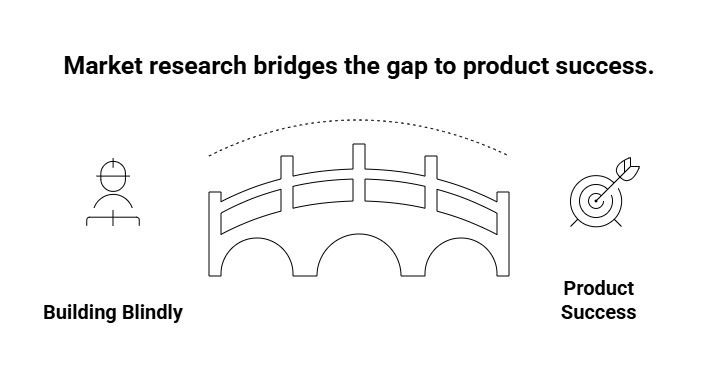
Skipping this step leads to expensive lessons later. One interview with a power user can save three months of wasted development.
Not Ready to Build Your MVP?
Types of Market Research for MVP Development
There are two key types of research: primary and secondary. You will use both.
Primary Research
Direct data collection from your target audience.
User interviews
Surveys
Landing page tests
Concept testing
Prototype feedback
Secondary Research
Indirect data from existing public or third-party sources.
Competitor reviews
Google Trends, Reddit, Product Hunt
Industry reports
SWOT analysis of existing tools
Start with secondary research to shape your assumptions. Follow with primary research to validate or disprove them.
Related Read: How to Validate SaaS Ideas Without Writing a Single Line of Code
The 6-Step Process for MVP Research
This is a lean, tactical approach that balances speed with rigor. Each step is designed to generate actionable insights.
1. Start with Secondary Research
Before speaking to users, gather insights from the existing market. Study:
Direct and indirect competitors
Search trends and keyword data
Forum discussions (Reddit, Product Hunt, Twitter)
G2 and Capterra reviews
Your goal here is to identify patterns and gaps. What has already been built? What do people still complain about? What language do they use?
You’re not just looking for problems. You’re looking for workaround behavior such as signs people are already trying to solve this, but poorly.
2. Define Your Core Hypothesis
Every MVP starts with a hypothesis. Without it, research has no focus.
A good hypothesis describes the problem, the audience, and what they are willing to do about it.
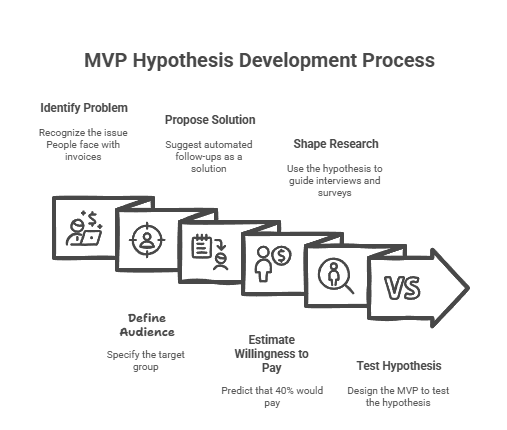
For example:
“Freelancers are losing time chasing invoices. If offered automated follow-ups, 40 percent would pay $10 per month.”
This will shape your interviews, surveys, and even landing page copy. Be specific. Your MVP should aim to test this hypothesis, not just build a product.
3. Conduct Fast, Insightful Interviews
Talking to users is still the highest ROI activity at this stage. Start with 5 to 10 interviews with people who match your target audience.
Ask open-ended questions such as:
When was the last time you faced [problem]?
How are you solving it now?
What do you wish existed?
Would a solution be nice to have or a must-have?
Avoid pitching your idea. You are listening for patterns, frustrations, and language. Record interviews, take notes, and look for repeated signals.
Use empathic design principles. Focus on what people do, not just what they say.
4. Run a Short, Focused Survey
Once you hear early patterns in interviews, scale validation with a short survey. This helps test assumptions across a larger group.
Your survey should include:
A few demographic or qualifying questions
One to two problem-awareness questions
Willingness to pay or usage intent
Optional email capture for follow-up
Tools like Survicate, Google Forms, or Typeform work well. Distribute it through email, LinkedIn, Reddit, or relevant communities.
Aim for 30 to 50 responses from people who fit your target profile. You do not need thousands of answers to detect clear signals.
5. Build and Test a Landing Page
This step helps validate real-world behavior. A landing page should present your idea clearly and measure interest.
Include:
A strong headline with your unique value proposition
Three core benefits
A single CTA (email capture or pre-order)
Drive traffic through organic sharing, niche forums, or a small paid test. Track:
Clickthrough rate on call to action
Email signups or demo requests
Bounce and time on page
Even a low-conversion page tells you something. Combine it with qualitative research to make sense of the signals.
If interviews show intent but the landing page doesn’t convert, your messaging may be off. If no one clicks at all, your hypothesis may be weak.
6. Analyze Results and Decide
Use a simple decision matrix to weigh all signals from research. Look for consistent alignment across interviews, surveys, and behavior on the landing page.
Sample signals:
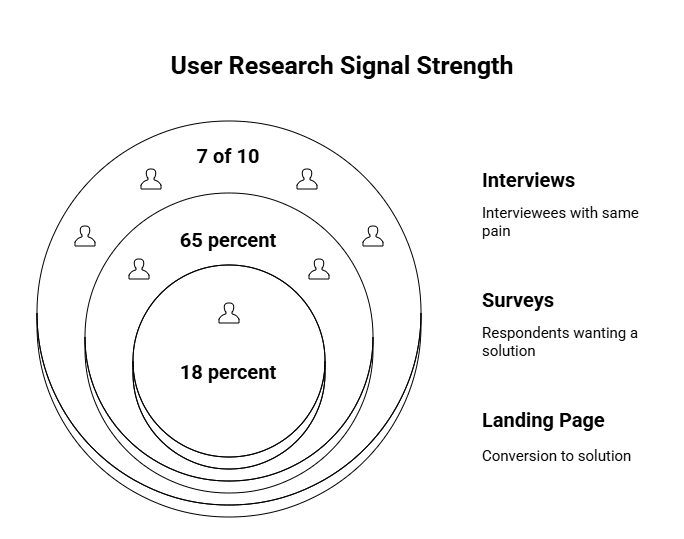
7 of 10 interviews described the same pain point
65 percent of survey respondents said they would use or pay for a solution
Landing page converted at 18 percent
If the signals are weak or inconsistent, you may need to reposition or dig deeper into the problem. If the signals are strong, you are ready to scope and build your MVP with confidence.
Key Concepts and Methods to Use
Concept Testing
Concept testing evaluates how your target users react to your idea. This can be as simple as showing them a product description, a landing page, or a Figma mockup.
You gather feedback on:
Clarity
Relevance
Emotional reaction
Purchase intent
Use monadic (one-concept-at-a-time) or comparative methods. Ask questions like “Would this solve your problem?” and “What is missing?”
Don’t just ask if it makes sense. Ask if they’d be disappointed if it didn’t exist.
Lead User Research
Lead users feel the problem more intensely and are more motivated to find solutions. Interviewing them first often reveals future product demand.
Reddit, Twitter, and founder Slack groups are good sources to find these users early.
They tend to hack together their own systems. They talk in specific detail, not vague pain. Their feedback will shape your first version better than casual users ever could.
Empathic Design
This method focuses on observing how people behave and solve problems, not just what they say. It is ideal for identifying hidden needs or emotional barriers that surveys miss.
Record what frustrates people, what tools they hack together, and what they wish existed.
Observation beats speculation. If someone builds a workflow just to survive a task, you’re standing on top of product gold.
Lay the Groundwork for a High-Impact MVP

Not Ready to Build Your MVP?
Work with Ellenox to Validate First Jumping into development without validating demand is the fastest way to waste time and money. If you're still figuring out your audience, messaging, or product positioning, Ellenox helps you lay the right foundation. We partner with early-stage B2B teams to: ➔ Uncover real customer pain through structured research ➔ Validate product-market fit before building ➔ Define your MVP scope with confidence If you're pre-built and want to move forward with clarity, let’s talk.
Lay the Groundwork for a High-Impact MVP
From Idea to Validated MVP Ellenox partners with early-stage founders to move from concept to product with speed and structure. We help you define the real problem, validate demand, and build the first version of your product, without guesswork. With a team across product, design, and development, you’ll move forward with clarity, focus, and confidence.