



You don’t want to be the founder who builds something no one needs.
Still, it happens all the time.
A few friendly conversations. A Reddit thread. A landing page shared in Slack. It feels like progress. Maybe even validation.
Then comes the build. Months of work. Launch day arrives.
A few hundred visitors. A few signups. No usage. No sales. Nothing.
This isn’t rare. It is the default. And it usually happens because there was never a real demand. Only weak signals are mistaken for proof.
Most founders validate by looking for reasons to keep going. Real validation is different. It is uncomfortable. It means talking to strangers, hearing “no,” and proving that someone will pay before you build.
If you want to avoid wasting the next year on a product no one needs, this guide is for you.
1. You Are Not Validating a Problem. You Are Validating Demand
Everyone has complaints. Most of them do not matter.
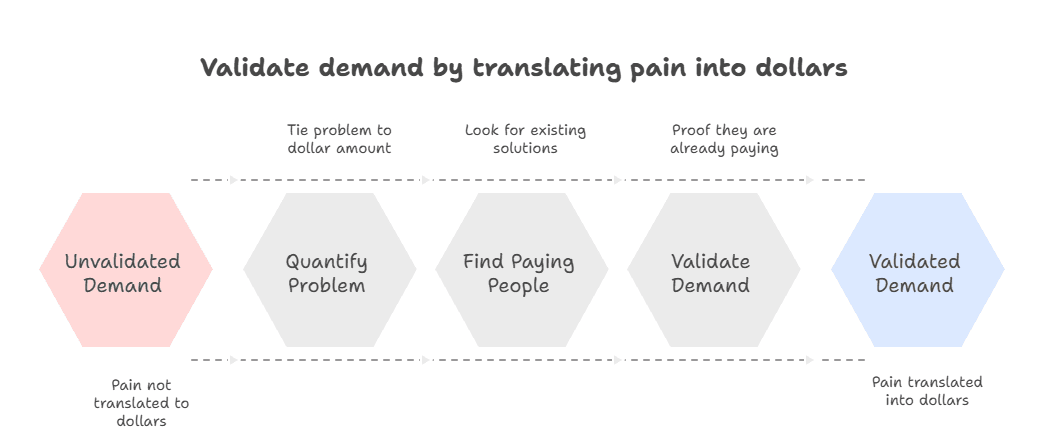
The real test is not whether a problem exists. It is whether anyone cares enough to act on it. If they are stitching together solutions with Notion, Zapier, spreadsheets, or virtual assistants, that is not just pain. That is the demand.
They are already spending time or money to fix it in a broken way. They are not waiting for you. They are already trying.
This is even more important if you are building for businesses. Consumers want comfort, fun, or convenience. Businesses do not. They want to make money or save money. That is it.
You cannot sell them a clean design or nicer dashboards. You have to tie the problem to a dollar amount. If you cannot do that, you are not ready to sell.
“Tired workers” is not a pitch. “Tired workers cause 20 percent more order errors. That costs two dollars per hour per person. This solution cuts errors by 15 percent and saves fifty thousand dollars a year,” is a pitch.
Translate pain into dollars. Look for people who are already paying in time, money, or frustration. Do not rely on survey answers or soft signals. Do not ask if they would use it. Look for proof they already are.
That is how you validate demand.
2. Go Deep, Not Broad
We are past the point where another general productivity tool is going to stand out. Everything has a surface-level solution now.
If you want to build something real, start narrow. Go deep inside a specific workflow. Talk to people in one role at one type of company. Understand exactly where things break. Build for that.
Broad tools sound impressive, but are impossible to validate. Specific tools solve specific problems that people face every day. That is where urgency lives.
Suppose someone is stitching together spreadsheets, Slack, and Zapier to fix something; that is real. That is where you should go.
3. Reverse Engineer Markets That Already Spend
You are not just validating problems. You are validating spend.
If no one spends time or money to solve it, you are building urgency from scratch. That is harder.
Start with markets where spending already happens. Then work backward.
You are not trying to convince a market to care. You are trying to catch a market that is already spending money.
If people are hiring for roles, that is a budget. If they are duct-taping solutions, that is an urgency. If they are paying for a workaround, that is proof.
Check job boards, Reddit threads, Slack groups, and G2 reviews. Look at what people complain about. Look at what they buy. Look at what they build in-house just to get things done.
Look at the tools people pay for. Scan Capterra, G2, or the Chrome Web Store. Pick a category. Read one-star and three-star reviews.
When someone says “missing key features” or “interface is slow,” that is not just a complaint. It is a list of opportunities.
Hiring is another signal. If companies are hiring for data cleanup, customer onboarding, or internal automation, they have already spent on that problem. That is your wedge.
See what tools get recommended on Reddit, shared in Slack groups, or screenshotted on LinkedIn. Not just mentioned. Screenshotted. That means people use them.
If teams customize Airtable, Notion, or Zapier to handle a niche workflow, the existing tools are not enough. If they write scripts, connect five tools, or pay someone to do it manually, they are solving it badly.
Before Superhuman existed, power users hacked Gmail with filters and shortcuts. That showed the gap.
You are not innovating from thin air. You are targeting what already exists, but it works badly.
4. Talk to Prospects Like a Researcher, Not a Salesperson
Most founders waste early interviews. They pitch. They explain the idea. They ask, “Would you use this?” or “Do you like this feature?” That is not validation. That is guesswork.
Stop talking. Start studying.
Treat every conversation like research. You are not selling. You are trying to understand what already happens without you.
Ask about past behavior, not future intent.
When was the last time you dealt with this?
What did you try first?
Did you look for a tool or just push through it?
Did you pay someone to solve it?
Did you build a workaround?
How much time or money does it cost you now?
The goal is to get real stories. Real timelines. Real spend.
If someone says, “Yeah, that’s annoying,” and moves on, it is not urgent. If they describe the system they built in Airtable, the Zap they set up, or the contractor they hired, that is a signal.
The more manual the solution, the more pain exists. The more people who are already working around the issue, the more likely they are to pay for a fix.
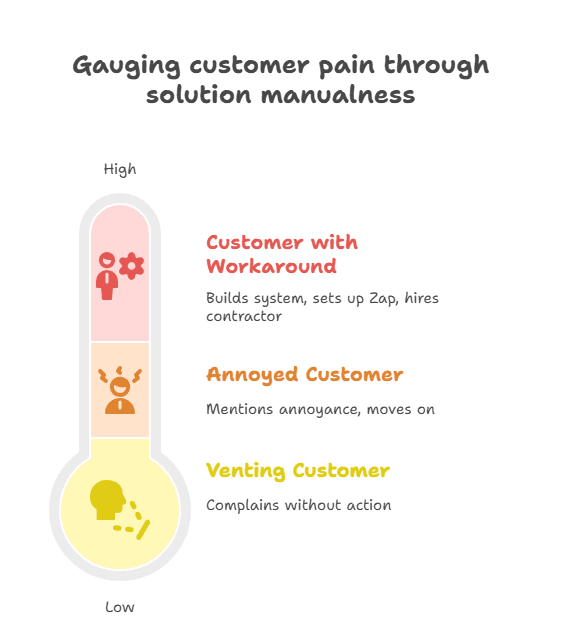
Listen for three things:
Pain: Is the current way frustrating or expensive?
Frequency: Does it happen once or all the time?
Action: Have they already tried to solve it?
If you hear all three, you are on to something. If you hear none, they are just venting.
Forget hypotheticals. Forget compliments. Focus on what they did.
5. Test Price and Positioning Before You Ship
Do not build an MVP before you have interest, price feedback, and a pitch that gets real replies.
Use a landing page. Use a pitch. Show a price. Show how it saves money or drives performance. Ask people to pay. If they say yes, that is validation.
You can always refund them later. But if no one is even willing to click “buy” or take a sales call, then your problem is not urgent enough.
Founders do this all the time.
Pieter Levels tested Nomad List pricing on day one. He shared a basic version and asked if people would pay a one-time fee for access. Enough said, yes, and that shaped the business.
Julian Shapiro writes short pitches and shares them cold. He tracks which versions get replies or clicks. That tells him what to build.
Marc Lou puts up fake products with pricing on Gumroad or Lemon Squeezy. If people buy, he builds. If not, he moves on.
You do not need to fake it. But you should learn from it. These founders do not guess. They test.
Even better, give the tool for free to a few teams and track usage. Collect before-and-after data. Show how it made something faster or cheaper, or more accurate.
That becomes your proof. Your case study. Your sales weapon.
Some founders fake this early. You do not need to. But you should learn from the fact that many buyers do not care unless they see numbers.
6. Know Who You Are Selling To
Business adoption is slow. Companies do not want to change tools unless they have to. The more people your product touches, the more resistance you will hit.
So your early product should touch as few people as possible. Pick one decision-maker, one workflow, and one outcome.
And be smart about internal politics. A mid-level manager is not going to buy something just because it is useful. They buy things that make them look good. Frame your pitch as “this tool makes your team the best-performing team in the company.”
That is how you get in.
7. Use Real Commitments to Validate Urgency
****
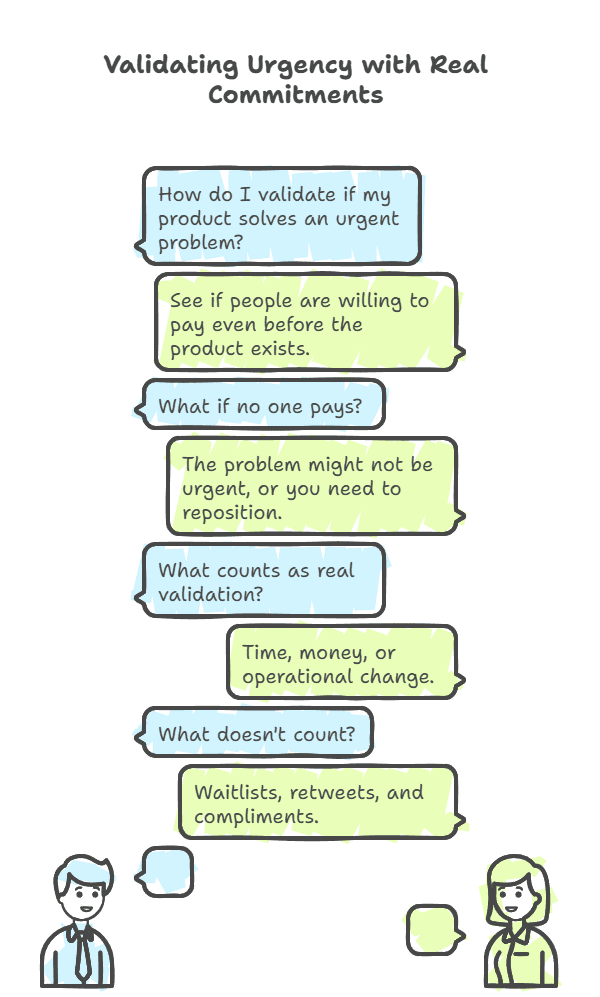
Polite interest is not enough. The best proof is if someone is willing to pay even before the product exists.
Create a simple landing page with a price and a checkout. Be honest that the product is early.
If people pay, that means urgency. You can always refund later.
If no one pays, the problem might not be urgent, or you need to reposition.
Most founders wait too long to ask for money. Do not.
Ask early. The truth will save you time and money.
Waitlists, retweets, and compliments do not count. A heart on Twitter is not a commitment. A kind email is not a signal.
Validation is time, money, or operational change.
If someone switches tools, pays for a prototype, or gives you internal access, that counts. Everything else is noise.
Do not chase what makes you feel good. Chase what makes them act.
Build SaaS Products People Use

Trying to Validate a SaaS Idea?
Ellenox works with founders to test ideas before they commit to building. We help you reach the right people, ask the right questions, and figure out if the market wants what you're planning to build. If you're stuck between a good idea and a real opportunity, talk to Ellenox.
Build SaaS Products People Use
Ellenox works with early-stage teams to turn product ideas into real, validated software. If you're building tools for real users, we help you test demand, shape the right feature set, and launch with confidence. Our team works alongside yours to validate the idea, design the MVP, and get it in front of people who are ready to use it. No hype. Just clear signals and solid execution.