



Bringing a new B2B product to market is exciting, but it is also filled with uncertainty.
You have something valuable to offer, but getting it in front of the right people, with the right message, at the right time is where most teams get stuck.
If you are a founder, marketer, or early sales hire trying to figure out where to start, you are not alone. A lot of people are asking the same questions.
“How do I reach decision-makers without wasting budget?” “What if my audience is split across industries or roles?” “Do I build a sales process or focus on marketing first?”
There is no single playbook that works for every B2B company, but there are proven steps you can follow to reduce guesswork and improve your chances of success.
Let’s break it down.
What Is a B2B Go-to-Market Plan?
A B2B go-to-market plan is your strategy for bringing a product or service to business customers in a focused, effective way.
It outlines who your ideal buyers are, what problems you solve for them, how you will reach them, and how your team will convert interest into revenue. Instead of relying on guesswork, a GTM plan aligns your sales, marketing, product, and customer teams with a clear path to growth.
Think of it like this. You are launching a new product. Rather than marketing to everyone, you narrow in on the buyers who actually need it. You craft a message that resonates, choose the channels that work, and set up the right sales motions to close deals. Each part of the plan supports the next.
Why Having a Go-to-Market Plan Matters More Than You Think
Launching a new product, entering a different market, or changing your pricing structure are all high-impact moves. Each one demands more than just a strong idea and a motivated team.
Without a go-to-market plan, efforts become disconnected. Marketing brings in the wrong leads. Sales wastes time on low-fit accounts. Product teams build features that fail to solve urgent problems.
A focused GTM plan keeps everyone aligned. It defines who you are targeting, what pain you are solving, and how you will win their attention.
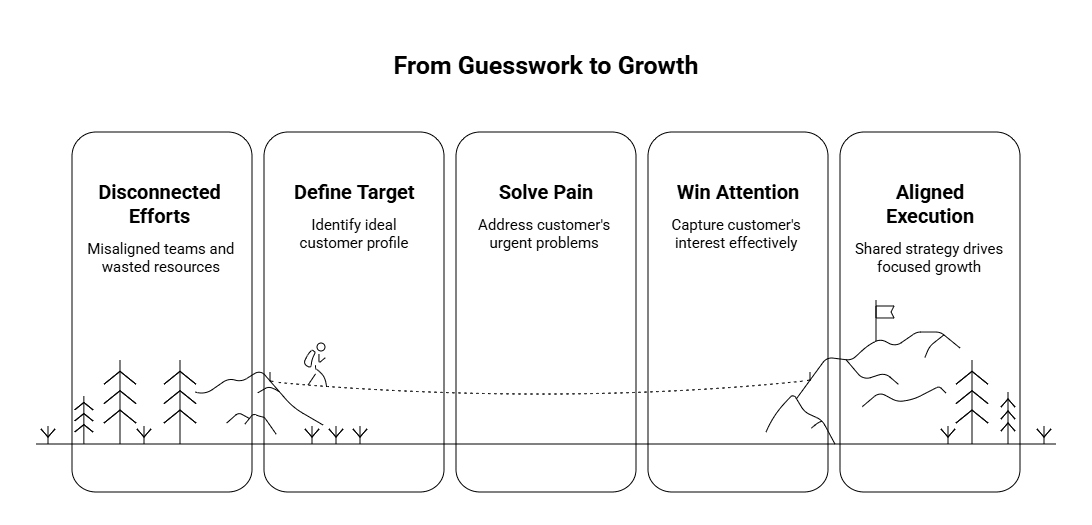
Clear execution starts with a shared strategy. A solid GTM plan turns guesswork into growth.
Not Ready to Launch Your GTM Strategy?
Core Components of a Strong B2B Go-to-Market Strategy
A strong B2B go-to-market (GTM) strategy is not a random mix of tactics. It is a connected system that helps your business deliver value, reduce risk, and generate reliable growth. Each component plays a critical role and supports the others.
1. Market segmentation
Not every potential buyer is worth pursuing. Dividing your total addressable market into meaningful segments helps you focus your resources where they matter most.
You can segment by:
Industry or company size
Funding stage or growth trajectory
Compliance or technical requirements
The goal is to identify the segments that are most likely to buy, retain, and expand—so you can scale efficiently.
2. Ideal Customer Profile (ICP)
An ICP defines who your best-fit customer is. It’s more than just firmographics.
A strong ICP includes:
Business model and size
Specific pain points or needs
Success criteria and buying triggers
A clear ICP helps you tighten targeting, personalize your messaging, and improve close rates.
3. Value proposition and positioning
Your value proposition explains why your product matters. It should connect a real business problem to a measurable outcome.
Positioning helps you stand out in the market. It tells the story of how your product fits into a broader trend or solves a challenge in a new way. Together, these elements shape how prospects perceive your offering.
4. Pricing and packaging
Pricing should reflect the value your product creates, not just your internal costs. Choose a pricing model that matches buyer expectations and makes adoption easy.
Offer entry-level options to reduce friction and give clear upgrade paths. Well-designed packaging supports faster decisions and stronger retention.
5. Sales and marketing channels
You need to meet your buyers where they already are. That might mean:
Outbound sales for high-ACV deals
Content and SEO for inbound traction
Strategic partnerships or events for credibility
Each channel should align with how your buyers prefer to learn, evaluate, and purchase.
6. Customer acquisition and retention strategy
Acquiring new customers is just the beginning. A strong GTM plan also outlines how to keep them engaged and successful.
Focus on:
Smooth onboarding
Customer support and education
Regular value delivery and upsell opportunities
Retention increases lifetime value and improves the overall economics of your GTM motion.
B2B Go-to-Market Challenges and How to Overcome Them
Even the best strategies face hurdles. Here are six common challenges B2B teams encounter and ways to tackle them effectively:
Identifying the right customer pain
Focusing on features instead of real problems can weaken your message. Concentrate on urgent issues your customers face and clearly communicate how your solution helps.
Crafting a clear value proposition
If your messaging is unclear or too technical, prospects won’t see the benefit. Explain how your product improves outcomes or solves problems in straightforward terms.
Choosing the right sales model
A mismatch between sales approach and product complexity wastes resources. Align your sales model with your price point and customer expectations.
Focusing marketing efforts
Trying to be everywhere spreads resources thin. Prioritize a few channels where your buyers are most active and invest your efforts there.
Supporting the sales team
Sales need strong training, clear messaging, and helpful materials to close deals efficiently.
Ensuring quick customer activation
Users must see value fast or risk abandoning your product. Design onboarding to guide customers to their first success quickly.
Understanding these challenges sets the stage for building a strong B2B go-to-market strategy. Let’s explore how to do that next.
How to Build a B2B Go-to-Market Strategy
1. Build a Practical Persona That Guides Execution
Many teams waste time creating over-detailed personas. Instead, focus on what influences buying decisions.
Start with just three points:
Role: What is their job title and daily responsibility?
Goals: What are they trying to achieve at work?
Challenges: What blocks them from achieving those goals?
Example:
Role: Operations Manager at a logistics firm
Goals: Improve delivery times and reduce dispatch errors
Challenges: Manual routing, inconsistent driver communication
You can build this without surveys. Use:
Landing pages and customer messages to find common pain points
Review platforms like G2 or Trustpilot to see what buyers love or hate
Online forums to see real-time discussions
Skip anything that doesn't affect targeting, messaging, or product adoption.
2. Define a Pain That Customers Face
Don't center your product around features. Focus on a real, existing problem your target customer is trying to fix now.
Look for signs of urgency:
Teams using workarounds like spreadsheets or Zapier
People are spending too much time fixing broken workflows.
Frustrated posts or reviews with DIY fixes
Validate pain by asking:
What are they doing now to solve it?
Where does that break down?
What does that cost them in time, money, or lost business?
If people are spending effort on a solution already, the demand is real.
Turn pain into ROI:
Don’t say: “We help sales teams stay organized.”
Say: “We reduce lost deals by 20 percent, saving your team $70,000 a year.”
That’s the kind of message decision-makers act on.
3. Craft a Clear Value Proposition
Your value proposition should answer one thing clearly: How does this make my customer’s life easier or better?
Do not start with what your product does. Start with why it matters now.
Ask:
What has changed in their industry or job role?
What new pressure or opportunity are they reacting to?
Example:
Instead of saying, “We improve B2B payments,” say:“Freelancers now demand faster payouts. Our platform helps marketplaces offer next-day payments without overhauling their finance systems.”
Structure your value like this:
We help [specific role or team]
Achieve [key business result]
by [unique method or approach]
Example: “We help customer success teams reduce churn by predicting account risk using behavior analytics.”
Use this core message across your sales decks, website, and campaigns.
4. Choose the Right Sales Model
The way you sell affects how you staff, price, and reach the market. Choose the model that fits your price point, sales cycle, and buyer expectations.
Core B2B models:
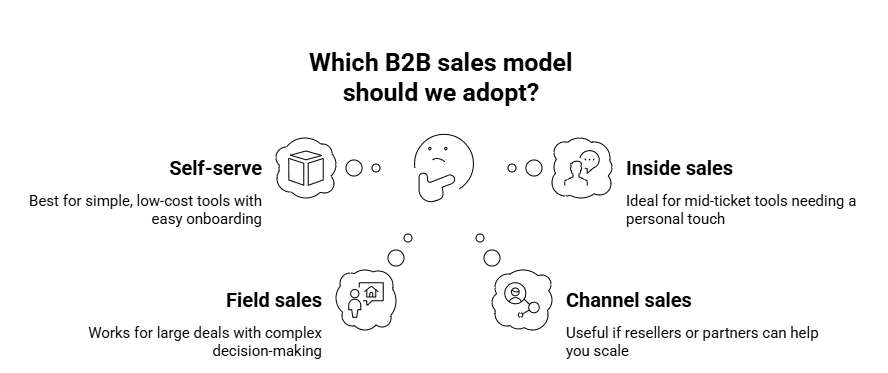
Pick one as your primary approach. For example, if your deal size is under $1000 a year, field sales are too expensive. If your tool needs education and trust, self-serve won’t work well.
5. Select Your Acquisition Channels
You can’t be everywhere at once. Pick two to three channels where your buyer already spends time.
Top channels for B2B include:
Outbound sales: Cold email, LinkedIn, and targeted outreach
Content marketing: SEO, webinars, blogs, and whitepapers
Partnerships: Affiliates, resellers, and integration partners
Paid ads: LinkedIn, Google Search, or niche directories
Events: Meetups, trade shows, and workshops
Test early traction by tracking demo conversions, click rates, or pipeline velocity before scaling spend.
6. Nail the First Activation Moment
Getting signups is not enough. You need to get users to value fast.
Activation happens when the user first sees the benefit. Examples:
Connecting to a data source
Sending their first report
Completing a key task or inviting a teammate
Design your onboarding to guide them to this moment. The faster they experience value, the lower your churn and the higher your conversions.
Sending their first report
Completing a key task or inviting a teammate
Design your onboarding to guide them to this moment. The faster they experience value, the lower your churn and the higher your conversions.
7. Build a Feedback Loop With the Market
Your go-to-market motion should not end at launch. It should evolve based on real input from customers, prospects, and the sales floor. The best GTM teams build structured learning loops across functions.
Create continuous feedback between:
Sales and marketing: What messages are resonating? What objections are common?
Customer success and product: Where are users getting stuck or churning?
Lost deals and positioning: What causes prospects to walk away?
Track win/loss reasons, objection themes, onboarding drop-offs, and usage patterns. Feed these insights into your messaging, content, roadmap, and pricing strategy.
Your GTM plan should specify who captures this feedback, how it is shared, and what cadence is used to act on it. Without this loop, you risk drifting out of sync with the market.
7. Build a Feedback Loop With the Market
Your go-to-market motion should not end at launch. It should evolve based on real input from customers, prospects, and the sales floor. The best GTM teams build structured learning loops across functions.
Create continuous feedback between:
Sales and marketing: What messages are resonating? What objections are common?
Customer success and product: Where are users getting stuck or churning?
Lost deals and positioning: What causes prospects to walk away?
Track win/loss reasons, objection themes, onboarding drop-offs, and usage patterns. Feed these insights into your messaging, content, roadmap, and pricing strategy.
Your GTM plan should specify who captures this feedback, how it is shared, and what cadence is used to act on it. Without this loop, you risk drifting out of sync with the market.
8. Align Metrics to Each GTM Stage
Do not wait for revenue to measure success. Your GTM plan should define specific metrics for each stage of the buyer journey. This allows you to spot weaknesses and make early adjustments.
Break your funnel into phases and assign ownership:
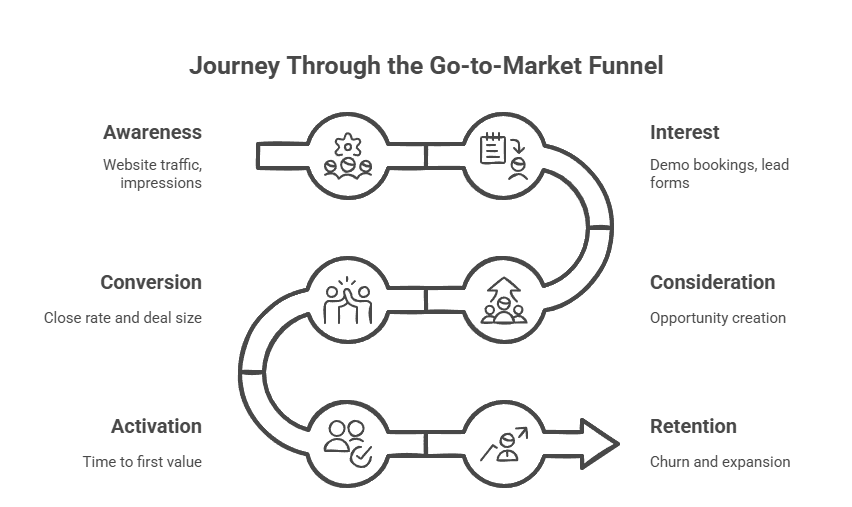
Awareness: Website traffic, impressions (Owned by marketing)
Interest: Demo bookings, lead forms (Owned by demand gen)
Consideration: Opportunity creation (Owned by sales)
Conversion: Close rate and deal size (Owned by sales leadership)
Activation: Time to first value (Owned by product)
Retention: Churn and expansion (Owned by customer success)
When each team owns a stage and its metrics, execution becomes accountable and data-driven.
9. Create a Launch and Scale Timeline
A strong GTM plan includes timing. Without clear phases, teams lose momentum or waste resources too early. Structure your launch into four stages to reduce risk and validate assumptions before scaling.
Alpha: Internal use or friendly customers. The goal is to validate core functionality and activation.
Beta: Invite-only release to a specific audience. Focus on tightening onboarding, refining messaging, and testing pricing.
Public Launch: Scaled demand generation, PR, and outbound sales. Messaging is clear, and systems are ready to convert interest.
Scale-Up: Team expansion, channel partnerships, outbound volume. Spend increases in proportion to conversion confidence.
Treat these stages as checkpoints. Do not move forward until the previous phase proves that customers are seeing value and your team is ready to deliver at scale.
10. Pricing Strategy to Match Perceived Value
Your pricing is part of your GTM strategy. It signals maturity, credibility, and value. A poor pricing model can undermine an otherwise strong product. Start by linking pricing to the outcome you deliver.
Use value-based pricing. Anchor your price to the business impact. If your product saves $50,000 per year in time, errors, or headcount, a $6,000 annual plan is justified.
Structure pricing into one to three tiers:
Keep it simple and aligned with customer size or usage
Avoid feature-based gating that punishes core users
Use higher tiers to unlock scale, not to hold back basics
Pricing is not just about revenue. It affects positioning, buyer trust, and deal velocity. Your GTM plan should explain how pricing maps to perceived value and how it will be tested during early sales conversations.
Turn Your Vision Into Traction

Not Ready to Launch Your GTM Strategy?
Work with Ellenox to Build the Foundation First Jumping into go-to-market without the right pieces in place can stall your progress. If you're still shaping your message, testing your channels, or refining your offer, Ellenox helps you get GTM-ready. We work with early-stage B2B teams to: ➔ Pinpoint real customer pain and validate demand ➔ Define a clear, actionable value proposition ➔ Build the first version of your sales and marketing motion If you're pre-launch but serious about getting it right, connect with Ellenox.
Turn Your Vision Into Traction
From Idea to Product With a Clear Path Ellenox partners with early-stage founders to turn vision into momentum. We help you define the problem, shape the right solution, and build your first product with speed and structure. With a team experienced in product, design, and development, you’ll move forward with clarity, focus, and confidence.