


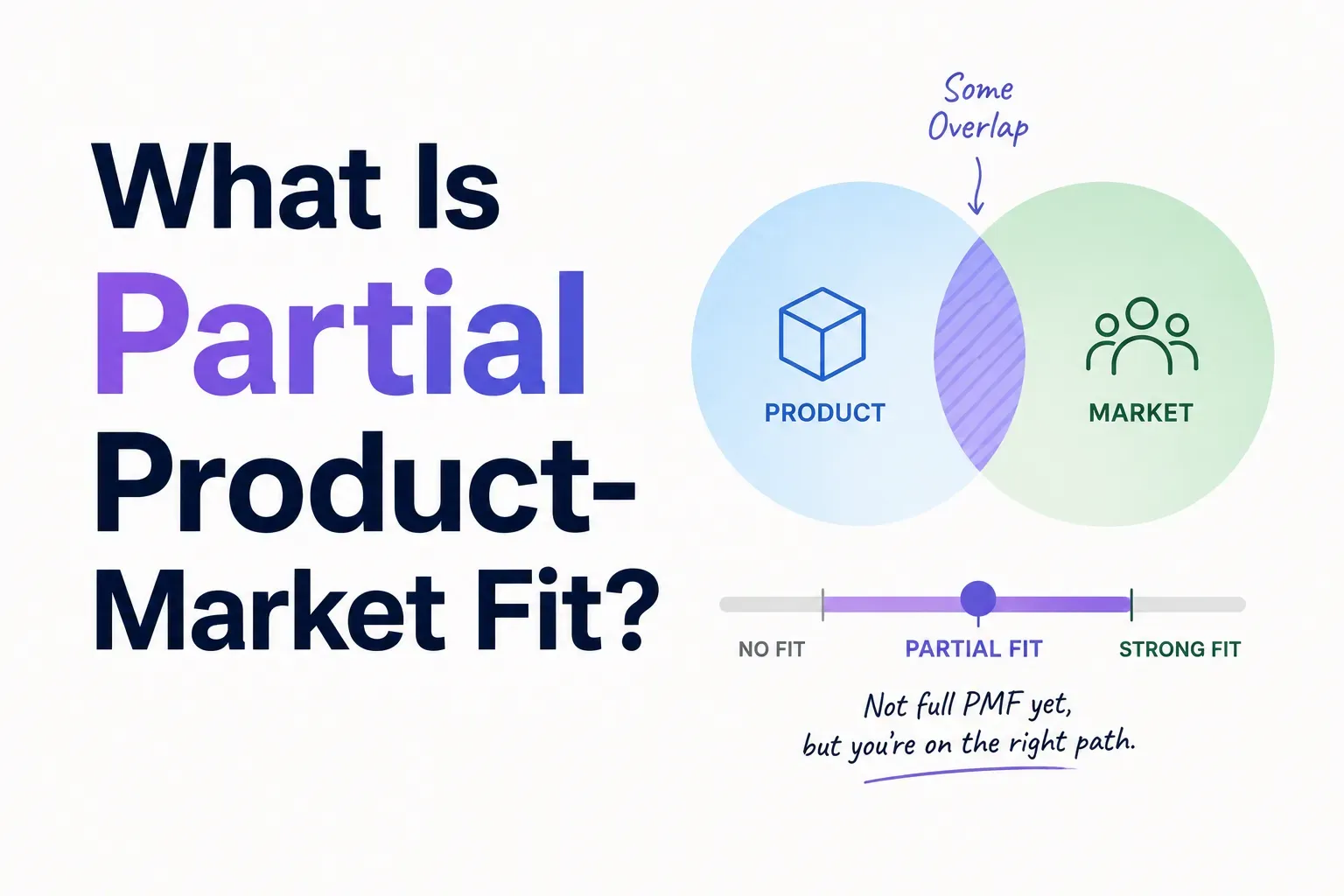
Most founders operate in one of two states. Pre-PMF, where nothing works yet, or post-PMF, where the product is pulling users faster than the team can serve them. There's a third state that gets almost no coverage and traps more startups than the other two combined: partial product-market fit.
Partial PMF is when the product works well for some users, revenue grows enough to keep the lights on, and every metric looks better than it did six months ago, but the growth doesn't compound. Retention flattens at a level that could sustain a lifestyle business but not a venture-scale one. Word of mouth exists but doesn't accelerate. The team is not failing. They are also not winning.
Founders in partial PMF often mistake the state for early PMF and hire, spend, and scale as if the pull is real. The signals look close enough that the mistake is easy to make. The cost of the mistake is high.
This piece covers what partial PMF actually looks like, why it's more dangerous than pre-PMF, how to diagnose it honestly, and the four moves that work when you're in it.
What Is Partial Product-Market Fit
Partial product-market fit is when a product has real users, real revenue, and real retention, but not at the level or growth rate that indicates true fit. The company is not pre-PMF, because something is working. It is not post-PMF, because the work isn't pulling.
The state has four defining characteristics:
A subset of users love the product. Not the whole market. A slice of it, often narrower than the founder targeted
Growth is real but linear, not exponential. Revenue climbs steadily but the growth rate stays flat or declines instead of accelerating
Retention curves flatten, but at a low level. Cohorts stabilize, which is a real PMF signal, but they stabilize at 10-20% instead of 40-60%
Word of mouth exists but doesn't compound. Some users tell others. Not enough to make paid acquisition unnecessary or to produce the K-factor that defines viral fit
Partial PMF is the state where a founder can honestly say "the product is working" and be right, while also being wrong about what that working means for the company's future.
Why Partial PMF Is More Dangerous Than Pre-PMF
Pre-PMF is uncomfortable but clear. Nothing works. The signals are unambiguous. The founder knows they haven't found fit and behaves accordingly: stays close to customers, keeps iterating, avoids scaling prematurely, treats the roadmap as a hypothesis. The pre-PMF vs post-PMF distinction makes this clear.
Partial PMF is dangerous because it looks like the beginning of PMF. Some cohorts retain. Some users evangelize. Revenue grows. Investors see the trajectory and encourage scaling. The founder, who has been grinding for two years, wants to believe the grinding is over.
The pattern that follows is predictable:
- The founder interprets partial signals as early PMF
- They hire ahead of the growth curve based on the projection, not the actuals
- They raise a Series A on the strength of the story
- Six to twelve months later, the growth rate hasn't accelerated the way the plan required
- Burn is now committed at a level the actual PMF cannot sustain
- The company enters a survival mode it did not need to enter if the diagnosis had been honest
Startup Genome's research on premature scaling maps to this exact pattern. Three quarters of failed startups scaled prematurely, and the majority of premature scaling happened in companies that thought they had PMF when they had partial PMF instead.
The Four Signals of Partial PMF (and How They Differ from Full PMF)
The difference between partial PMF and real PMF is easy to see in retrospect and easy to miss in real time. Four diagnostic signals separate them.
Retention curve height
Both partial and full PMF produce a flattening retention curve. The difference is the level at which it flattens.
| Retention curve pattern | Interpretation |
|---|---|
| Curve keeps declining past month 6 | Pre-PMF; the product isn't sticky |
| Curve flattens at 5-15% | Partial PMF; a subset of users stick, most don't |
| Curve flattens at 40%+ (consumer) or 90%+ (B2B) | Full PMF; the majority of activated users retain |
A curve flattening at 12% is a real signal. It's just not the signal founders want to read it as. It means you have a niche within the segment you targeted, not the segment itself.
The Sean Ellis test result
The 40% "very disappointed" threshold on the Sean Ellis test is a useful cutoff for full PMF. Partial PMF typically produces a Sean Ellis score in the 25-38% range. Close enough to look promising, far enough from the threshold that the pull mechanic doesn't fire.
The trap: a founder with a 32% score reads "we're almost there" instead of "we have partial fit and need to sharpen the segment before scaling."
Growth rate over time
Full PMF produces accelerating or stable-high growth. Partial PMF produces linear growth that often decelerates. The math on burn versus runway looks fine at the current growth rate but breaks the moment growth slows further, which it usually does.
A useful frame: full PMF companies grow faster after they raise. Partial PMF companies grow at the same rate or slower after they raise, because the capital doesn't fix the underlying fit problem.
Word of mouth intensity
Full PMF produces users who tell others without being asked. The referral coefficient is above 0.5 for consumer, or the net revenue retention is above 110% for B2B. Partial PMF produces some referrals but not enough to compound. Users like the product but don't feel the "I have to tell someone about this" urgency that drives organic growth.
How to Diagnose Whether You Have Partial PMF
The diagnosis is straightforward if you're willing to look at the numbers honestly.
Run these four checks:
- Cohort retention analysis: pull retention data by monthly cohort for the last 12 months. Where does the curve flatten, and at what percentage? Anything below 30% for consumer or 80% for B2B is partial, not full
- Sean Ellis test: survey active users. Ask how they'd feel if they could no longer use the product. Under 40% "very disappointed" means partial, not full
- Growth rate by month: plot monthly revenue or user growth for the last 12 months. Is the rate accelerating, stable, or decelerating? Deceleration in an early-stage company usually means partial PMF, not maturity
- Referral tracking: what percentage of new users come from organic word of mouth versus paid or founder-led sales? Under 30% organic in a consumer product or under 20% in B2B suggests the pull isn't there yet
If two or more of these signals point to partial PMF, the honest diagnosis is partial. The strategic response is different from the response to pre-PMF or full PMF.
The Four Moves That Work in Partial PMF
Partial PMF is not a dead state. It's a signal that something in the current setup is close to working, and the strategic move is to figure out what and sharpen it, not to scale into it.
1. Narrow the ICP until the retention curve rises
The most common cause of partial PMF is targeting too broad a segment. A subset of users loves the product; the rest tolerate it. If you segment the retention curve by user type, industry, company size, or use case, you'll usually find a slice where retention is materially higher than the aggregate.
That slice is your real ICP. Everything else is noise the current product isn't built for.
The move: narrow the target market to the segment where retention is strongest, redesign positioning and marketing around that segment, and stop pursuing users who tolerate the product but don't love it. Growth may slow temporarily as you stop selling to the wrong customers. The retention curve within the new segment should climb.
2. Cut features to sharpen the core
Partial PMF often reflects a product that's tried to serve too many use cases. The core workflow that drove initial adoption is diluted by features added to serve adjacent customers who never became core users anyway.
The move: identify the workflow the retained users run most often. Cut or hide features that don't support that workflow. Rebuild the product experience around the single thing users love. This feels like going backward. It's usually the fastest path to a retention curve that rises instead of flattens.
3. Change the wedge, not the vision
A wedge is the specific first use case that gets users in the door. Startups with partial PMF often have the right long-term vision and the wrong wedge. The wedge attracts users who convert but don't retain, because the wedge use case isn't the one that creates lasting value.
The move: identify the use case where retention and expansion are strongest, and rebuild the wedge around that. This is different from a full pivot; the vision stays, the entry point changes. Instagram (photos from Burbn) and Slack (chat from a game company) are canonical wedge changes. The vision was social/collaboration; the wedge was the specific feature that pulled users in.
4. Stop raising and start compounding
Founders in partial PMF often try to raise their way through it. A Series A gives the company runway to keep working on the problem, but the additional capital does not create fit that wasn't there.
The alternative: reduce burn, extend runway, and use the extra time to find full PMF before raising. Founders who reach full PMF with less capital raise on materially better terms and dilute less. Founders who raise on partial PMF often find the round works against them within 18 months.
Our equity guide covers the dilution math on raising at each stage. The math on raising during partial PMF is worse than founders assume.
Common Mistakes Founders Make in Partial PMF
The five patterns that turn recoverable partial PMF into failed companies:
Interpreting partial signals as full PMF: the linear growth chart looks like early PMF; the founder scales as if it is
Hiring against projected growth instead of actual growth: the plan assumes growth accelerates; hiring commits to that plan before the acceleration proves out
Raising a Series A on the story: investors buy the trajectory, the round closes at a valuation that assumes acceleration, and the acceleration doesn't come
Adding features instead of cutting them: the founder tries to widen the product to serve more users; the retention curve stays flat because the core wasn't the constraint
Refusing to narrow the ICP: giving up "the whole market" feels like giving up on the ambition; keeping "the whole market" as the target keeps the product diluted
The founders who navigate partial PMF successfully are the ones who resist all five moves. They narrow before they widen. They cut before they build. They raise less before they raise more.
When Partial PMF Should Trigger a Pivot or Kill Decision
Partial PMF is often recoverable. Sometimes it isn't. The distinction matters because the wrong response to unrecoverable partial PMF is more expensive than the right response to full pivot territory.
Partial PMF is recoverable when:
- A specific subsegment shows materially higher retention than the aggregate
- A specific use case shows materially higher engagement than others
- The founders still believe in the underlying problem and have energy to sharpen the approach
- The runway allows 6-12 months of sharpening without forced fundraising
Partial PMF is not recoverable when:
- The retention curve flattens at similar levels across every segment tested
- No subsegment shows the pull needed for full fit at any level
- Multiple pivots have already produced no signal
- The founding team has exhausted its energy for the problem
The unrecoverable version calls for the pivot or kill decision, not for another six months of sharpening.
Working With Ellenox on the Path Through Partial PMF
Most founders in partial PMF need an outside read on whether the state is recoverable and, if it is, what specifically to sharpen. The signals are ambiguous enough that internal debate rarely resolves the question, and the cost of the wrong call, either scaling into partial or killing something that would have converted with focus, is significant.
Ellenox works with founders diagnosing PMF state, sharpening ICPs, and preparing for either the fundraise that comes after full PMF or the pivot that comes when the current direction isn't going to convert. If you're seeing partial signals and trying to figure out what they mean, talk to Ellenox.