


There's a moment in almost every successful startup's history where the founders look back and realize they nearly killed the company by applying the right skills at the wrong time. The brilliant founder who kept experimenting after finding PMF because changing things was the habit that got them there.
The experienced operator who joined pre-PMF and immediately started building the machine the company would eventually need, two years too early. The investor-favorite startup that raised $10M pre-PMF and spent it efficiently, on the wrong product.
Most content on this topic treats PMF as a milestone on a roadmap. Pre-PMF is about finding fit. Post-PMF is about scaling it. Both true. Both nearly useless when you're in the middle of it.
The honest version is that PMF is a phase change. The operating logic before the line is in active conflict with the operating logic after the line. Founders who don't recognize the shift run the wrong operating system at the wrong time, and the failure modes look completely different depending on which direction the mistake goes.
This piece is about what each mode requires, why the transition is so hard to time, and the honest diagnostics for knowing which one you're in.
What is Pre-Product Market Fit (Pre-PMF)?
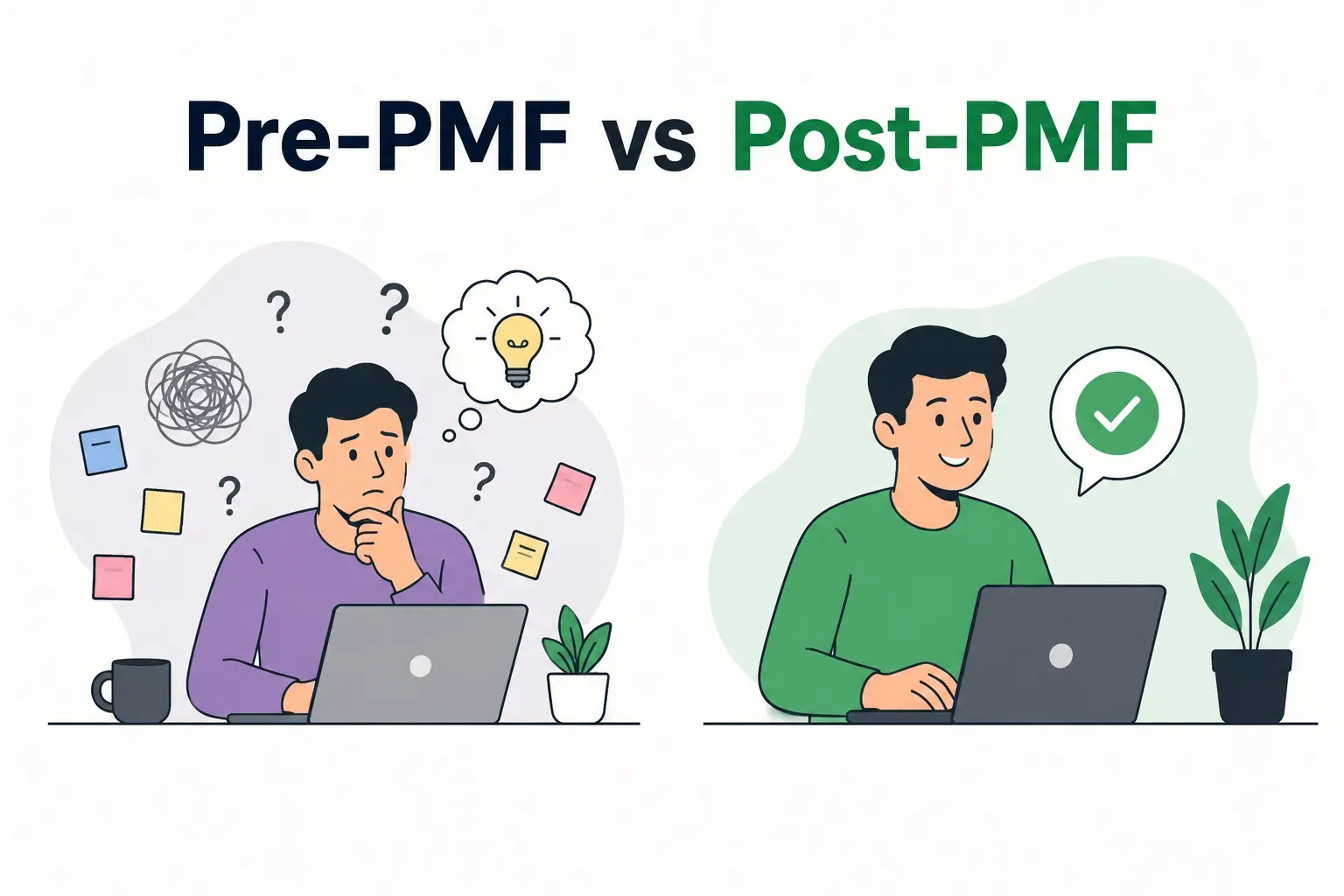
Pre-Product Market Fit (Pre-PMF) is the early stage of a startup where the primary goal is to discover and validate a strong fit between a customer problem and the product being developed. During this phase, founders focus on customer research, rapid experimentation, product iteration, and testing assumptions to determine whether the market truly needs their solution.
What is Post-Product Market Fit (Post-PMF)?
Post-Product Market Fit (Post-PMF) is the growth stage of a startup that has successfully validated demand for its product and established a strong product-market fit. The focus shifts from experimentation to scaling, optimizing operations, acquiring customers, and expanding market share. In this stage, startups benefit from structured processes, specialized teams, delegation, and protecting the proven business model.
Why Pre-PMF and Post-PMF Demand Opposite Behaviors
Product-market fit lacks a single agreed-upon definition, which is part of why so many founders misdiagnose their position. Retention, revenue, growth rate, user sentiment, and word-of-mouth are all proxies. None is the thing itself. The thing itself is the match between a specific problem a specific kind of person has, and a product that solves it in a way they'd be genuinely worse off without.
The cleanest formulation: PMF is the nailing before the scaling. The metaphor works because nailing and scaling are both essential and in direct tension. You can't do both at once. The sequence matters more than the activities.
The conflict between the two modes isn't stylistic. The behaviors are direct opposites:
| Dimension | Pre-PMF mode | Post-PMF mode |
|---|---|---|
| Primary job | Find out which assumptions are wrong | Deliver and expand what works |
| Founder's role | Sensor in direct contact with every customer | Orchestrator building systems that capture customer signal at scale |
| Primary risk | Building the wrong thing | Misalignment between teams; losing sight of what made the product work |
| Process posture | Deliberately lightweight; responsiveness over formality | Deliberate process; repeatability over reinvention |
| Roadmap function | Hypothesis to test | Commitment to execute |
| Hiring profile | Generalists who tolerate ambiguity and change direction quickly | Specialists who build repeatable motion at scale |
| Growth tactics | Mostly irrelevant; you're still searching | Core strategic question: which channels and motions scale what you found |
Every row is a behavior that's correct in one mode and damaging in the other. Hiring an experienced VP of Sales is right at $5M ARR and dangerous at $500K ARR. Throwing out the roadmap is right when you haven't validated direction and reckless when teams are coordinating to deliver. Staying in every customer call is right when you're learning and a bottleneck when you're scaling. The same action gets graded differently depending on which side of the line you're on.
This is why the transition is genuinely hard. It's not that founders need to do new things post-PMF. They need to stop doing things that worked, and start doing things that would have been fatal six months earlier.
What the Pre-PMF Operating Mode Requires
The defining feature of pre-PMF isn't uncertainty. It's a specific kind of uncertainty: you don't know which of your assumptions is wrong. Some of them definitely are. The job is to find out which ones, as fast as possible, before you run out of money or conviction.
This makes five things true that feel deeply counterintuitive:
Proximity to customers is the entire job, not part of it: Not market research. Not user interviews on a quarterly schedule. Direct, unmediated connection to the people experiencing the problem. Before PMF, a layer between the founder and the customer signal is dangerous regardless of what fills that layer. Hiring a full-time product manager pre-PMF is one of the most common ways founders accidentally create that layer, regardless of how good the PM is. Once the founder stops feeling the road, the ability to know when to change direction degrades fast.
Process is a bet, not a best practice: Every process you build is a bet that you're doing the right thing repeatedly. Before PMF, you don't know if you're doing the right thing at all. Formalizing wrong activities makes them more expensive to stop. The companies that scaled spending pre-PMF in 2021 didn't fail because they were incompetent. They failed because they were efficiently doing the wrong things.
The roadmap is a hypothesis, not a commitment: Roadmaps are tools for executing on validated direction. Pre-PMF, you have guesses, not direction. Treating a roadmap as a commitment when it should be a hypothesis is one of the most expensive mistakes experienced product leaders make when they become first-time founders. The discipline that produces shipped products in a scaled company produces shipped wrong-products in a pre-PMF startup.
Pre-PMF is sales-led, even for product-led companies: Even if your eventual strategy is fully product-led growth, before PMF you're doing founder-led sales. Personally convincing people that this matters. Learning from every "no." Treating yourself like a software team that works for free in exchange for the right to learn.
Revenue before PMF means almost nothing: The dangerous one. Early customers often pay for things that don't scale. Logo customers who bought because of a relationship. Lighthouse customers serviced manually at a cost that won't survive volume. Pre-PMF revenue is a signal to investigate, not to celebrate.
The question that defines this stage: Which of my assumptions is wrong, and how quickly can I find out?
What the Post-PMF Operating Mode Requires
The phase change feels like emerging from a steep mountain trail onto an open plateau. Before PMF, you're climbing, occasionally catching glimpses of a pass in the distance. Post-PMF, you can suddenly see for miles. Multiple mountains in the distance, with roads leading to each of them.
The instinct when you hit the plateau is relief. The real challenge is that you now have too many choices.
Five things shift post-PMF:
The product stops being a question and starts being an asset. Everything you do now is building the machine that delivers and expands on what the product does. Hiring, process, and structure stop being premature and start being necessary. The founder who built the company through ambiguity tolerance and constant pivoting has to build a different kind of organization: one that protects what's working from the founder's own instinct to keep changing it.
The founder's job shifts from sensor to orchestrator. The thing that made the founder irreplaceable pre-PMF, their direct relationship with customer signal, becomes a bottleneck post-PMF. There is now more customer signal than one person can process. The job becomes building systems and teams that capture and act on that signal at scale. The PM hire that should wait pre-PMF becomes urgent post-PMF for exactly the same reason.
The risk profile inverts. Pre-PMF, the biggest risk is building the wrong thing. Post-PMF, the biggest risk is misalignment between teams and losing sight of the customers who made you. The pre-PMF skill of questioning everything becomes a post-PMF liability when applied to things customers are now depending on.
The plateau problem is too many choices. Companies that fail after finding PMF usually don't fail because they stop working hard. They fail because they try to climb too many mountains at once. Every instinct that was right during the search becomes a strategic liability when the job is to go deep on one direction rather than wide across many.
Growth becomes a strategy problem, not a discovery problem. Pre-PMF, growth tactics are irrelevant because you don't know if what you're growing is working. Post-PMF, growth becomes one of the core strategic questions: which channels, which motions, which team structure scales what you've found.
The question that defines this stage: How do I deliver and expand what's working without breaking what made it work?
The Three Failure Modes That Kill Startups in the Transition
With both operating modes laid out, the failure modes become predictable. Each is a case of running the wrong OS at the wrong moment:
1. Scaling before PMF (the deadliest)
The most common and most lethal mistake. Three-quarters of startup failures Startup Genome studied involved premature scaling. The 2021 version was companies that raised on growth metrics that looked like PMF but weren't, and spent the money efficiently building a machine for the wrong product. Growth amplifies what's already there. If what's there is wrong, growth helps you be wrong faster and more publicly.
The signature pattern: aggressive hiring on the back of metrics that turn out to be founder-led sales, lighthouse customers, or a niche too small to scale. By the time the metrics correct, the burn rate is committed and the runway is gone.
2. Staying in pre-PMF mode after finding fit
Less discussed, equally real. The founder who found PMF through radical customer intimacy and constant product changes, and can't stop doing that after the product is right. They keep iterating on what's working because iteration is their identity. They introduce instability into something customers are now depending on.
The post-PMF skill set (conviction, repeatability, scale thinking) doesn't come naturally to the person who excelled at the pre-PMF phase. Customers start to feel like beta testers for changes they didn't ask for. The team can't build a process because the goal keeps moving.
3. Hiring post-PMF talent before PMF
The experienced VP of Sales. The enterprise sales leader from a scaled company. The CMO from a public unicorn. These hires are often exactly right at the right stage and exactly wrong one stage too early. The mismatch isn't about quality. It's about what they were built to do. A great VP of Sales in a company with a repeatable sales motion will often destroy the discovery culture that needs to exist before PMF is real.
The pattern across all three: the right behavior at the wrong stage looks identical to the wrong behavior at the right stage. Which is why diagnosing the stage correctly is the entire game.
How to Diagnose Whether You Have Product-Market Fit
Most startup disasters involving PMF timing aren't caused by founders who ignore the distinction. They're caused by founders who genuinely believe they're post-PMF when they're pre-PMF. The signals are ambiguous enough that smart founders get this wrong for months at a time.
Four diagnostics practitioners use:
1. The Sean Ellis test. Survey your active users with one question: how would you feel if you could no longer use this product? If 40% or more say "very disappointed," you likely have PMF. Under 40%, you don't, regardless of how excited the other signals look.
Sean Ellis developed this test after studying hundreds of startups and identifying the 40% threshold as the inflection point where organic growth typically begins. It's imperfect, sample size matters, but it remains the most widely validated single question for diagnosing PMF.
| Sean Ellis test result | Interpretation |
|---|---|
| 40%+ "very disappointed" | Likely PMF; organic growth typically follows |
| 30-39% "very disappointed" | Close but not there; tighten the ICP, look for the subsegment that scored 40%+ |
| Under 30% "very disappointed" | Not PMF; the product is solving a problem most users don't care enough about |
2. Push or pull? Pre-PMF, every customer acquisition requires founder energy: calls, introductions, personal selling, custom demos. Post-PMF, customers start appearing without that energy. Referrals happen organically. Inbound requests arrive from contexts you didn't engineer. The shift from push to pull is one of the most reliable subjective indicators founders describe when reflecting on the moment.
3. Would this survive without you? Remove yourself from customer acquisition entirely in your head. Would the business continue to grow? Pre-PMF, the honest answer is almost always no. The founder's personal involvement is load-bearing. Post-PMF, the product and word-of-mouth carry weight that doesn't require the founder.
4. Retention curve flattening. Pre-PMF, retention curves keep declining. Users try the product and leave. Post-PMF, the retention curve flattens. Cohorts stabilize at some percentage that represents genuinely satisfied users. A retention curve that hasn't flattened is a curve still telling you something about the product.
The question that cuts through most of the noise: are your best customers your best customers because of the product, or because of you? If the answer is "because of me," you don't have PMF yet. You have a consulting business that looks like a product company. That's not failure. It's a stage. But it's a stage that requires the pre-PMF operating mode, not the post-PMF one.
What the Diagnosis Means for Hiring, Process, and Fundraising
Once you've honestly diagnosed where you are, the implications cascade through every operational decision. The three that matter most:
Hiring shifts more than any other function
The hiring decision changes more across the PMF line than any other operating choice:
| Hiring dimension | Pre-PMF | Post-PMF |
|---|---|---|
| Profile | Generalist | Specialist |
| Trait priority | Ambiguity tolerance, willingness to do things that don't scale | Repeatability, function-specific expertise |
| Team size | Small, close to customers | Functional teams with defined roles |
| PM hire | Wait; founder needs the unfiltered customer signal | Urgent; founder can no longer be sole interpreter at scale |
| Sales hire | Founder-led until repeatability is proven | Repeatable motion needs a builder, not a hustler |
| First operational hire | Someone who can do five jobs adequately | Someone who can build a process so they're not needed at scale |
The transition window catches founders off-guard. You're starting to hire for scale before you've completely stopped searching. The people who join during this window need to do both, which is rare. The mismatch produces some of the most common executive hiring failures in startups. The talented post-PMF executive who joined too early and feels constrained by ambiguity. The talented pre-PMF generalist who can't transition into the structured role the company now needs.
The hiring question to ask explicitly: is this person joining a company that's still searching, or a company that's executing? Their answer should match yours.
Process and operating cadence
Pre-PMF process should be minimum viable. Weekly customer conversations the founder personally runs. A single shared document tracking what you're learning. No quarterly planning cycle that locks in commitments you'll regret in three weeks.
Post-PMF process becomes deliberate. Quarterly planning that teams can rely on. OKRs or equivalent goal-setting. Defined handoffs between functions. The first hire whose primary job is to make other people's work repeatable.
Building post-PMF process pre-PMF is the most common form of premature scaling that doesn't show up in headcount or burn rate. It shows up in slowed decision-making, in commitments to roadmaps that turn out to be wrong, and in founder attention pulled away from customer conversations into internal coordination.
Fundraising
For founders preparing for a Series A, PMF is the single biggest milestone in the startup's early journey. It's both the operational milestone and the primary evidence investors use to evaluate Series A readiness.
What investors check when they ask about PMF:
- Is growth organic or manufactured? Inbound vs outbound mix tells the story
- Do customers come back? Cohort retention curves separate real fit from early enthusiasm
- Do they expand? Net revenue retention above 100% is the strongest quantitative PMF signal in subscription businesses
- Do they tell other people? Organic referral and word-of-mouth driving acquisition is the clearest market signal
- Would they be worse off without this product? The Sean Ellis 40% threshold and qualitative customer conversations both speak to this
Pre-PMF investment looks different from post-PMF investment from the investor side. Pre-PMF capital is staged based on milestones, with active advising and portfolio approaches that assume many bets will fail. The investor making a pre-PMF bet is backing the team's ability to find PMF, not a product that's already found it.
The mistake founders make is trying to raise Series A capital with pre-PMF metrics dressed up as PMF metrics. Sophisticated investors see through it quickly, and the damage to founder credibility outlasts the failed round. If you don't have PMF, raise as a pre-PMF company at pre-PMF terms. If you do, the metrics tell the story without spin.
The Asymmetric Cost of Getting the Diagnosis Wrong
The reason this distinction is hard in practice isn't that founders miss the concept. It's that you have every incentive to believe you're further along than you are.
Investors are pushing for growth. Competitors are raising rounds. Your team wants to feel like you've crossed the line. Your own ego wants the validation of being post-PMF. The honest diagnosis of "we're still searching" is harder than the optimistic diagnosis of "we found it, time to scale."
The asymmetry that should drive the decision:
| Mistake | Reversibility | Typical cost |
|---|---|---|
| Scaling too early (false PMF) | Largely irreversible | Hires don't unwind cleanly; burn rate doesn't shrink fast enough; wrong product gets entrenched; runway runs out before the diagnosis is corrected |
| Staying pre-PMF one quarter longer than necessary | Fully recoverable | A missed quarter of growth, not a missed opportunity |
Given that asymmetry, the right error to make is staying in pre-PMF mode slightly too long, not exiting it slightly too early. The companies that find real PMF the latest often have the best long-term outcomes because they earned the right answer instead of declaring victory on the wrong one.
If you've found PMF, the right move is conviction. Commit. Build the machine. Hire for scale. Protect what works.
If you haven't, the right move is humility. Stay small. Stay close to customers. Treat every plan as a hypothesis. Resist the pressure to look more arrived than you are.
Getting the Diagnosis Right
If your team is trying to figure out whether the traction you're seeing is real PMF or convincing pre-PMF, and you'd benefit from a structured outside read on where you are, talk to Ellenox. Getting this diagnosis right is worth more than almost any other decision a founder makes in the early years.
For founders earlier in the journey, our guides on user research for early startups, validating pricing and positioning, and scoping an MVP cover the work that puts you in a position to find real PMF rather than declare victory on the wrong signals.