


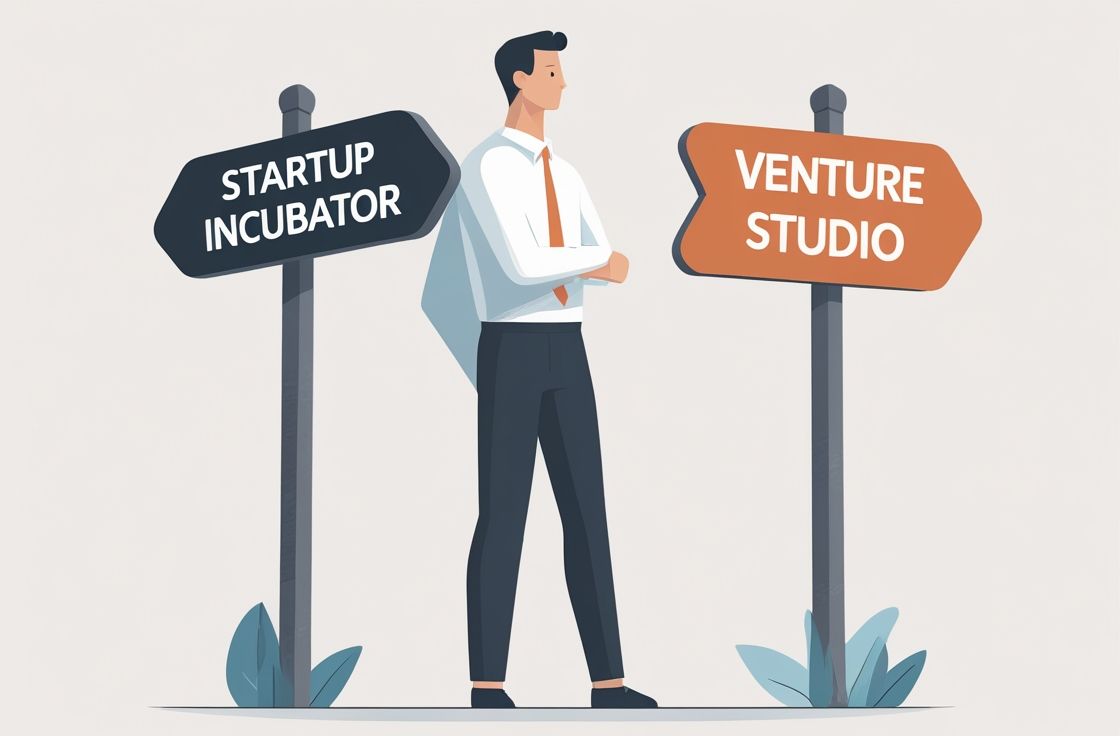
If you are an early-stage founder today, you are standing at a critical decision point. Should you join a startup incubator or build alongside a venture studio?
Both promise growth. Both offer resources, connections, and a faster path to market. But they are built on very different foundations and deliver very different outcomes.
Once, startup support meant university-led incubators and nonprofit spaces offering mentorship. Today, the landscape looks very different. With venture studios building companies from scratch and incubators supporting external founders, the choice you make will shape your equity, your ownership, and even your startup’s survival.
That brings us to the important question: what has changed, and why does it matter?
What is a Startup Incubator?
A startup incubator is a program designed to nurture early ideas and transform them into viable businesses. Often run by universities, government organizations, or ecosystem foundations, incubators create a safe environment for young companies to test and grow.
Typical features include:
Shared office space or coworking facilities
Mentorship and guidance from experienced founders and investors
Access to training sessions, workshops, and pitch events
Limited funding or grants, in some cases
Incubators are not operators of the business. They are enablers. They focus on external founders who already have an idea and need help refining it.
What is a Venture Studio?
A venture studio is a company builder. Unlike incubators, venture studios create startups internally. The studio team conceives ideas, validates them, assembles cofounders, and provides hands-on operational support.
Venture studios act more like a cofounder than a mentor. They typically employ in-house teams of engineers, designers, marketers, and product strategists. They also invest capital into their startups and take a significant ownership stake.
Common characteristics:
Ideas are generated and tested within the studio
Founders are recruited to lead validated concepts
Operational teams execute from day one
Studios retain large equity positions in exchange for their involvement
Key Differences Between Startup Incubators and Venture Studios
The difference between incubators and venture studios is more than terminology. It reflects how each model supports founders, manages risk, and expects returns.
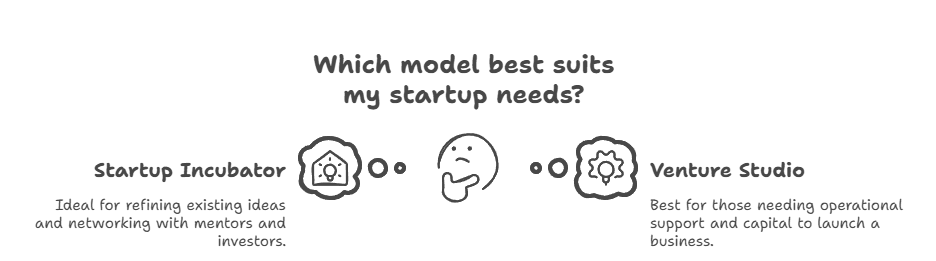
1. Technology and Operating Model
Startup Incubators Incubators operate as structured programs. They provide external startups with community support, access to mentors, and light resources. Most do not have internal operational teams to build or launch products.
Venture Studios Studios are execution engines. They use internal teams, data-driven validation processes, and capital to launch businesses in-house. Studios behave like parallel entrepreneurs, building multiple companies at once.
2. Capabilities and Functions
Startup Incubators
Help refine business ideas
Provide access to workshops and demo days
Connect founders with mentors and investors
Work best for founders who already have a concept
Venture Studios
Generate ideas and recruit founders to lead them
Provide operational staff to build products quickly
Supply capital, networks, and go-to-market support
Works best for entrepreneurs who want to start but lack a ready idea or team
3. Founder Experience
Startup Incubators Incubators offer guidance but not execution. Every session often feels like starting fresh because incubators do not provide long-term continuity or operational memory. The experience is valuable for learning, but execution depends on the founder.
Venture Studios Studios provide continuity, memory, and execution power. They integrate teams, retain knowledge, and build a personalized experience for each company. The trade-off is equity: founders give up significant ownership for this level of support.
A Direct Comparison Between Startup Incubator vs Venture Studio
| Category | Startup Incubator | Venture Studio |
|---|---|---|
| Idea Source | External founders bring ideas | Studio generates and validates ideas |
| Operational Role | Mentorship and support only | In-house teams execute and scale |
| Equity Model | Minimal equity (0 to 10 percent) | Large equity (0 to 20+ percent) |
| Duration | Fixed program cycles | Ongoing engagement |
| Best For | Founders with validated ideas | Entrepreneurs seeking execution and ideas |
Use Cases and Applications
Incubators and studios serve different startup needs. Here are common scenarios to understand how they apply.
1. Customer-Facing Product Startup
A founder has already built a prototype app and wants feedback.
Incubator: Provides mentorship, connects them to angel investors, and helps polish the pitch.
Venture Studio: Would not be a fit since the idea is already formed outside.
2. Market-Driven Venture Creation
An entrepreneur knows they want to build in fintech but has no specific idea.
Incubator: Offers little value because the founder lacks a defined concept.
Venture Studio: Generates a fintech idea internally, builds the MVP with its team, and recruits the entrepreneur as cofounder.
3. Scaling an Idea with Execution Power
A solo founder has a strong concept but no technical team.
Incubator: Provides learning, workshops, and advice but no actual engineers.
Venture Studio: Deploys in-house developers and designers to bring the idea to market.
Potential Pitfalls
Both incubators and venture studios come with risks and limitations.
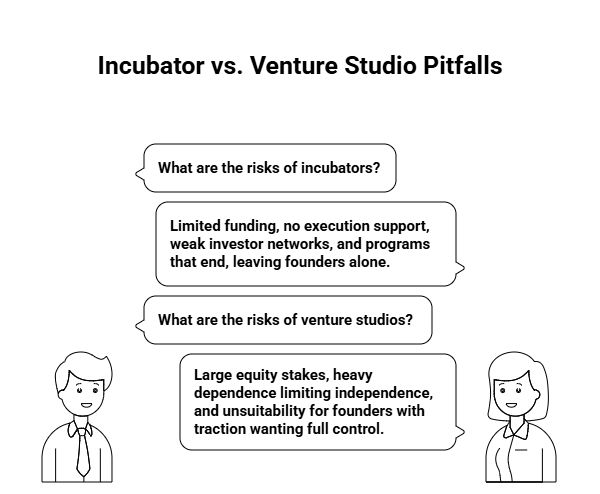
Incubators
Limited funding and no execution support
Often nonprofit and may lack strong investor networks
Programs end after a cycle, leaving founders on their own
Venture Studios
Large equity stakes reduce founder ownership
Heavy dependence on the studio can limit independence
Not suitable for founders who already have traction and want full control
Considerations for Founders
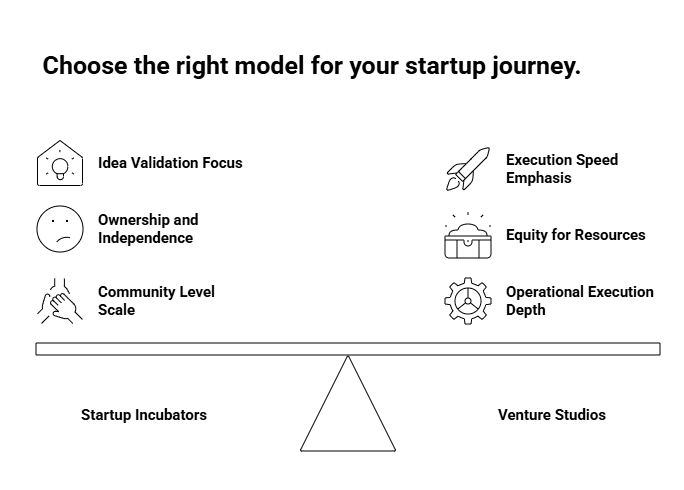
The real decision is not whether to join an incubator or a studio. The question is how each model fits your journey right now.
Build with Ellenox

Build with Ellenox
Building a successful startup requires more than joining a program or giving up equity for resources. It requires evidence that your idea solves the right problem, clarity about your users, and a product that can scale from the start. This is where Ellenox stands apart. With a founder-first approach, Ellenox provides research, product strategy, design, and development as a unified service. Our work is integrated with your goals and context so you move from concept to launch with confidence. The focus is not on volume but on traction, fit, and building products that last. As early founders look for smarter paths than incubators or studios alone, Ellenox offers a way forward. If you are ready to stop guessing and start building with precision, it is time to build with Ellenox.