


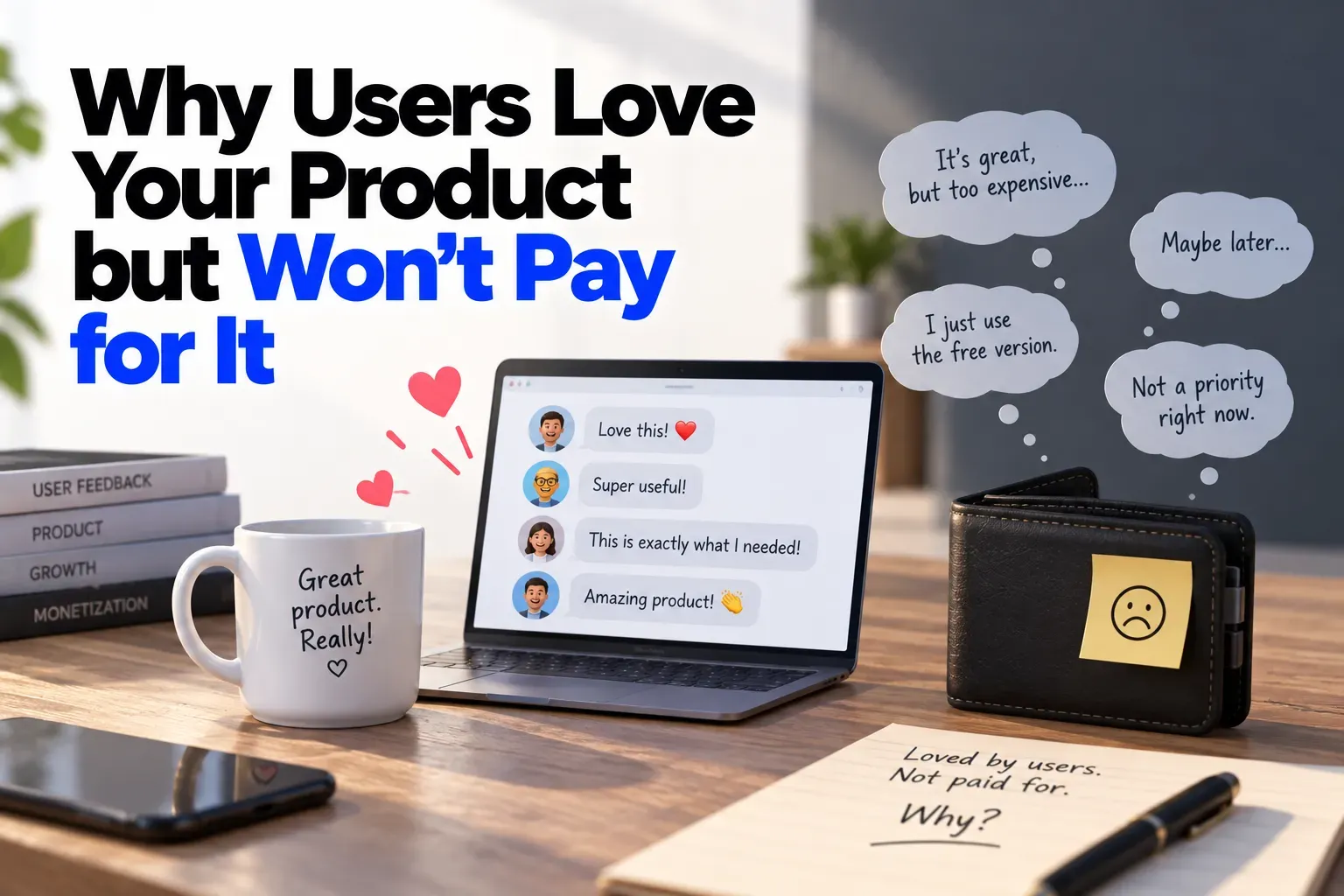
A founder built a free bookmarking tool, watched it grow to 500 users through organic search and word of mouth, and got glowing feedback the whole way. Multiple users even said they wanted to pay for it. So the founder spent two months building a premium tier and launched it to those same 500 users.
Zero sales. Nobody upgraded.
The lesson: lots of people using a free product is validation that people want to use it for free. It is not validation for a business model. Usage and willingness to pay are different signals entirely, and confusing them is one of the most expensive mistakes an early-stage founder can make, because it usually takes months to discover.
This piece covers why usage doesn't predict revenue, the real reasons users stall at "I'd definitely pay" without ever paying, and how to test true willingness to pay before building another feature hoping it closes the gap.
Interest vs Intent: Why Usage Doesn't Predict Revenue
Interest is cheap. A user saying "I'd pay for this," giving a five-star review, or telling you it's "way better than the competition" costs them nothing.
Action is expensive. Actually pulling out a credit card, requesting budget approval, or committing real time to onboard a team costs something, and that cost is exactly what separates genuine demand from polite enthusiasm.
The pattern shows up constantly:
- Founders see 4.8-star reviews and rave feedback
- Then crickets the moment payment is due
- The instinct is to assume it's a pricing problem or a missing feature
- The price gets tweaked, or the requested feature gets built
- Conversion barely moves
That's usually because the real problem was never pricing or features. It was that free users were never real customers to begin with.
A useful test: ask users to do something that costs them time, effort, access, or money, not just tell you what they think:
- A letter of intent
- A meaningful onboarding commitment involving their team
- A discounted but real charge, instead of another free extension
Users who won't take any of those actions aren't customers who need convincing. They're free users who were never going to convert, no matter what gets built next.
The Six Real Reasons Users Won't Pay for a Product They Use
Several distinct root causes produce the exact same symptom. Diagnosing which one applies changes what actually fixes it.
| Root cause | What it looks like |
|---|---|
| Free tier delivers full value: the free version already solves the problem completely | High usage, zero upgrade pressure |
| Pain isn't severe enough: the problem is real but mild | Frequent light usage, no urgency |
| Wrong ICP: users have no budget authority | Individual contributors, students, hobbyists using a tool built for buyers |
| No activation moment tied to the paywall: users never reach the "aha" point | High signups, low depth of use |
| Wrong pricing model: charging for something users don't actually value | Users engaged, but the price feels arbitrary |
| Free positioned as permanent: users mentally categorize the whole category as free | Long-term free usage with no upgrade intent, ever |
Free tier delivers full value: if the free version solves the problem completely, there's no reason left to upgrade. This is the most common and most self-inflicted cause: a free tier built to be "generous" that accidentally cannibalizes the paid plan entirely.
Pain isn't severe enough to justify money: usage can be real and frequent while the underlying problem stays mild. People will use a free tool that saves them a little friction indefinitely, but mild friction rarely clears the bar required to pull out a credit card. Severe, urgent, expensive problems get paid for. Mild inconveniences get used for free, forever.
Free users were never the paying ICP: a tool used by individual contributors with no budget authority (sales reps, students, hobbyists) can have enormous usage and zero conversion, because the people using it structurally cannot pay, regardless of how much they love it. The person who needs to approve the purchase was never in the product at all.
No activation moment tied to the paywall: users who reach a real "aha" moment, the point where they experience the core value clearly, convert at five to ten times the rate of users who never get there. If the paywall sits in front of a feature nobody has reached yet, or behind a feature nobody actually needs, it keeps producing silence regardless of price.
Pricing model charges for the wrong thing: charging per seat when the value is usage-based, or charging for storage when the value is collaboration, creates a mismatch between what's expensive and what's actually valuable to the user. The price doesn't track the value, so paying for it never feels justified even to an enthusiastic user.
Free positioned as the permanent plan, not a trial of value: once users mentally categorize a product as "the free thing," reframing it as something worth paying for later is an uphill fight. Some products train their own users to see the entire category as worth $0.
Is It a Value Problem or a Pricing Problem? A Quick Diagnostic
Before touching your price or building another feature, ask: would your free users do something costly to keep using the product if the free option disappeared tomorrow?
| Signal | What it suggests |
|---|---|
| They'd switch to a competitor's free tier immediately | Value isn't tied to your product, it's tied to the category being free |
| They'd email asking for an extension or workaround | Value is real personally, but not worth paying for |
| They'd escalate internally to get budget approved | Genuine customer. The blocker is likely process or pricing model |
| They'd simply stop using it | The pain was never severe enough to begin with |
Only the third row describes a near-customer worth iterating pricing for. The other three describe a usage number that was never going to become revenue, regardless of how the pricing page is worded.
The Free Tier Trap: What the Conversion Numbers Actually Look Like
Free tiers feel like a growth hack until the conversion math shows up.
- Typical freemium-to-paid conversion: roughly 2 to 5%, meaning 95 to 98% of free users never become customers
- OpenView survey finding: a 6% visitor-to-freemium-signup rate paired with only 5% freemium-to-paid conversion, netting out to roughly 0.3% of total website visitors ever paying
- Dropbox's benchmark conversion: around 4%, often cited as a success story, but one that took enormous, sustained product and growth effort to reach
- "Normal" freemium conversion: closer to 1%
None of this means freemium is a bad model. It means a free tier only works as a business strategy when it's deliberately built as a lead-generation or activation mechanism, not as a way to avoid the harder work of proving people will pay. A free tier with no clear reason for existing, beyond "it grows our user count," is usually the thing quietly training users never to convert.
How to Test Real Willingness to Pay Before Building More
The fastest way to find out if usage will ever turn into revenue is to force a decision, not ask an opinion.
- Charge money upfront, even at a discount: a discounted but real charge filters out everyone who was never going to pay at any price
- Ask for a meaningful commitment instead of a "yes": a signed letter of intent, an internal champion escalating for budget, or a team actually onboarding are all costly enough to reveal real intent
- Stop building for the free users who love the product: their feedback optimizes the free experience, not the paid one, and following it too closely can quietly make the free tier even harder to convert out of
- Watch what happens when a trial or discount ends, not what people say will happen: behavior at the actual moment of payment is the only signal that matters
Founders who skip this step and instead spend months building the "missing feature" free users asked for often find, like the bookmarking tool above, that the feature changes nothing, because the real blocker was never the feature list.
What to Do When Usage Is High but Revenue Isn't
If the diagnosis points to a real value or ICP mismatch rather than a pricing model or activation-moment fix, the corrective moves are usually structural, not cosmetic:
- Narrow the ICP to people who actually hold budget: if active users are individual contributors with no purchasing power, the product needs a path to reach their manager, or a different ICP entirely
- Move the paywall to sit after the real activation moment: not before it, and not absent entirely. Users need to feel the value clearly before being asked to pay for more of it
- Reconsider what you're charging for: if usage is high but perceived value is diffuse, the pricing metric (seats, usage, outcomes) may not match what users actually value
- Run a paid-only test with a new cohort: skipping free entirely for a new segment reveals whether real demand exists independent of the free tier's gravitational pull
- Accept that some usage will never convert, and stop optimizing for it: not every free user is a future customer. Some are permanently outside the paying ICP, and that's fine as long as the free tier isn't costing more to support than it's worth as a funnel
Work With Ellenox on Closing the Gap Between Usage and Revenue
High usage with no revenue is one of the most disorienting problems a founder can face, because every surface-level signal looks like success. The fix rarely starts with a new feature or a different price. It starts with a clear-eyed diagnosis of whether the people using the product were ever the people who could pay for it, and whether the product has genuinely earned the moment it's asking for money.
Ellenox works with early-stage founders on exactly this kind of diagnosis: validating real willingness to pay before more building happens, and identifying whether the fix is the ICP, the pricing model, or the product's activation flow. If your usage numbers look strong but revenue doesn't match, talk to Ellenox.