


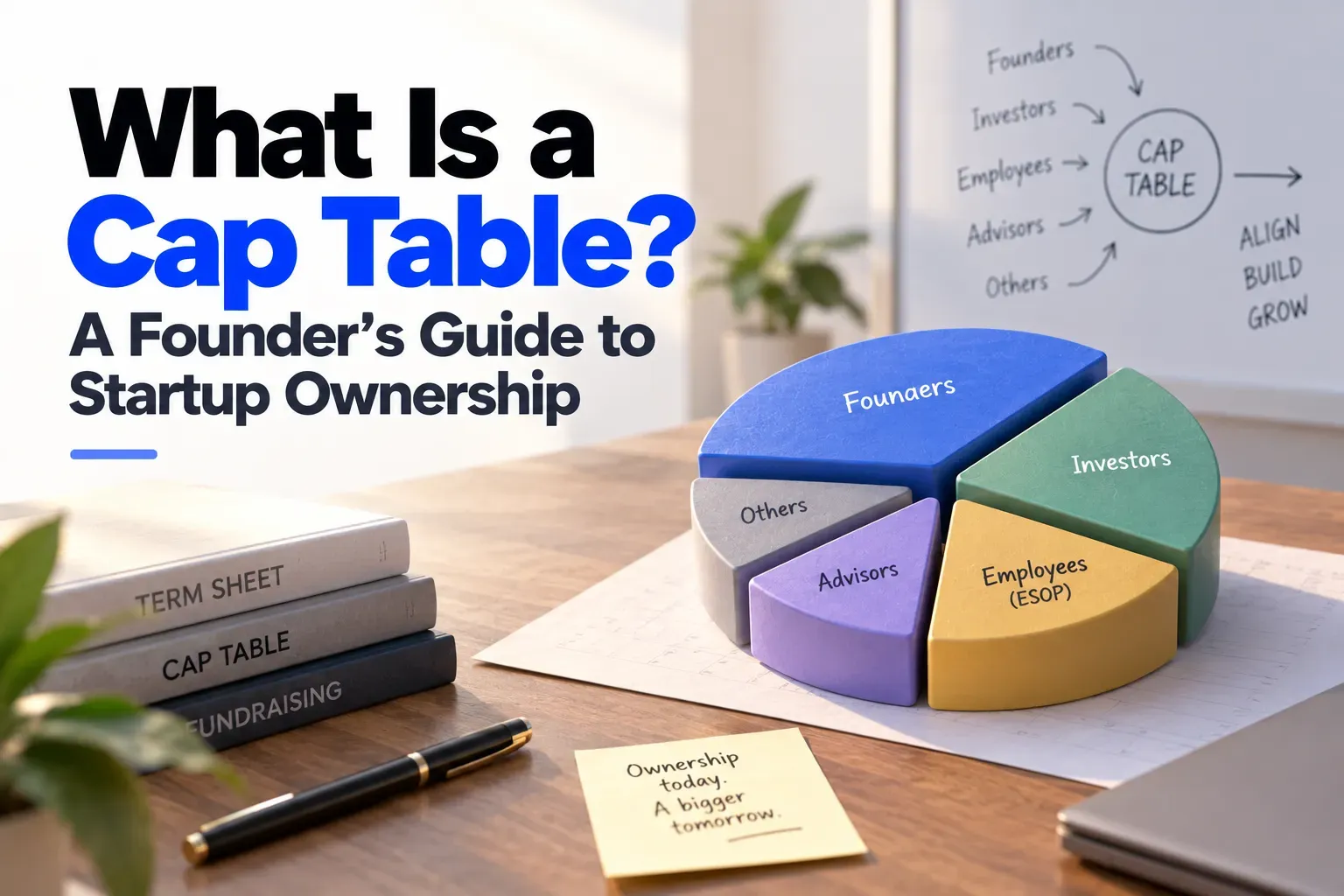
A cap table is the single document that tells you the truth about who owns your company, and most founders don't look at it closely enough until a term sheet is already on the table and the math no longer works in their favor.
By the time that happens, the damage is usually already done. This guide covers what a cap table is, what it tracks, how ownership actually changes as you raise, and the mistakes that cost founders real equity when nobody catches them early.
What Is a Cap Table?
A cap table, short for capitalization table, is the authoritative record of every equity interest in a company: who owns it, in what form, at what price, and under what conditions.
At minimum, a working cap table tracks:
- Shareholders: founders, investors, employees, and advisors holding equity
- Share class and type: common stock, preferred stock, options, warrants
- Number of shares held by each party
- Percentage ownership, both current and fully diluted
- Price paid per share and date of issuance
- Outstanding convertible instruments: SAFEs, convertible notes, and their specific terms (valuation cap, discount, interest)
That last item is where a lot of founders get it wrong. A SAFE or convertible note doesn't show up as shares yet, since it converts into equity at a future priced round. But it belongs on the cap table as an outstanding obligation the moment it's signed. Treating it as invisible until conversion is one of the most damaging cap table mistakes a founder can make, because it means nobody has an accurate picture of who will actually own what once those instruments convert.
A Simple Cap Table Example
Here's what a basic post-seed cap table might look like for a company that raised $1.5M after founders held 100% ownership at incorporation:
| Shareholder | Share Type | Shares | Ownership % |
|---|---|---|---|
| Founder A | Common stock | 4,000,000 | 40% |
| Founder B | Common stock | 4,000,000 | 40% |
| Employee option pool | Options | 1,000,000 | 10% |
| Seed investors | Preferred stock | 1,000,000 | 10% |
| Total | 10,000,000 | 100% |
This is a fully diluted view: it counts the entire option pool as issued, even though most of those shares haven't been granted to specific employees yet. A non-diluted view of the same company would show only shares actually issued, which makes the founders' percentage look higher than what they'll actually hold once the pool gets used. Investors negotiate against the fully diluted number. Founders should read every offer that way too.
Cap Table vs Stock Ledger: Why They're Not the Same Document
Founders often use these terms interchangeably, and they shouldn't.
A stock ledger is a formal legal record: the names and addresses of shareholders, the number of shares each holds, and the dates of issuance. If a company is a Delaware C-Corporation, which most venture-backed startups are, maintaining a stock ledger is a legal requirement, not optional paperwork.
A cap table is the broader, analytical view built on top of that legal record. It includes everything the stock ledger has, plus modeling: fully diluted ownership, option pool sizing, and the projected impact of instruments that haven't converted yet. A cap table should reconcile back to the stock ledger regularly. When the two drift apart, that's usually the first sign an equity event went unrecorded somewhere.
How Founder Ownership Changes From Seed to Series B
The dilution curve surprises most first-time founders, mainly because they underestimate how much of it compounds across rounds rather than happening once.
According to Carta's 2026 Founder Ownership Report, median founding team ownership moves like this:
| Stage | Median Founder Ownership |
|---|---|
| After a seed round | 56.2% |
| At Series A | 36.1% |
| At Series B | 23% |
Each round dilutes the previous one, and the option pool created for future hires dilutes founders further on top of that. Knowing this curve ahead of time changes how founders negotiate: understanding that Series B founders typically hold less than a quarter of their company makes it easier to judge what ownership percentage is reasonable to fight for at seed, and which battles aren't worth the friction.
How the Option Pool Shuffle Dilutes Founders More Than Investors
This is the mechanic that catches the most first-time founders off guard.
Institutional investors typically require an option pool, often around 10% of the company, to be carved out before a new investment round closes. That pool covers future employee equity grants. The catch: when the pool is created pre-money, meaning before the new investor's capital is added, the dilution from creating it is borne entirely by existing shareholders, which in practice means the founders. The incoming investor's ownership percentage is calculated after the pool already exists, so their stake isn't diluted by it at all.
Founders who don't model this before a term sheet negotiation consistently end up more diluted than expected, discovering only after signing that the "20% for $2M" they thought they agreed to actually cost them several additional points once the option pool math ran through.
What to check before signing: whether the option pool is being created pre-money or post-money, and model both scenarios. A pre-money pool always costs founders more.
How to Read a Cap Table Before Signing a Term Sheet
Four things worth checking directly against the cap table before agreeing to any funding terms:
- Pre-money vs post-money ownership: confirm whether the percentages being discussed are calculated before or after the new capital, and before or after any new option pool
- Fully diluted vs non-diluted view: confirm which basis is being used, since investors almost always negotiate off the fully diluted number
- Outstanding SAFEs and notes: confirm every convertible instrument is accounted for and modeled at its actual conversion terms, not treated as an afterthought
- Vesting schedules: standard founder vesting runs four years with a one-year cliff, and this applies even between fifty-fifty co-founders. It protects the company if someone leaves early
Common Cap Table Mistakes That Cost Founders Equity
Treating convertible instruments as invisible until conversion. SAFEs and notes are real obligations from the day they're signed. Leaving them off the working cap table produces a false sense of how diluted founders will actually be.
Not modeling the option pool shuffle before negotiating. Founders who accept a headline equity percentage without checking whether the pool is pre-money or post-money routinely end up with less ownership than they thought they agreed to.
Skipping founder vesting because "we trust each other." Vesting isn't a signal of distrust between co-founders. It protects the company if one founder leaves early, and its absence is one of the fastest ways to create a cap table dispute down the line.
Letting the cap table and stock ledger drift out of sync. When these two documents disagree, it usually means an equity grant, a share transfer, or a conversion event went unrecorded, and that gap tends to surface at the worst possible moment: due diligence for a raise or an acquisition.
Not updating the cap table in real time. A cap table is a living document. Every option grant, SAFE, and departure should update it as it happens, not get batched into a scramble right before the next raise.
Best Tools for Managing a Startup Cap Table
Most startups past the earliest, informal spreadsheet stage move to dedicated equity management platforms like Carta, Pulley, or AngelList Stack, which handle 409A valuations, compliance, and dilution modeling in one place. A spreadsheet works for the first few months. It stops being reliable the moment SAFEs, an option pool, and multiple share classes are all in play at once, which for most startups happens by the first real fundraise.
Why Cap Table Literacy Matters Before You Raise
Understanding a cap table isn't a legal formality. It's part of the same readiness question every founder should answer before opening a round: not just whether you can raise, but what you're actually agreeing to give up when you do.
Ellenox works with early-stage founders on exactly this kind of fundraising readiness, from validating the traction that justifies a raise to understanding what a term sheet's equity terms actually mean before signing one. If you're preparing to raise and want a clear-eyed read on your cap table and what a specific offer would cost you, talk to Ellenox.