


Every founder is selling a story before the product exists. To investors, it's why this market, why now, why you. To early customers, it's why this problem is worth solving today instead of living with it another year. To a candidate weighing your seed-stage offer against a stable job, it's why this company is worth the risk. The product comes later. The story is what gets you the resources to build it.
Most founders treat storytelling as a pitch deck problem. It isn't. It's a judgment problem: which story to tell, when to tell it, and how to structure it so the person on the other end actually acts. Founders who get this right raise faster, close better customers, and hire people who would have said no to almost anyone else.
This guide breaks down how to pick the right story, when to tell it, how to structure it, and which format and channel fits which audience.
What Is Startup Storytelling (And Why It's a Founder Skill, Not a Marketing Skill)
Startup storytelling is the practice of framing a company's problem, product, and vision as a narrative that moves a specific audience (investors, customers, employees, press) to act. At an established company, storytelling is delegated to a marketing department with a brand history to draw on. At a startup, there is no department to delegate to. The founder is the story for a long stretch of the company's life.
Investors are backing a narrative about a market opportunity. Early customers are trusting a founder's account of where the product is headed, not a track record. Early employees are joining a story about what the company will become, since the company they're evaluating today barely exists yet.
This means startup storytelling carries more weight per sentence than storytelling inside an established company. There's no brand reputation to fall back on. There's no case study library. The founder's ability to make the story land is often the only asset in the room, which is what makes this a core founder competency rather than a function you hire out.
How to Pick the Right Startup Story: The Three-Part Check
Before building a pitch, a customer story, or a recruiting narrative, run it through three checks. Skipping any one of them is why founders walk out of investor meetings, customer calls, or recruiting conversations confused about why a strong story didn't land.
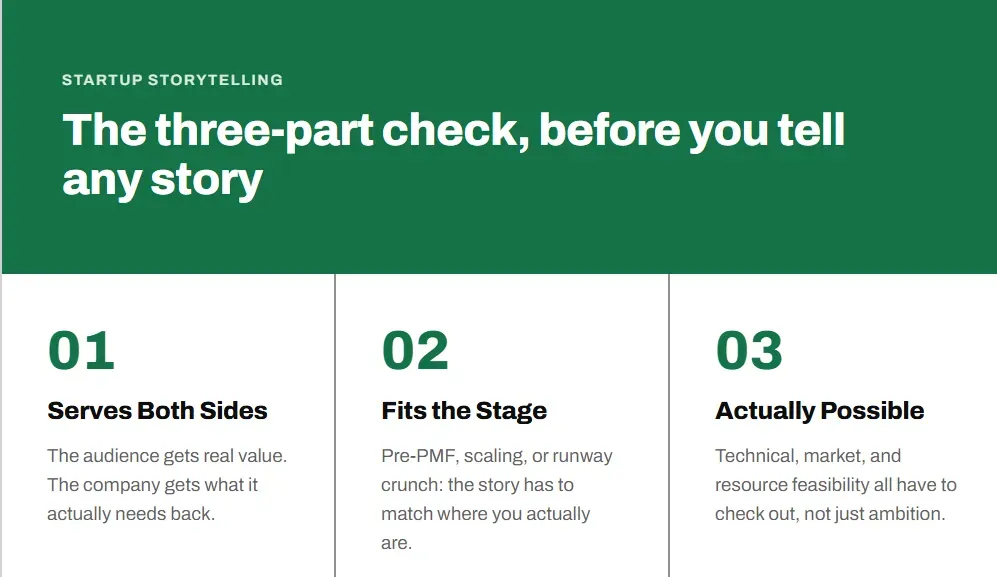
1. Does the Story Serve the Audience and the Company?
Every startup story has two stakeholders: the person you're talking to, and the company. Both need a real stake in the outcome.
- For an investor pitch: does the investor get a venture-scale return, and does the company get the capital and support it actually needs
- For a customer pitch: does the customer solve a real, costly problem, and does the company get a customer who will stick around and expand
- For a recruiting pitch: does the candidate get a role that grows their career meaningfully, and does the company get someone who moves the mission forward
The story falls apart when it only serves one side. A pitch that oversells the opportunity to get a "yes" from an investor, without a credible path to the return they need, gets you a check you'll regret cashing. A customer pitch that promises capabilities the product doesn't have yet gets you churn in month two.
2. Does the Story Fit the Company's Actual Stage?
A seed-stage founder pitching a five-year platform vision to an investor evaluating pre-seed risk is telling the wrong story for the stage. A founder six months from running out of cash pitching "we're not focused on revenue yet, we're focused on the mission" to a board is telling the wrong story for the moment.
Check the story against your actual stage before you tell it:
| Company stage | The story that fits |
|---|---|
| Pre-PMF, searching | A tight wedge, a specific customer segment, and evidence you're learning fast |
| Partial PMF | A narrowing thesis: which segment retains, which doesn't, and what you're cutting |
| Post-PMF, scaling | Growth mechanics, unit economics, and the machine you're building to capture demand |
| Runway under 6 months | Direct, focused, and honest about what the capital or deal unlocks |
Telling a scaling story before you have PMF is the single most common startup storytelling mistake. It reads as either naive or dishonest to anyone who has seen the pattern before, and most investors, seasoned customers, and senior hires have.
3. Is the Story Actually Possible?
Ambition is not the same as plausibility. A story needs a credible path, not just a compelling destination.
Check for:
- Technical feasibility: does the technology exist, or is there a credible path to build it in the timeframe you're implying
- Market feasibility: is this the kind of problem the audience believes is solvable by a company your size, at your stage
- Resource feasibility: can the ask (money, a design partner slot, a job offer) actually be fulfilled by what you're requesting
Founders who tell stories that sound incredible but skip this check get read as either inexperienced or evasive. The best startup pitches make ambition feel inevitable, not magical.
Startup Storytelling Timing: Reading the Room Before You Pitch
The same story lands differently depending on the context the person you're pitching is operating in. Before telling a startup story, read five signals about your audience's current state.
The Five Timing Signals to Check Before Every Pitch
Their financial and market position: a VC deploying the last checks of a fund behaves differently than one who just raised a new fund. A customer whose budget got cut this quarter behaves differently than one flush with new headcount approval. Ask, or find out, before you pitch.
The competitive pressure they're under: an investor watching three competing firms chase the same category moves faster and takes more risk. A customer facing new competitive threats is more open to trying something unproven if it addresses that threat directly.
Where they are in their own decision cycle: a VC two weeks from a partner meeting behaves differently than one who just closed a deal and is decompressing. A customer mid-renewal with an incumbent vendor is a different conversation than one whose contract just lapsed.
How much trust already exists: a warm introduction from a respected founder changes what you need to prove in the first meeting. A cold outbound pitch needs to do more work earlier to establish credibility.
Whether it's a good time to ask for something big or something small: if trust is low or the timing is bad, lead with a smaller ask (a follow-up call, a pilot, an intro) rather than the big one (the check, the annual contract, the executive hire).
Founders who ignore timing send the same pitch deck to every investor regardless of fund stage, pitch every prospect the same way regardless of budget cycle, and wonder why conversion rates are inconsistent. Reading the moment before telling the story is not optional polish. It changes whether the story gets heard at all.
Startup Story Structure: The Framework That Makes a Pitch Convert
Once the story is right and the timing is right, structure determines whether it lands. Every effective startup story follows the same skeleton: a main character with a problem, an action, and a result. But startup storytelling changes the order and adds one critical element most founders skip.
The Three Elements Every Startup Pitch Structure Needs
1. Two main characters, not one: every startup story needs both a human main character (the customer, the user, the person feeling the pain) and the business (the company: yours or theirs). A pitch that's all about the market opportunity with no human at the center feels abstract. A pitch that's all about one user's story with no business case feels like a nice-to-have, not a fundable company.
2. Result before action: most founders build their pitch chronologically: here's the problem we found, here's what we built, here's what happened. That's backwards for an audience deciding whether to act. Lead with the result: the traction number, the transformation, the outcome. Then walk back to how you got there. An investor or customer who isn't bought into the result won't care about the mechanism, no matter how clever it is.
3. The explicit ask: this is the step most founders skip, and it's the one that determines whether the story converts. Every startup story exists because you want something: a check, a pilot commitment, a yes on the offer letter, a press mention. State it directly. "We're raising $2M to get to $1M ARR in 12 months" converts better than a pitch that ends with the vision and lets the investor infer what happens next.
The Six Types of Startup Stories Every Founder Needs to Tell
Founders tell versions of the same underlying story to different audiences, but each version needs its own structure and depth.
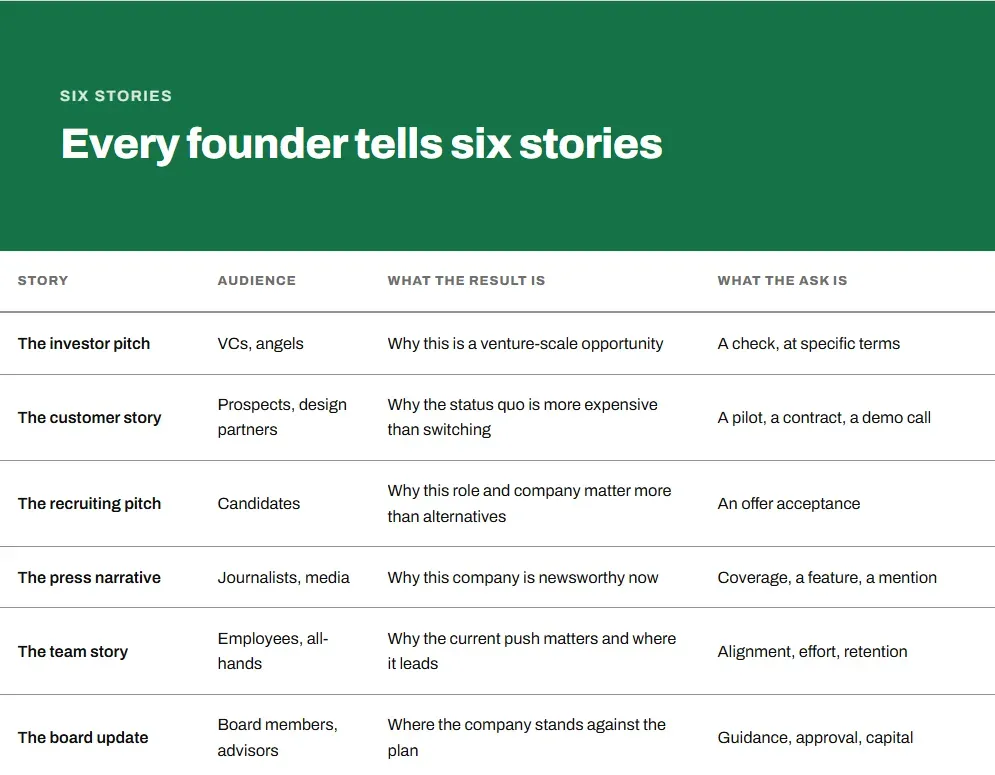
Each of these needs the same underlying discipline (right story, right timing, right structure), but the depth and format shift dramatically. An investor pitch might run 15 slides over 30 minutes. A recruiting pitch to a strong candidate might be a 20-minute conversation with no deck at all. Confusing the format that works for one with the format that works for another is a common founder mistake, especially early, when the same deck gets recycled for every audience.
How to Pick the Right Format and Channel for Your Startup Pitch
Once the story and structure are set, the delivery mechanism matters more than founders often credit.
Startup Pitch Formats and When to Use Each
- Presentation (deck): best for investor pitches and structured customer demos where visuals support the narrative
- Written (one-pager, memo): best for board updates, async customer proposals, and any audience that needs to review and forward internally
- Conversation (no deck): best for early recruiting pitches, informal investor coffee chats, and situations where over-preparing reads as inauthentic
- Demo (live product): best for customer pitches once the product can carry the story itself
- Video: best for async updates to distributed teams or investors who can't take a live meeting
Startup Communication Channels and When to Use Each
- Large meetings: all-hands updates, board meetings, and any story that needs shared context across a group at once
- Small meetings or 1:1s: investor pitches, key customer negotiations, and recruiting conversations where nuance and trust-building matter
- Email or async written updates: investor updates between meetings, customer follow-ups, and board communication that doesn't need real-time discussion
- Slack or team channels: internal team storytelling, especially for smaller, fast-moving startups where formal meetings slow things down
The mismatch to avoid: a 40-slide investor deck sent cold over email to a VC who prefers a five-minute warm intro call first. Or a rambling unscripted pitch to a customer's procurement team who needs a written proposal to forward internally. Match the format and channel to what the specific audience actually needs to say yes.
Common Startup Storytelling Mistakes to Avoid
- Leading with the founding story instead of the result: "We started this company because..." is a weaker opener than the traction number or the transformation the product creates. Save the origin story for later in the pitch, once the audience is bought into the outcome
- Reusing the same pitch for every audience: the investor pitch, the customer pitch, and the recruiting pitch share a spine but need different depth, different asks, and often different formats entirely
- Skipping the explicit ask: ending a strong story without stating exactly what you want forces the audience to guess, and guessing usually defaults to no
- Ignoring timing: pitching a scaling story to an investor evaluating pre-seed risk, or pitching a five-year vision to a customer who needs a solution this quarter, both misread the moment
- Treating storytelling as a one-time deliverable: the story needs to evolve as the company does. The pitch that got you your first angel check should not be the same pitch you're using at Series A
Work With Ellenox on the Story Behind Your Raise
Most founders who struggle to raise, sell, or hire are not short on substance. They are telling the right story in the wrong structure, at the wrong time, to an audience that needed a different ask. Getting the story right is not a cosmetic exercise. It changes whether the capital, the customers, and the talent show up when you need them.
Ellenox works with early-stage founders on the substance behind the story: validating the problem, building the product that makes the pitch credible, and preparing the narrative and metrics that make a fundraise or a launch land. If you're heading into a raise, a launch, or a hiring push and want the story to match the strength of what you've built, talk to Ellenox.