


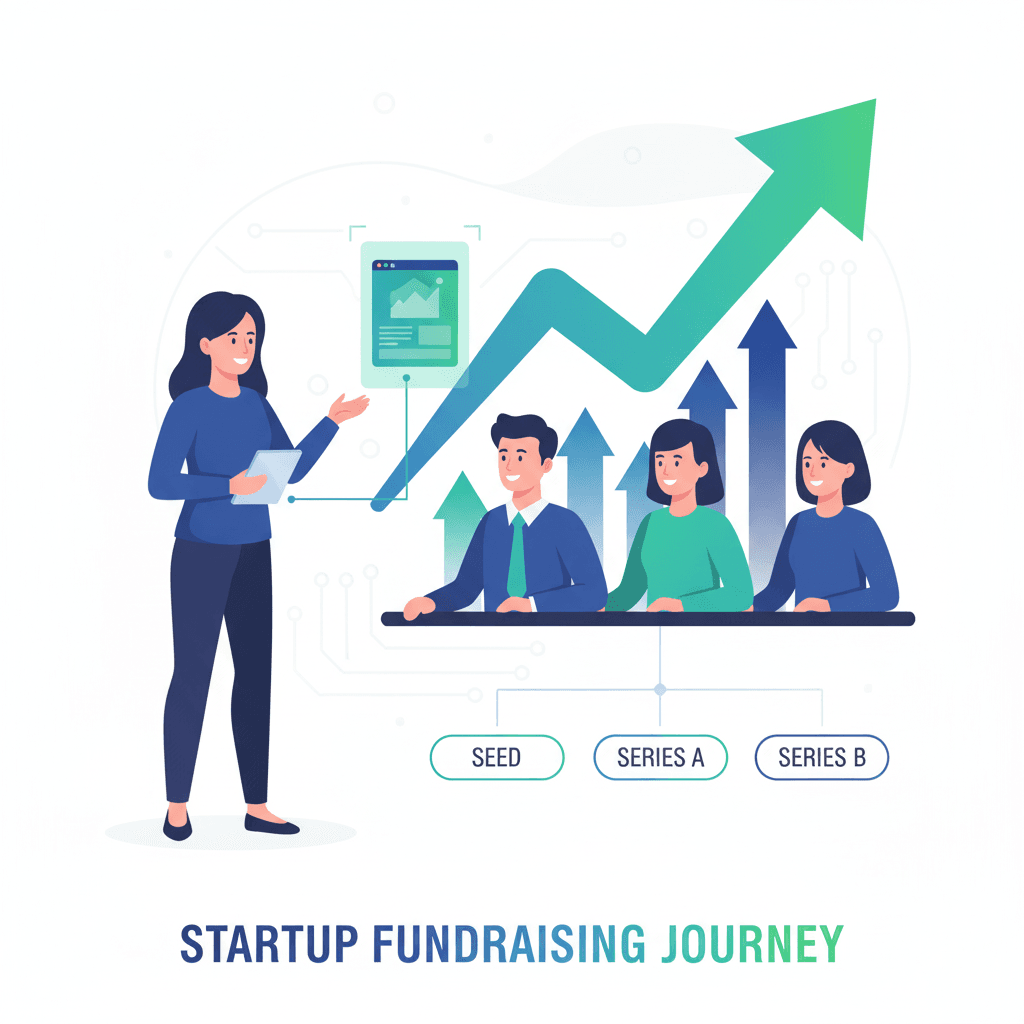
When most people picture startup fundraising, they imagine dramatic pitches, investors battling to get into the round, and founders walking away with giant checks. The truth is much less glamorous. Fundraising is slow, repetitive, and often frustrating.
In this post, we will walk through the actual stages of startup fundraising.
The Roadmap: Stages of Startup Fundraising
Every stage of fundraising is tied to a milestone. Money is not raised just to have money, it is raised to reach the next level of growth.
Bootstrapping
Every company begins here. Bootstrapping means funding from your own savings, credit cards, or side jobs. The goal is simple: build a minimum viable product, gather early insights, and prove there is a reason to continue. Some founders pre-sell their product or use free tools to keep costs low. Bootstrapping works for starting out, but relying on it forever is a stressful way to build.
Pre-Seed
Pre-seed funding is the very first external capital. Rounds are usually small, anywhere from $50K to $500K, and often come from friends, family, angels, micro-VCs, or accelerators. At this point, investors are betting on you as much as on the idea. A prototype, a credible team, and early signs of traction are the keys.
Seed
The seed round is where things start to get serious. Typical raises range from $500K to $2M, though they can be smaller or larger. The milestone here is product market fit. You should have a product in beta, early customer feedback, and ideally some revenue. Seed investors include angels, seed-focused venture firms, and crowdfunding platforms.
Series A
Series A is all about scale. Companies raise between $5M and $25M, with the average in the $15M to $20M range. By this point, investors expect evidence that the business model works. Metrics such as $1M or more in annual recurring revenue, strong month-over-month growth, and healthy unit economics matter. This is usually the first round where venture capital firms take board seats.
Series B
Series B takes scaling to the next level. Companies raise $20M to $100M to expand aggressively, enter new markets, and build out a full management team. Investors expect several million in revenue and a proven business model at scale.
Series C and Beyond
Later rounds are about dominance. Series C funding often exceeds $30M and can reach hundreds of millions. Companies use it for international expansion, acquisitions, or IPO preparation. At this stage, investors are less focused on vision and more on hard financial performance, revenue multiples, and profitability.
The Funding Gap
Many startups get stuck between Seed and Series A. They have traction but not enough momentum for a full Series A. This often leads to a Post-Seed or bridge round, where the company has less leverage.
What Investors Look For
Investors do not invest in ideas alone. They invest in founders and teams who can survive setbacks and execute over the long haul.
Mission and Obsession: Investors want founders who care deeply about the problem, not just the opportunity.
Resilience: Startups face near-death moments. Investors want to see proof that you can keep going when things collapse.
Agility: Strategies must change quickly, but values like integrity and customer focus should stay consistent.
Team Strength: A balanced team matters. Having a strong technologist or CTO is often non-negotiable.
Storytelling and Authenticity: You must be able to explain your company clearly and honestly. Investors can sense when a founder is pretending.
Insight-Driven Hustle: Hard work only matters if it is directed by genuine insight into the problem.
Network helps, but traction matters more. If you are making something people want and customers are paying, investors will find you. Rejection is universal. Even billion-dollar companies were turned down dozens of times before they found their first believers.
The Mechanics of Fundraising
SAFEs: The Standard Tool
Most early-stage rounds today are raised on SAFEs (Simple Agreements for Future Equity). Created by Y Combinator in 2013, the SAFE is only five pages long, free to use, and simple enough to close without a lawyer. Founders usually negotiate only the investment amount and the valuation cap. Investors do not get board seats, information rights, or actual shares until the next priced round.
Control and Dilution
Using SAFEs gives founders more control at the seed stage. Still, dilution is unavoidable. A seed round usually costs 10 to 20 percent of the company. Series A may require 15 to 25 percent. By Series C, founders often own less than half. The art is raising enough to reach milestones without giving up too much too early.
Cost and Timing
Seed rounds can close in weeks with little legal cost. Growth rounds like Series A or B take months, involve heavy negotiation, and often rack up hundreds of thousands in legal fees. Pre-seed rounds are slowest, because friends and family investors move cautiously.
Deal Terms That Matter
Every founder should understand:
Pre-money valuation, post-money valuation, and cap tables.
The difference between equity, convertible notes, and SAFEs.
Investor protections such as liquidation preference, anti-dilution, and board seats.
The best leverage in negotiation is having more than one investor competing to lead your round.
Alternative Paths
Not every company needs traditional venture capital. Revenue-based financing, venture debt, and strategic partnerships can provide cash or resources without as much dilution.
The Philosophy Behind Fundraising
Now that we have covered the roadmap, expectations, and mechanics, it is important to pause and reflect on the philosophy.
Fundraising is not the goal. It is a tool. The only thing harder than raising money is making something people want. If investors are not buying in, the solution is rarely a better pitch. The solution is usually a better product, more progress, and clearer traction.
Fundraising is also not glamorous. Freshpaint, a Y Combinator company, met 160 investors over four months to raise $1.6 million. That grind is normal. Success comes from persistence and from demonstrating progress in real terms.
Finally, while everyone bootstraps at first, permanent bootstrapping is exhausting. It keeps you distracted and always close to running out of money. A more sustainable path is to show traction, raise a meaningful amount once, and then devote yourself fully to customers.
Ready to Navigate Startup Fundraising?
At Ellenox Venture Studio, we believe fundraising is not about pitch decks or theatrics, but about clarity, traction, and execution. Our work is to help founders understand investor expectations, structure their rounds, and raise with confidence.
If you are preparing your first raise, navigating investor meetings, or planning for scale, Ellenox can help you chart the right path forward. Partner with us at Ellenox Venture Studio.

Ready to Navigate Startup Fundraising?
At Ellenox Venture Studio, we believe fundraising is not about pitch decks or theatrics, but about clarity, traction, and execution. Our work is to help founders understand investor expectations, structure their rounds, and raise with confidence. If you are preparing your first raise, navigating investor meetings, or planning for scale, Ellenox can help you chart the right path forward.