


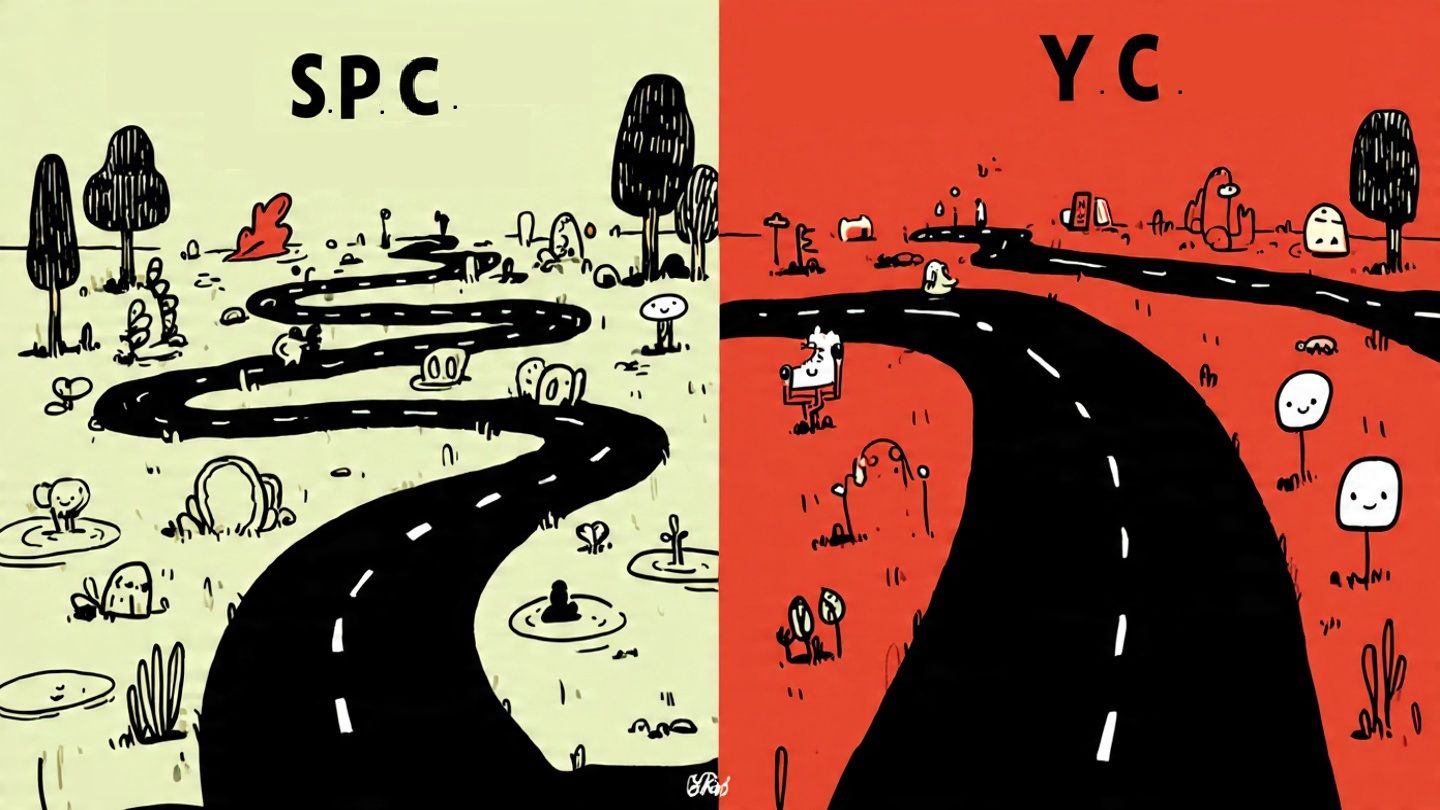
Startup accelerators and community programs are often discussed as if they serve the same purpose. In reality, the experience, expectations, and outcomes can feel radically different depending on which path you choose.
SPC is built for exploration, giving founders time, space, and upfront funding to discover the right problem before committing to a startup path.
YC is built for compression, pushing founders with clear direction to execute rapidly, fundraise quickly, and scale through a time-boxed accelerator with Demo Day as the forcing function.
Rather than asking which is better, a more useful question is where you are in your founder journey and what kind of support structure will actually move your company forward right now.
South Park Commons vs Y Combinator: High-Level Comparison
| Feature | South Park Commons | Y Combinator |
|---|---|---|
| Founded | 2016 | 2005 |
| HQ | San Francisco, CA | Mountain View, CA |
| Program Length | Open-ended exploration; Fellowship is cohort-based but not time-boxed | ~3 months |
| Investment | $400K for 7% plus ~$600K follow-on commitment | $125K for 7% plus $375K SAFE |
| Cohort Size | Small, selective fellowship cohorts | 200+ companies |
| Focus | Exploration, idea validation, deep research | Product, growth, execution |
| Network Strength | Dense, boutique peer community | Elite Silicon Valley, massive alumni base |
The Core Difference in Philosophy Between South Park Commons and Y Combinator
Both programs work with early-stage founders and provide capital, mentorship, and network access. That is where the similarities mostly end.
South Park Commons is built around exploration and discovery. It assumes the best companies sometimes need time to find the right problem, that conviction comes from deep thinking rather than rapid execution, and that a dense peer community can help founders navigate the messy early stages before a startup fully crystallizes.
Y Combinator is built around clarity and compression. It strips startup building down to a small number of principles and pushes founders to execute relentlessly against them within a fixed timeline.
Neither approach is right nor wrong. They reward different stages and different founder temperaments.
What South Park Commons Optimizes For
South Park Commons operates as a community and fund rather than a traditional accelerator. The philosophy is centered on giving builders space to think, explore, and validate ideas before committing to the compressed intensity of fundraising and scaling.
The organization offers two primary paths. Member Residency provides workspace, community programming, and peer exposure for builders still figuring out what to build. Founder Fellowship provides upfront capital and structured support for founders in the pre-traction phase who need funding while they validate their idea.
SPC's model is deliberately slower and less prescriptive than a typical accelerator. There is no fixed three-month timeline, no mandatory Demo Day, and no pressure to demonstrate clear metrics by a specific deadline.
The value of SPC often shows up in three areas:
1. Time and space to discover the right problem: Many founders arrive at SPC with technical expertise or domain knowledge but without a clear startup idea. The community model allows exploration without the pressure of immediate fundraising milestones. This matters especially for deep tech, research-heavy, or long-horizon bets where the right problem takes time to crystallize.
2. Dense peer network and cross-pollination: SPC deliberately curates a community of highly technical builders, domain experts, and experienced operators. The value is relational rather than transactional. Many founders cite peer feedback and collaborative discovery as the most enduring benefit of the program.
3. Upfront funding with follow-on support: The Founder Fellowship provides $400,000 upfront for approximately 7% equity, plus substantial credits for cloud and developer services, and a guaranteed follow-on commitment of approximately $600,000 in the next external round. This structure gives founders runway to iterate without immediately needing to prove Demo Day-ready traction.
SPC tends to work best for founders who:
Are pre-traction or still searching for the right problem to solve
Have deep technical or research backgrounds and want to explore complex domains
Value a boutique, collaborative community over a standardized accelerator curriculum
Need funding while validating rather than funding contingent on demonstrated traction
What Y Combinator Optimizes For
Y Combinator's internal model is opinionated, focused, and built for speed.
Founders are pushed to talk to users constantly, identify a small number of meaningful metrics, build something people want, and grow consistently even if slowly at first.
The program itself is intentionally lightweight. Outside of weekly check-ins, office hours, and group dinners, most of your time is expected to be spent building and learning directly from customers. The entire experience is compressed into approximately three months and culminates in Demo Day, where hundreds of investors gather to see companies present.
The value of YC often shows up in three areas:
1. Decision clarity and forced prioritization: YC narrows the problem space dramatically. Founders rarely leave unsure about what matters. The constant pressure to prioritize makes tradeoffs unavoidable, which can be clarifying for teams that would otherwise spend months deliberating on product direction.
2. Partner pattern recognition: Most YC partners have built and scaled companies themselves. Advice tends to come in the form of concrete stories rather than abstract frameworks. The mentorship style is direct, sometimes blunt, and heavily focused on metrics, growth levers, and fundraising readiness.
3. Brand leverage and Demo Day momentum: YC's reputation still carries significant weight with investors, early hires, and later-stage partners. Demo Day concentrates investor attention in a way that often creates immediate fundraising momentum that would be difficult to replicate elsewhere.
YC tends to work best for teams that already have:
Clear product direction or early signs of traction
Strong technical execution capability
Readiness for an intense, time-boxed program with clear deliverables
Desire to accelerate fundraising quickly
Funding Terms and Equity
South Park Commons Funding
South Park Commons Founder Fellowship offers:
$400,000 upfront for approximately 7% equity via standard SAFE
Guaranteed follow-on commitment of approximately $600,000 in the next external round
Substantial credits and perks for cloud, AI, and developer services
No fixed Demo Day or three-month deadline
The structure prioritizes giving founders runway to validate and iterate without immediate pressure to demonstrate clear metrics. The follow-on commitment reduces the need to fundraise immediately after joining the program.
Y Combinator Funding
Y Combinator offers a standardized deal:
$125,000 for 7% equity via post-money SAFE
Additional $375,000 on an uncapped SAFE with MFN clause
Terms are uniform across the batch
The advantage is speed and predictability. There is little negotiation, which allows founders to focus on execution rather than deal structure. The trade is that the initial capital is smaller, and the additional SAFE is uncapped, meaning YC's ultimate ownership will depend on your next fundraise.
Funding key difference: SPC provides larger upfront capital with a follow-on backstop, optimized for exploration. YC provides smaller initial capital with a compressed timeline optimized for momentum.
Acceptance Rate and Application Process
| Aspect | South Park Commons | Y Combinator |
|---|---|---|
| Entry Routes | Member Residency (rolling) and Founder Fellowship (cohort-based) | Open application twice yearly |
| Applications | Selective, curated intake | 40,000+ annually |
| Acceptance Rate | Intentionally small cohorts, highly selective | ~1–2% |
| Application Style | Application and interview | Open application |
| Interviews | Partner and community fit assessment | Partner interviews |
South Park Commons operates with intentionally small cohorts. The fellowship focuses heavily on founder quality, domain expertise, and community fit rather than polish or proven traction. Earlier profiles have described SPC's acceptance as highly selective, with the organization emphasizing curation over volume.
Y Combinator's application process is highly competitive but accessible to anyone. Selection heavily favors clarity of thinking, founder capability, and early signals of demand. The sheer volume of applications makes acceptance rates extremely low.
Program Structure and Curriculum
South Park Commons
SPC operates two distinct programs with different structures.
Member Residency is rolling and program-lite. It offers workspace, community programming, workshops, and ad hoc mentorship. Members have the flexibility to explore, attend events, and engage with the community without fixed requirements.
Founder Fellowship is cohort-based but not time-boxed like a traditional accelerator. Fellows receive upfront funding, credits, 1:1 partner mentorship, and access to SPC's network and fund. There is no mandatory Demo Day or strict three-month deadline. The emphasis is on iteration, validation, and building conviction around the right problem.
The overall structure supports exploration over execution speed. Founders have space to test ideas, pivot, and discover product direction without the pressure of immediate fundraising milestones.
Y Combinator
YC runs a deliberately minimal but intense program:
Weekly office hours with partners
One group dinner per week
Limited formal curriculum
Heavy emphasis on founder self-direction
Founders are expected to spend most of their time building, talking to users, and improving a small set of core metrics. The program culminates in Demo Day, where companies present to hundreds of investors in a concentrated fundraising moment.
Mentorship and Support Style
| Area | South Park Commons | Y Combinator |
|---|---|---|
| Mentorship | Community-driven, bespoke | Partner-led |
| Style | Collaborative, exploratory | Direct, sometimes blunt |
| Curriculum | Flexible, domain-focused | Minimal, metric-focused |
| Founder Autonomy | Very high | Very high |
SPC mentorship is collaborative and exploratory. Fellows and members get deep peer feedback, partner mentorship tailored to their specific domain, and access to SPC's fund and network for ongoing support. The style emphasizes long-term positioning and domain insight rather than immediate growth levers.
YC mentorship often focuses on strategic clarity and hard prioritization. Advice is concise, tactical, and heavily oriented toward metrics, traction, and fundraising readiness. Partners push founders to narrow focus and demonstrate clear progress against a small number of key indicators.
Demo Day and Fundraising Outcomes
South Park Commons
SPC does not center on a single Demo Day moment. Instead, fundraising outcomes are supported by SPC's fund, ongoing investor introductions, and the fellowship's guaranteed follow-on commitment. This structure reduces immediate fundraising pressure and allows companies to raise capital on their own timeline.
Fundraising typically unfolds more gradually and organically. SPC supports portfolio companies with introductions and follow-on capital, but the expectation is not that everyone will raise a seed round within weeks of joining.
Y Combinator Demo Day
Large-scale investor attendance
Hundreds of funds present
Strong inbound interest for top-performing companies
Often accelerates seed or Series A fundraising quickly
YC Demo Day benefits from brand concentration and investor density. For companies that present well and demonstrate clear traction, the momentum can be significant. The compressed timeline often means founders are fundraising immediately after the program ends, with YC's network providing warm introductions and credibility signaling.
Which One Is Right for You
Choose South Park Commons if:
You are pre-traction or still searching for the right problem to solve
You want time and a talent-dense peer network to iterate and build conviction
You have a deep technical or research background and are exploring complex domains
You value upfront funding while validating rather than funding contingent on traction
You prefer a slower, exploratory approach over compressed execution timelines
Choose Y Combinator if:
Your product direction is already clear or you have early signs of traction
You want pressure to focus, prioritize, and execute rapidly
You are preparing for institutional fundraising and need Demo Day visibility
Brand signaling matters significantly for your next stage
You perform well under intense, time-boxed pressure
Many strong companies could thrive in either environment. The difference is not quality. It is fit and timing.
Before the Accelerator: When You Need to Build the Foundation First
Both SPC and YC assume a certain baseline. SPC assumes you have technical depth and domain expertise, even if you haven't found the exact problem yet. YC assumes you have product direction and early signals of demand, even if you haven't scaled yet. But many founders are still one or two steps behind either starting line.
The product concept is still forming. The technical foundation does not exist. The team is incomplete. The first version needs to be built before anything can be validated. This is not a gap that community exploration or accelerator pressure can fill. It requires a hands-on execution partnership.
Ellenox works at this stage. It is not a program or a cohort. It is a venture studio that partners directly with founders to build the product, validate the direction, and set up the technical and strategic foundation that makes acceleration or exploration actually useful. Product development, design, early hiring, and go-to-market positioning are handled alongside the founder, not advised from a distance.
This fits non-technical founders who need a technical co-founder equivalent, early teams who need to ship a real product before fundraising, or anyone who recognizes they are not yet ready for SPC or YC but wants to be. Ellenox helps close that gap so that the next step.