



You've built something people want. Your first users love it. Now comes the hard part: growing without breaking what made it work in the first place.
Most products fail at scale not because the idea was wrong, but because of a timing problem. You either optimize for your first 100 users and build in dependencies that make serving 100,000 impossible, or you build for massive scale before you understand what users actually need. Both paths lead to the same place: a product that can't grow efficiently.
The companies that scale successfully do something different. They understand that building for 100 users and building for a million users require fundamentally different approaches, and they know when to switch between them. They take deliberate shortcuts early that they can fix later, and they make strategic investments in the few things that are nearly impossible to change once you have traction.
This guide is about making those decisions well. About knowing which corners you can cut now and which foundations you need to get right from day one. About building products that can serve millions without requiring an army to operate.
What Is A Scalable Product? Understanding Product Scalability
Scalability is the ability to do more with less. It means growing your user base and revenue at a fast pace without having to grow your team or internal costs at the same organic rate. When a product scales effectively, each new customer costs progressively less to acquire and serve than the previous one.
However, scalability is often misunderstood. It's not just about growth; it's about efficient growth. A company that doubles its revenue by tripling its workforce hasn't scaled. A company that triples its revenue while only increasing headcount by 20% has achieved true scalability.
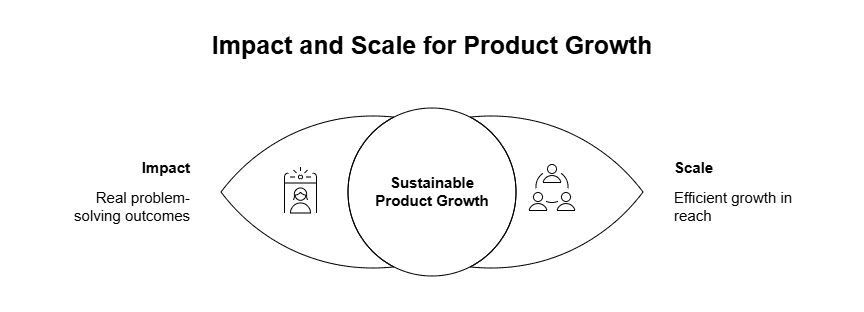
Impact vs Scale: Two Core Concepts for Product Growth
Impact Equals Outcomes
You cannot determine whether your product has a real impact without looking at actual outcomes. Impact is defined by whether your product or feature actually solved the problem it was intended to solve. This can be measured in two ways:
Quantitatively: Through metrics, moving the needle on key performance indicators, and measurable accomplishments
Qualitatively: Through the personal value users derive from your product, which is often individualized and varies throughout a career
Scale Equals Growth in Reach
Scale refers to how far your reach extends and how many people your product touches. The key is thinking about scaling as efficient growth, where your ability to serve customers expands faster than your costs.
How to Validate Market Size Before Scaling
Before you can scale anything, you need to ensure you're solving a problem that matters to a large number of people. Scalability starts with a product that addresses a need shared by millions. You must validate the potential market size before trying to scale.
A product that serves a niche of 10,000 people might be a great business, but it's not going to scale in the way that products serving tens of millions can. This doesn't mean you need to launch with millions of users. In fact, most successful scalable products start small, focusing on a specific segment before expanding. But the potential for broader appeal must exist from the beginning.
Consider Slack: they started with tech companies, but the core problem they solved, fragmented team communication across email, chat, and meetings, exists in every organization. This gave them a foundation to scale. Compare that to a specialized CRM built specifically for small dental practices. It might be profitable, but the addressable market fundamentally limits how large it can become.
The 4 Phases of Scaling a Product
Scaling is not a single event but a journey through distinct phases. Understanding which phase you're in helps you make appropriate decisions about where to invest time and resources. Each phase builds on the previous one: validation informs what to optimize, optimization reveals what to automate, and automation enables true scaling.
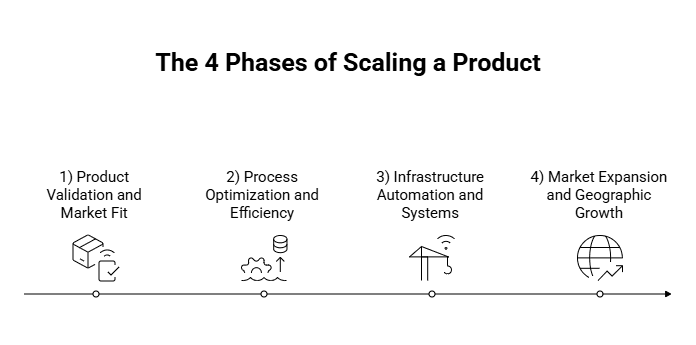
Phase 1: Product Validation and Market Fit
This is the scrappy phase focused on finding product-market fit. Processes are manual and hands-on because you're gathering early feedback and learning what your users actually need.
In this phase, it's perfectly acceptable to do things that don't scale. You might manually onboard every user, personally respond to every support ticket, and hand-hold customers through their first experiences. This manual approach gives you invaluable insights.
When Airbnb was starting, the founders personally visited hosts to take better photos of their listings. This didn't scale, but it taught them what made listings successful—insights that later informed their automated recommendation engine and professional photography program.
Phase 2: Process Optimization and Efficiency
This phase is characterized by interim solutions. Teams start to specialize, and internal processes are streamlined to handle more volume. You're not fully automated yet, but you're finding efficiencies and building systems that can handle more load than your initial scrappy processes.
You might bring in a dedicated customer service team, implement basic automation for common workflows, and start documenting processes that were previously just institutional knowledge.
Etsy moved through this phase by standardizing their seller onboarding. Instead of custom guidance for each seller, they documented best practices from their manual phase and created templates, guides, and checklists that most sellers could follow independently.
Phase 3: Infrastructure Automation and Systems
Now you're investing in enterprise-level solutions. Critical manual tasks are replaced with automation and significant infrastructure support. This is where you implement tools like enterprise authentication systems, automated identity verification, and sophisticated deployment pipelines.
The cost of automation is high, but the payoff is that you can serve exponentially more users without linear increases in operational costs.
Uber's move from manually approving each driver to automated background checks and document verification exemplifies this phase. The upfront investment in verification systems was significant, but it allowed them to onboard thousands of drivers per week instead of dozens.
Phase 4: Market Expansion and Geographic Growth
Focus shifts to go-to-market activities and expanding into new markets. This might mean moving from the US market to the EU, entering government sectors, or expanding into adjacent verticals.
Your core product and infrastructure are now solid enough to support growth, so the limiting factor becomes market reach rather than technical or operational capacity.
Zoom reached this phase when their product was reliable, automated, and simple enough that they could focus purely on market expansion. They entered education, healthcare, and government sectors not by rebuilding their product each time, but by layering compliance and specific features onto their already-scalable foundation.
Building Scalable Products: Essential Design Strategies
Building a scalable product requires intentional design choices from day one. These strategies work together: simplicity enables automated onboarding, which reduces the support burden that would otherwise grow with your user base, which in turn prevents the technical debt that comes from constantly firefighting.
Creating Simple User Experiences That Scale
Even if you are solving a complex problem, the solution must be easy to understand and use. Simple products have much higher adoption rates because they reduce friction in the user journey. Every additional step, every moment of confusion, every feature that requires explanation becomes a barrier to scale.
Instagram understood this when they launched with just photo sharing and filters. They could have built albums, messaging, and video from day one, but they didn't. The simplicity meant anyone could understand the product in 30 seconds.
How to Build Automated User Onboarding
Users should be able to find the value of your product immediately and on their own. If a user has to call a salesperson or search Google to figure out how to use your tool, you have already lost a chunk of your potential market.
Automated onboarding is essential for scale because manual onboarding simply doesn't scale. You cannot personally walk through your product with millions of users.
Dropbox demonstrates this perfectly. Their onboarding shows you exactly how to add files, share folders, and access them from anywhere—all within the product, in under two minutes. No demo calls, no training sessions. This automation is why they could grow from thousands to hundreds of millions of users without proportionally expanding their onboarding team.
Managing Technical Debt in High-Growth Products
It's tempting to take shortcuts during development to ship faster or save money in the short term. However, these shortcuts often become massive roadblocks that cause a product to collapse under the weight of mass adoption.
Technical debt accumulates like financial debt, with compounding interest. The time you save today by cutting corners becomes weeks or months of work later when you need to refactor systems that are already serving thousands or millions of users.
Twitter's early scaling problems illustrate this cost. Their "fail whale" became infamous because their initial architecture couldn't handle growth. What started as shortcuts to ship quickly became months of engineering work to rebuild core systems while the service was already serving millions.
Scalable Business Models: From Sales to Support
Beyond the product itself, your business model must be designed for scale. Traditional business models that rely on high-touch sales and support simply cannot support exponential growth without proportional cost increases.
Each element here connects back to your product design: automated onboarding reduces the need for manual sales, simple design reduces support tickets, and strategic pricing removes friction from the buying process.
Building Self-Service Customer Support Systems
Large support teams are expensive and slow. To scale effectively, you need to minimize manual support through:
Online communities where users help each other solve problems
Automated support tools like chatbots and comprehensive help documentation
Self-service knowledge bases that users can search independently
Stack Overflow built an entire business on this principle. Instead of hiring support staff to answer developer questions, they created a platform where developers answer each other's questions. Their community now handles millions of support queries that would otherwise require thousands of employees.
Implementing Digital Sales and Self-Service Purchasing
Move away from one-to-one sales conversations. The purchase process should be easy, transparent, and doable entirely from within the product without contacting a representative.
This doesn't mean eliminating human sales entirely for enterprise deals, but your core product should be sellable without human intervention for the majority of customers.
Atlassian grew to billions in revenue with almost no sales team. Their products were designed to be discoverable, understandable, and purchasable entirely online. A developer could find Jira, understand what it does, try it with their team, and buy it—all without talking to anyone.
Pricing Strategies for Scalable SaaS Products
While not universal (Apple being a notable exception), highly scalable models often use competitive pricing or freemium models to appeal to the widest possible population. The goal is to remove price as a barrier to entry for as many potential users as possible.
Spotify's freemium model connects directly to their scalability strategy. Free users reduce acquisition costs (since the product sells itself), automated onboarding gets them listening immediately, and simple design means minimal support needs. Only when users see value do they convert to paid.
Scaling Through Partnerships and Integrations
Reach new audiences by letting other businesses sell or integrate your product into their own offerings. Licensing and franchising allow you to expand your market reach without directly building infrastructure in new markets or verticals.
Stripe leveraged this brilliantly. Instead of only selling directly, they enabled other platforms to embed Stripe payments. Now when Shopify, Lyft, or thousands of other companies need payment processing, they use Stripe—expanding Stripe's reach without Stripe having to acquire each end customer directly.
Automating Marketing for Product-Led Growth
Use search engine optimization, search engine marketing, and automated email and in-product journeys to reach users at scale without manual outreach. Every marketing process that requires human intervention limits your ability to scale efficiently.
HubSpot built their entire growth engine on this principle. Their content ranks highly in search results, bringing in prospects automatically. In-product emails nurture these prospects based on their behavior. The entire funnel runs with minimal human involvement, allowing them to acquire customers at scale.
How to Build High-Performing Product Teams at Scale
Your team structure and culture are just as important as your product architecture when it comes to scaling. The teams you build must mirror the scalability principles in your product: clear ownership (like automated onboarding), minimal dependencies (like self-service features), and data-driven decisions (like your product strategy).
Essential Elements of Scalable Team Structure
Every successful scaling team needs:
System: Clear processes and frameworks that don't require constant management oversight
Accountability: Defined ownership and responsibility so everyone knows what they're responsible for
Support: Resources and infrastructure that enable people to do their jobs effectively
These three elements create a foundation where teams can operate autonomously. At Spotify, their "squad" model gave small teams full ownership of specific features. Each squad had clear systems (how they work), accountability (what they own), and support (access to shared infrastructure and data). This structure allowed Spotify to scale from dozens to thousands of employees without creating bottlenecks.
Implementing Small Teams for Maximum Velocity
Use "minimally effective teams" to move quickly and avoid bottlenecks. Small teams with clear ownership can make decisions and ship features faster than large teams with diffuse responsibility.
Amazon's "two-pizza teams" embody this principle. If a team can't be fed with two pizzas, it's too large. This constraint forces focus and maintains the speed of a startup even as the company scales to hundreds of thousands of employees.
Single-Threaded Leadership: Distributing Decision-Making
Give leaders full autonomy and ownership over their areas to distribute decision-making. When every decision needs to flow through a central authority, you create bottlenecks that prevent scaling. Single-threaded leadership means one person owns an entire area and has the authority to make decisions within it.
When Amazon built AWS, they gave the team a single-threaded leader who owned everything from product strategy to infrastructure. This autonomy meant they could move quickly without waiting for corporate approval on every decision, enabling them to launch and scale faster than if every choice required executive sign-off.
Using RACI Framework for Clear Team Accountability
Use frameworks like RACI (Responsible, Accountable, Consulted, Informed) to define roles clearly and reduce conflict and duplication of effort. When everyone knows who is responsible for what, teams can move faster and with less friction.
At Google, their RACI frameworks for product launches ensure that engineering knows they're responsible for building, product management is accountable for decisions, design is consulted on UX, and leadership is informed of progress. This clarity eliminates the meetings and confusion that slow down scaling organizations.
Building Effective Escalation and Decision Processes
To avoid "resolution by exhaustion" where the person with the most stamina wins arguments, use written templates that present both perspectives clearly for decision-makers. This ensures decisions are made on merit rather than politics or persistence.
GitLab's "Directly Responsible Individual" system combined with written decision documents creates this structure. When teams disagree, they document both perspectives and the DRI makes the final call based on data and strategy, not on who argued longest.
Agile Processes and Workflows That Enable Scale
How you work matters as much as what you build. These processes connect directly to your team structure: autonomous teams need efficient methodologies to coordinate, clear ownership requires focused goals to align efforts, and data-informed decisions demand the right culture to act on insights.
Adopting Agile and Design Thinking Methodologies
Adopt Agile and Design Thinking to establish faster, more reliable ways of working. These methodologies are designed specifically to help teams move quickly while maintaining quality.
Spotify's agile squads ship features weekly rather than quarterly because their methodology emphasizes iteration and learning. This speed compounds over time: while competitors ship four major updates per year, Spotify ships 50+, learning and improving faster at scale.
Creating Autonomous Product Squads and Teams
Empower "Product Squads" to own the entire lifecycle of a feature, from strategy and design to implementation and maintenance. This reduces bottlenecks from upper management and allows teams to move at the speed of decision-making rather than the speed of approval-seeking.
Netflix's "context not control" culture exemplifies this. Teams understand the business context and goals, then make their own decisions about how to achieve them. This autonomy allowed them to scale from DVDs to streaming to original content without reorganizing their entire company each time.
Using OKRs to Maintain Focus During Growth
Use Objectives and Key Results (OKRs) to keep teams focused on one or two core goals. If a task doesn't help achieve those goals, don't do it. This discipline is essential because there will always be more good ideas than you have capacity to execute.
When Google was scaling, they used OKRs to ensure every team, from engineering to sales, aligned on the same priorities. If a project didn't contribute to the quarter's OKRs, it was postponed—no matter how interesting it seemed. This focus prevented the diffusion of effort that kills scaling momentum.
Building a Culture of Ownership and Independence
Not everyone is built for a high-growth environment. You must hire or train people who are comfortable taking ownership and driving results independently. In a scaling organization, there isn't time for constant hand-holding or direction.
Stripe deliberately hires for people comfortable with ambiguity and ownership. They know that scaling requires every person to identify problems and solve them without waiting for explicit direction. This culture enables their small teams to have outsized impact.
Managing User Churn While Maintaining Product Focus
You cannot make everyone happy. Focus on solving your core problem exceptionally well, even if it means some users who want slightly different features will leave. Trying to be everything to everyone results in a product that's nothing special to anyone.
Basecamp actively accepts churn by refusing to add complexity. They could add features that some users request, but it would compromise the simplicity that most users value. This focus on their core value proposition, simple project management, maintains their scalability even as some users leave for more complex alternatives.
Common Scaling Mistakes and How to Avoid Them
Even with the best strategies, there are common mistakes that derail scaling efforts.
These pitfalls often stem from ignoring the connections we've built: scaling before validating contradicts Phase 1 principles, dropping quality breaks the user trust needed for automated onboarding, and vanity metrics mislead the data-informed strategy you need.
Why Scaling Before Product-Market Fit Fails
Do not scale before validating product-market fit or ensuring your architecture can handle growth. Scaling too early means you're amplifying something that doesn't work yet, which only makes the problems bigger and more expensive to fix.
Quibi spent $1.75 billion scaling a product before validating that people wanted short-form video on their phones. They built infrastructure, hired teams, and launched marketing for a product that users fundamentally didn't want. Had they validated in Phase 1, they could have pivoted or shut down for a fraction of the cost.
Maintaining Product Quality During Rapid Growth
Maintain a "quality bar" goal that mirrors your growth goals to ensure the user experience doesn't degrade as you expand. Fast growth often comes at the expense of quality if you're not intentional about maintaining standards.
Uber's rapid expansion into new cities came with declining service quality—drivers weren't properly vetted, customer support couldn't keep up, and safety issues emerged. The short-term growth created long-term problems that damaged their brand and required expensive remediation.
Vanity Metrics vs Business Metrics That Matter
Avoid focusing on downloads or traffic alone. These vanity metrics make you feel good but don't necessarily correlate with business success. Instead, focus on core metrics like retention, engagement, and revenue that actually indicate whether your product is delivering value.
Many mobile apps celebrate hitting 1 million downloads, but if 90% of users never open the app after day one, those downloads are worthless. Snapchat learned this when they prioritized user acquisition over engagement and had to refocus on daily active users—the metric that actually predicted revenue.
Best Practices for AI Integration in Scalable Products
Artificial intelligence has become a hot topic in product development, but it must be integrated thoughtfully rather than for its own sake. AI should serve your scaling strategy: simplifying complex tasks (supporting simple design), automating repetitive work (enabling automated onboarding), and personalizing experiences (informed by your data strategy).
When to Use AI: Solving Real Problems vs Hype
Avoid using AI just because it's trendy. If a problem can be solved with simpler means, do so. For example, Spotify's AI-generated "Wrapped" podcast was poorly received because it lacked the personal touch that made the original Wrapped feature special.
The lesson: AI should enhance your product's value proposition, not replace what users already love. Grammarly uses AI to improve writing, which directly serves their core promise. Adding AI for its own sake dilutes your focus and complicates your product.
Using AI to Simplify Complex User Tasks
AI is best used to simplify complex tasks that would otherwise require significant user effort. Features like "Magic Eraser" style image editing use AI to make complex photo manipulation accessible to anyone, regardless of technical skill.
Google Photos' AI-powered search lets users find photos by typing "sunset" or "birthday cake" without manually tagging anything. This automation removes friction and scales perfectly—the AI improves for everyone as more people use it, without Google needing to manually categorize billions of photos.
AI Testing and Quality Assurance at Scale
AI can be a "black box" where you don't fully understand how it arrives at outputs. Extensive testing is required to avoid offensive or unintended results. Even major companies have had to roll back AI features that produced inappropriate content.
Microsoft's Tay chatbot launched and within hours was generating offensive content because they didn't adequately test how it would learn from user interactions. The lesson connects back to Phase 1: validate thoroughly, even with AI, before scaling.
Validating AI Features with Small Datasets First
Test AI ideas with small, manual datasets first. At Amazon, product leaders tested search changes on just 100 high-traffic queries before scaling to millions. This approach allows you to validate effectiveness and catch problems before they impact your entire user base.
This mirrors the four phases of scaling: start manual (Phase 1), optimize on small datasets (Phase 2), automate the successful patterns (Phase 3), then scale broadly (Phase 4).
Ethics and Governance for AI-Powered Products
Ensure AI models align with your ethics and business policies, not just short-term engagement metrics. An AI that maximizes engagement might surface harmful or divisive content, which ultimately damages your brand and user trust.
Facebook learned this when their engagement-optimizing algorithm promoted divisive content because it drove clicks. The short-term engagement came at the cost of long-term trust and regulatory scrutiny. Your AI must serve your sustainable growth strategy, not just immediate metrics.
How to Set Growth Milestones and KPIs for Scaling
When setting goals for growth, consider three key factors that connect back to everything we've discussed: your data strategy informs metrics-based factors, your business model determines adoption targets, and your team's capacity influences time horizons.
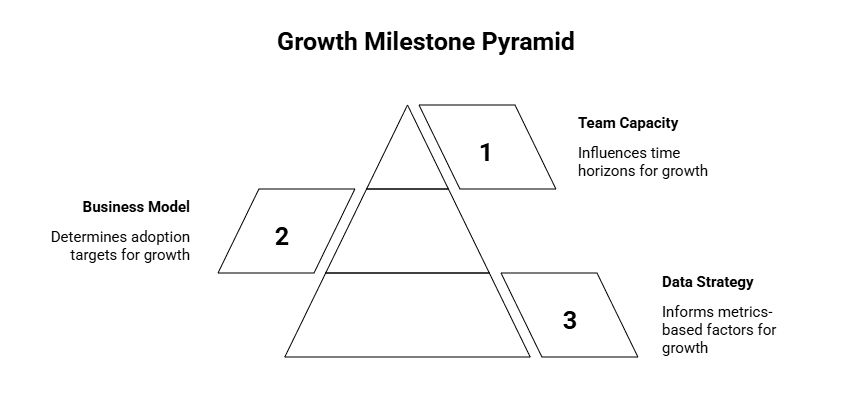
Metrics-Based Factors: Use Northstar and guardrail metrics to understand when you're approaching limits. For example, monitor whether website performance degrades after reaching a certain user threshold.
Adoption Targets: Set specific targets for the number of partners, users, or customers you want to reach within a given timeframe.
Time Horizons: Plan for event-based growth such as preparing for holiday traffic surges or high-visibility events like product launches or major partnerships.
Amazon uses all three when planning Prime Day. They set adoption targets (number of Prime members they want participating), metrics-based factors (site performance under load), and time horizons (the specific day and hour of the event). This comprehensive approach ensures they scale successfully rather than crashing under demand.
Step-by-Step Framework for Product Scaling
Before moving between growth phases, follow these three steps. This framework ties together your product strategy (what you're building), business model (how you're selling), team structure (who's building), and data insights (why you're building it).
Set a specific, measurable goal: For example, "Support 100 new enterprise customers in six months" or "Grow daily active users of Spanish-speaking users by 40% by year-end."
Anticipate challenges: Identify barriers that prevent you from meeting the goal effectively, such as data capacity limitations, security requirements, or infrastructure constraints.
Address critical challenges: Solve only the problems necessary to reach the next step rather than trying to solve for ultimate scale all at once.
This incremental approach prevents over-engineering and allows you to validate assumptions before making massive investments.
When Slack moved from startups to enterprise customers, they didn't rebuild everything. They set a goal (50 enterprise customers in one year), identified barriers (security compliance, admin controls), and solved only those specific challenges. They didn't build features for hypothetical future needs, avoiding waste while successfully scaling.
Choosing the Right Growth Model for Your Business
It's important to recognize that high scalability, such as growing 50% per quarter, isn't right for every business. Some businesses serve specialized markets where sustainable 10-20% annual growth is excellent. Some businesses require high-touch service that limits pure scalability but commands premium pricing.
Understand your specific market, your competitive position, and your goals before deciding whether you truly need a "hyper-growth" scaling model. Scaling for the sake of scaling can destroy a perfectly good sustainable business.
McKinsey doesn't scale like a software product, and they don't try to. Their business model depends on high-touch consulting where each client gets custom attention. They grow by adding consultants, not by automating consulting. This is a conscious choice that aligns with their value proposition and market position.
The key is being intentional about the type of growth you want and building the product, business model, team, and processes that support that vision. Whether you're building the next billion-user platform or a focused tool for a specific professional market, these principles of efficient growth, data-informed decisions, and thoughtful automation will serve you well.
Scaling is not about growth at any cost. It's about building products that deliver increasing value to more people while maintaining quality, staying true to your core mission, and creating a sustainable business that can thrive for the long term.
Need Help Building a Product That Scales From Day One?
Scalability does not happen by accident. It requires intentional design decisions, the right technical foundation, and an architecture that can handle growth without breaking.
Ellenox partners with teams to build products designed for scale from the start, combining engineering execution with a venture studio approach that supports founders and product teams with strategic guidance, technical leadership, and hands on collaboration to create scalable businesses and reduce cost per customer as growth accelerates.