


Updated: Feb 7
Most SaaS teams do not start by worrying about safety or bias. They start by trying to make the model useful.
The first version of an AI feature usually answers questions, summarizes text, or helps users write something faster. It works well enough in internal testing. Prompts are clean. Context is controlled. Everyone involved understands what the system is supposed to do.
Then the product ships.
Real users behave differently. They paste messy data. They ask follow-ups that rely on assumptions. They try to get the model to say things it probably should not. Not always maliciously, often just out of curiosity.
That is when teams realize the model needs constraints.
Where Unsafe and Biased LLM Outputs Actually Come From
In production systems, failures cluster around a few technical causes.
Prompt surface area grows faster than expected:
Users do not treat your LLM like a demo. They test boundaries. They phrase instructions ambiguously. Prompt injection is rarely obvious. Most attempts look like normal conversation with subtle instruction shifts.
Retrieval pipelines amplify risk:
RAG systems make models more useful, but they also increase exposure. If your retriever pulls policy drafts, internal notes, or culturally narrow material, the model will reproduce those biases faithfully. That is not a hallucination. That is compliance.
Generation has no built-in stopping point:
Once decoding begins, the model will continue unless something intervenes. If tone shifts mid-response or a sensitive inference emerges halfway through, nothing inside the model will correct it on its own.
Guardrails Are a System, Not a Plugin
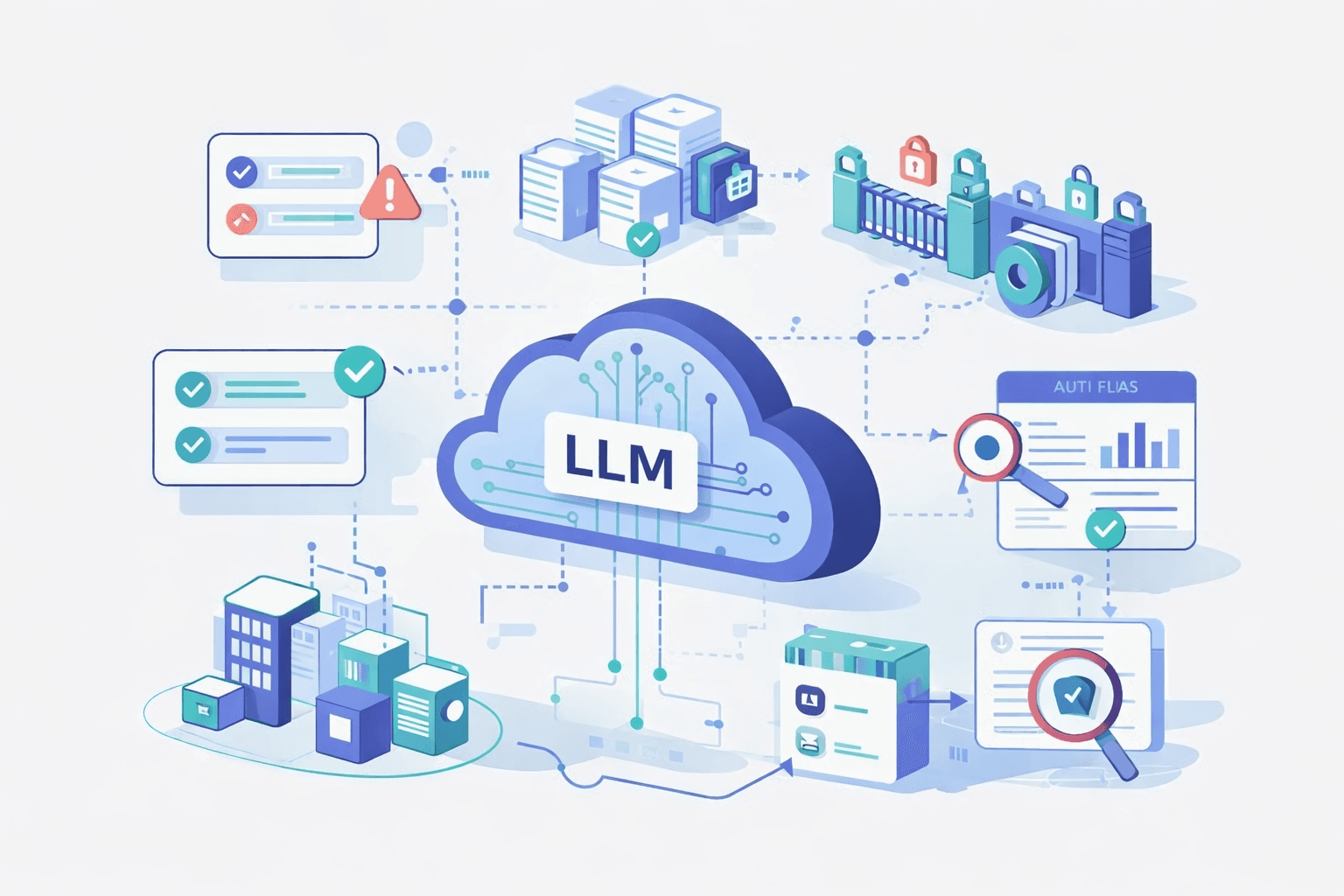
In practice, guardrails are control mechanisms around an LLM that decide what the model is allowed to see, allowed to do, and allowed to return. They live in the application, not in the model weights.
A guardrail can block a request, rewrite it, reroute it, interrupt generation, or suppress an output. Teams that do not implement guardrails rely entirely on training to enforce behavior. That works until real traffic arrives.
The most effective way to think about guardrails is by intervention point. Each point corresponds to a different failure mode.
Input Guardrails: Constraining the Problem Early
Input guardrails operate before tokenization and inference. They are cheap, fast, and critical.
At this stage, systems typically detect:
Prompt injection patterns
Attempts to override system or developer instructions
Requests for disallowed transformations
High-risk topics that require alternative handling
Technically, this is best handled with lightweight classifiers, rules, and embedding similarity. You do not need a full LLM here. Latency matters more than nuance.
The key decision is whether to block, rewrite, or reroute. Blocking everything increases false positives. Rewriting often preserves UX while neutralizing intent.
Retrieval Guardrails: Governing What Becomes Context
If your system uses retrieval-augmented generation, this layer is one of the highest leverage safety controls available.
Retrieval guardrails sit between the vector store and the model. Their job is to decide which chunks are allowed to influence generation.
This includes:
Removing sensitive fields from documents
Filtering outdated or unreviewed content
Detecting biased language in retrieved passages
Enforcing domain, role, or audience constraints
Most teams rely on vector similarity alone. That is insufficient. Retrieval must be constrained by metadata, provenance, and policy, not just cosine distance.
If unsafe content never enters the context window, the model cannot echo it later.
Context Management Is a Safety Control
Context windows are not neutral.
Every additional token increases the probability of drift. Early phrasing biases later responses. Old assumptions persist. Irrelevant history quietly shapes tone and framing.
Safety-conscious systems:
Truncate aggressively
Summarize instead of append
Drop conversational turns that no longer matter
Separate factual memory from conversational memory
This reduces hallucination, bias, and cost at the same time. For info, check Why AI Is Forgetful.
Generation Guardrails: Watching the Model While It Writes
Once decoding starts, the model enters a feedback loop with its own output. This is where unsafe behavior often emerges gradually, not immediately.
Generation guardrails monitor partial outputs during decoding and look for:
Gradual tone shifts
Emerging stereotypes or assumptions
Overconfident claims without evidence
Sensitive inferences based on limited input
Implementation varies. Some teams run a smaller parallel model on partial outputs. Others rely on heuristic triggers tied to token patterns.
The challenge is latency. Continuous monitoring must be efficient or it becomes cost-prohibitive. This is where small, specialized models outperform general ones.
Output Guardrails: The Final Check
Output guardrails evaluate the completed response before it reaches the user.
They typically scan for:
Toxic or abusive language
Biased or exclusionary phrasing
Leakage of system prompts or internal logic
Exposure of sensitive or proprietary data
Most teams start here because it is easy to add. Output scanning works best as a final confirmation, not the primary line of defense.
Tooling Choices Are Architectural Decisions
Guardrail tooling is not interchangeable.
Structured validation frameworks work well when outputs must conform to schemas. Flow-control systems make sense when entire conversational paths should be disallowed. Orchestration-level guardrails reduce glue code but increase coupling.
Bias evaluation tools are usually offline. They help diagnose and measure problems rather than enforce behavior at runtime.
The right choice depends on where enforcement should live: before inference, during generation, after output, or during evaluation.
Define Non-Negotiable Constraints
Before implementing anything, teams need clarity.
There are classes of inputs and outputs that should never be allowed, regardless of intent or context.
Most SaaS products converge on four categories:
Toxic or abusive language, including dismissive tone
Bias and stereotyping across roles, cultures, or abilities
System manipulation and prompt extraction
Exposure of sensitive or proprietary data
These constraints should be enforced deterministically wherever possible. Ambiguity increases risk.
Balancing Accuracy, Latency, and Cost
Every guardrail adds overhead. Naive implementations double inference cost.
High-performing systems parallelize aggressively. Input and retrieval checks run alongside prefill. Output scanning overlaps with streaming. Classification tasks use small models, not the primary LLM.
Some teams fine-tune lightweight models for prompt injection or bias detection in their domain. These models are cheap, fast, and more accurate than general solutions.
The goal is not to catch every edge case. It is to catch failures users would actually notice.
Measuring Bias With Real Signals
Bias mitigation fails when it is not measured.
Established datasets exist because intuition is unreliable. Implicit bias often looks reasonable to internal teams.
Evaluation can happen at multiple levels:
Embedding analysis to detect representational skew
Token probability analysis to surface preference bias
Generated text evaluation to capture user impact
Patterns matter more than individual incidents. Repeated failures indicate a system problem.
Mitigation Happens Across the Lifecycle
Bias enters at different points, so mitigation must be distributed.
Pre-processing reduces inherited bias. Instruction tuning reshapes default behavior. Prompt design guides framing. Runtime guardrails catch what everything else misses.
Skipping any layer increases pressure on the rest.
Guardrails Are Never Finished
Production systems change continuously.
New documents enter retrieval. User behavior evolves. Attack patterns adapt.
Effective teams log guardrail triggers, review false positives, remove problematic data at the source, and regularly test adversarial prompts.
This turns safety from a static rule set into a living system.
Building Production-Grade LLM Systems with Ellenox
Running LLMs in production introduces challenges that do not show up in demos. Inference cost grows unevenly. Retrieval pipelines drift. Context management becomes brittle. Safety and bias issues surface alongside latency spikes, throughput limits, and unpredictable behavior under load.
Ellenox works with SaaS teams to design LLM infrastructure that holds up under real conditions. We help companies think through the full system, from model selection and serving architecture to retrieval design, guardrails, concurrency, and cost control. Safety and bias mitigation are treated as engineering constraints, not standalone features.
If you are building or scaling LLM-powered products, Ellenox can help you design an AI foundation that is production-grade.