


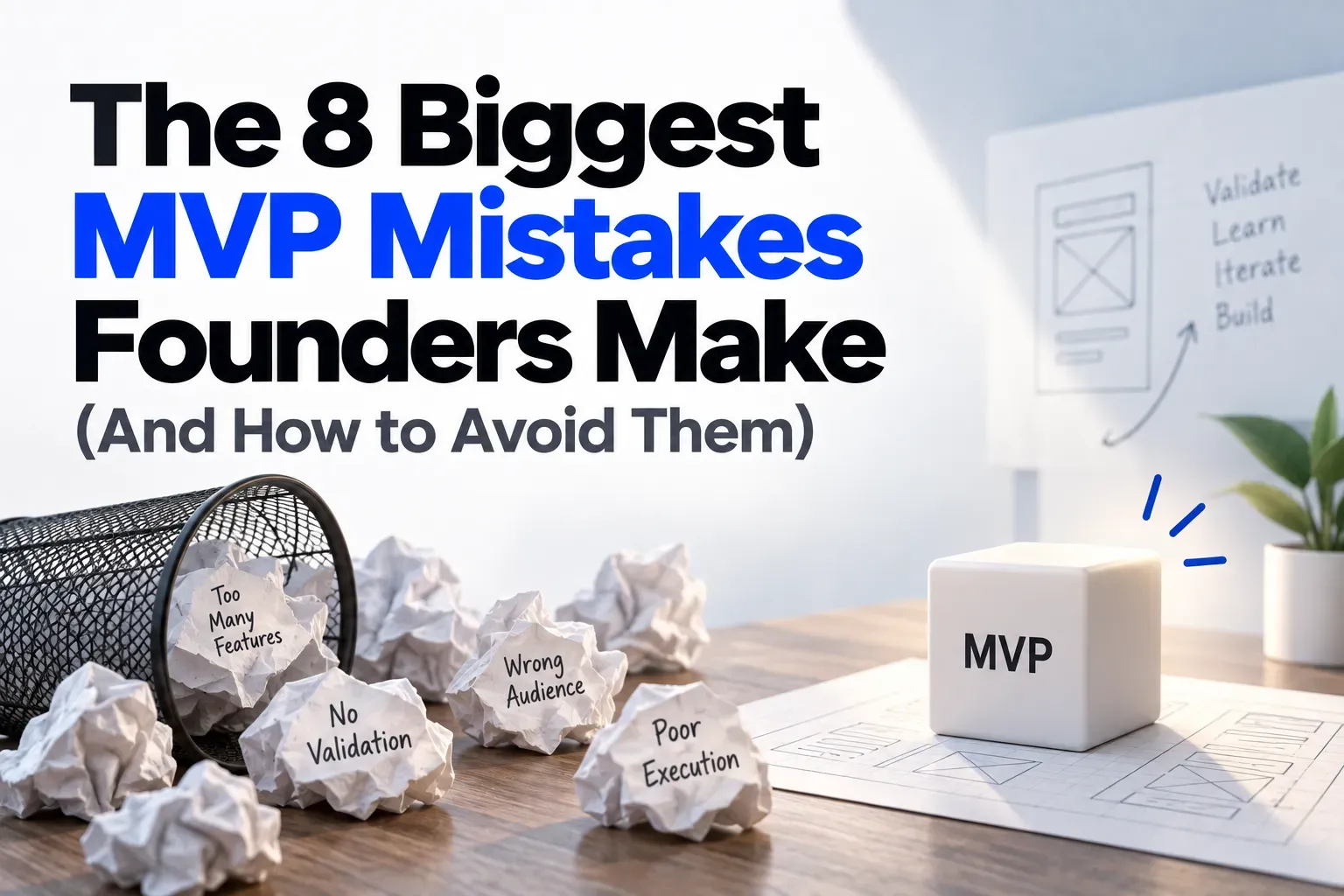
One founder spent $17,000 and six to eight months of a team's time building an MVP that got zero customers and zero revenue. Not because the code was bad. Because nobody had validated that the problem was worth solving before the building started.
This is the pattern behind almost every failed MVP. It's rarely a technical failure. It's a sequence failure: skipping a validation step, building for the wrong audience, or optimizing for the wrong outcome, and not finding out until months of runway are already gone.
This piece covers the mistakes that actually sink MVPs, based on real founder post-mortems, not the generic "don't build too much" advice that gets repeated everywhere without explaining what "too much" actually looks like.
Mistake 1: Building a Solution Before Validating the Problem
The single most common MVP failure: falling in love with the idea instead of the problem, then building a full version of that idea before checking whether anyone urgently needs it solved.
What this looks like in practice: a team spends months building something sleek and functional. It works. It looks good. Then it launches to silence, or to users who try it once and disappear. When someone finally asks why, the answer is almost always the same: the problem being solved wasn't painful enough for anyone to change their behavior over it.
The test that catches this before you build: if your product disappeared tomorrow, would anyone who's actually used it be upset? If the honest answer is "probably not," you're building a solution in search of a problem, and no amount of good execution fixes that.
The fix: validate the problem's urgency before writing code. A landing page, a waitlist with a real explanation of why people are excited, or direct manual delivery of the outcome (a Wizard of Oz test) all surface real demand faster and cheaper than a full build does.
Mistake 2: Confusing "Minimum" With Either "Cheap" or "Complete"
MVP failures cluster at two opposite extremes, and both come from misunderstanding what "minimum" actually means.
| Failure mode | What it looks like | Why it fails |
|---|---|---|
| Overbuilding | Adding features "just in case," delaying launch to polish UI, building backend systems before demand is proven | Burns runway and delays the feedback that would have told you what to build next |
| Underbuilding | Shipping something so broken or confusing that users can't experience the actual value being tested | Produces no usable signal, since users bounce before reaching anything worth learning from |
Signs you're overbuilding: you're adding functionality so the user "will understand the product," you've delayed launch for months to get the brand or UI right, or you're building infrastructure for scale you don't have users to justify yet.
Signs you're underbuilding: early users can't complete the core workflow at all, the product is too rough to deliver the actual value proposition even once, or feedback is entirely about bugs and confusion rather than the idea itself.
The right target sits between these: a product that delivers one real slice of value, usable even if it's rough everywhere else. As Reid Hoffman put it, your first product should embarrass you a little. If it doesn't, you shipped too slowly.
Mistake 3: Skipping the Manual Test Before Automating It
Before building any automated version of a workflow, the fastest and cheapest validation is doing it manually first: a Wizard of Oz test where the "product" is actually a human doing the work behind the scenes while the customer experiences it as if it were automated.
Teams that skip this step often build a fully automated system for a workflow they've never actually watched a real customer struggle through. The automation ends up solving the wrong part of the problem, because nobody has spent time inside the manual version long enough to know which part actually needs fixing.
The fix: run the ugliest, most manual version of your idea first. If a human doing it by hand for ten customers doesn't produce enthusiastic demand, an automated version of the same thing won't either.
Mistake 4: Launching to a Vague, General Audience
Opening an MVP to "everyone" instead of a specific, named group is one of the most avoidable mistakes, and one of the most common. A vague audience produces vague, unusable feedback: some people like it, some don't, and no clear pattern emerges because the group was never coherent in the first place.
What works instead: a waitlist or early access group built around a specific reason for excitement, not just interest. Founders who ask signups to explain why they want the product, then onboard the most enthusiastic responses first, get sharper, faster, more actionable feedback than founders who let anyone in.
The tighter and more specific the first audience, the more the feedback actually means something. "Freelance graphic designers who bill hourly and hate their current invoicing tool" is a group you can learn from. "Small business owners" is not.
Mistake 5: Building More Than One Feature or Product at a Time
Getting one feature genuinely right is hard. Getting several right simultaneously, before any of them has real signal, multiplies that difficulty without multiplying the chance of success.
Teams that spread MVP scope across multiple features or, worse, multiple products at once, dilute the feedback signal on all of them. Nothing gets validated cleanly, because users are reacting to a bundle instead of a single, clear hypothesis.
The fix: ruthlessly cut scope to the one feature tied to the core problem being tested. Everything else, no matter how compelling it seems, waits until that one thing is proven.
Mistake 6: Optimizing for Investor Optics Instead of Customer Truth
Some MVPs get built to look impressive in a pitch deck rather than to genuinely test demand. This produces a product shaped by what investors are assumed to want to see, not by what a real customer needs.
The tell: feature decisions get justified by "this will look good to investors" rather than "this is what our target customer told us they needed." Fundraising is a tool for building the company, not the goal the MVP itself should be optimized around. Investors are chasing evidence of real traction, not slide polish, and a cap table full of interested investors doesn't matter if the underlying product doesn't work for actual users.
Mistake 7: Treating the MVP as a Never-Ending Draft
The opposite failure of overbuilding upfront is getting stuck in an endless revision loop after the first version ships: perpetually tweaking, polishing, and refining instead of getting the version that exists in front of real users and collecting real feedback.
This trap is seductive because it feels like productive work. It isn't. An MVP that never stops changing before it's tested produces no usable signal, just continuously deferred judgment day. The goal was never a perfect MVP. It was fast, honest feedback, and that requires actually shipping the imperfect version and letting real users react to it.
Mistake 8: Ignoring Distribution Until After the Build Is Done
A working MVP with no plan for how it reaches its first users is a product nobody will ever test. Distribution isn't a step that starts after building finishes; it needs to be part of the plan from the first day of scoping, even if the initial answer is as simple as "I will personally message 50 people in this specific community."
Founders who build first and think about acquisition second frequently discover, only after the product is done, that there's no real channel to reach the audience they built it for. That's an expensive way to learn a distribution problem that could have been surfaced in week one.
The Pattern Behind All of These Mistakes
Every mistake on this list traces back to the same root cause: skipping a validation step because building feels more like progress than testing does. Writing code, designing screens, and shipping features all produce visible output. Talking to ten more customers or running a manual test doesn't feel like the same kind of momentum, even though it's usually the higher-leverage move.
The founders who avoid these mistakes aren't the ones who plan more thoroughly upfront. They're the ones who stay honest about which step they're skipping, and skip straight to building only after the cheaper, faster validation step has actually happened.
Work With Ellenox on Getting the MVP Right the First Time
Most of the mistakes above are avoidable with the right sequence: validate the problem, test manually before automating, scope ruthlessly to one feature, and plan distribution before the build is finished, not after.
Ellenox works with early-stage founders through exactly this sequence: validating real problems with real users, scoping an MVP that tests one clear hypothesis instead of everything at once, and building the first version fast enough to get honest feedback before months of runway disappear. If you're about to start building and want the scope right before you write the first line of code, talk to Ellenox.