


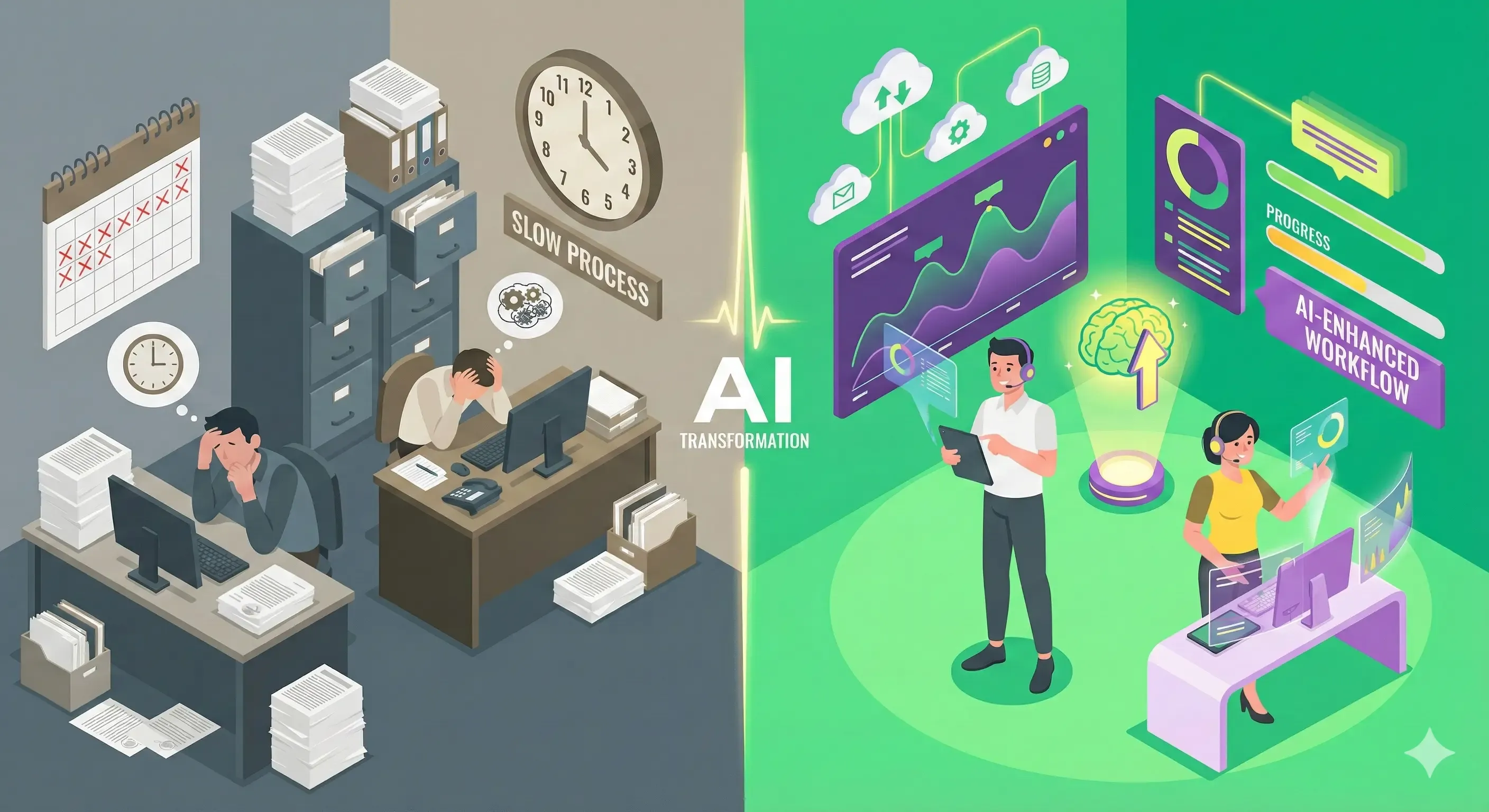
The product development landscape changed overnight, and most teams are still catching up.
What separates winning products from failed ones isn't resources anymore. It's speed and precision. Teams that ship functional MVPs in weeks instead of quarters. Founders who validate ideas with real users before burning through their runway. Developers who catch bugs before users ever see them.
The difference? Strategic AI integration.
But here's what nobody tells you: throwing AI at your product process doesn't automatically make things better. I've worked with dozens of startups trying to "AI all the things" only to end up with worse outputs and frustrated developers.
This guide covers practical ways to use AI in product development that you can implement starting today.
Why this matters now
Traditional product development is broken in predictable ways.
Around 40% of new products fail. That's $215 billion wasted annually in the US alone on products that never find market fit. The culprits are familiar: slow validation cycles, missed market timing, building features nobody asked for.
The old playbook looked like this: spend three months gathering requirements, another two months designing, six months building, then finally ship something. By then, the market has moved. Your assumptions are outdated. Competitors have launched similar features.
Here's what's different now.
Teams using AI strategically are cutting development time by 50%. They're reducing time to market by 20-40% and slashing development costs by 20-30%. These aren't marginal improvements. They're the difference between a startup reaching product-market fit or running out of runway.
The speed advantage compounds. When you can test three product concepts in the time it used to take to build one, you learn faster. When you learn faster, you make better decisions. Better decisions mean products that actually solve problems users will pay for.
The challenge isn't whether to use AI in product development. It's knowing where to apply it for maximum impact and how to avoid the costly mistakes that derail most implementations.
What AI actually does for product teams
Let's cut through the marketing noise and focus on concrete benefits you can actually measure.
Compress your timeline from idea to working product.
The traditional product timeline is dying.
What used to require a full engineering team and three months can now happen with two developers in three weeks. Sometimes faster. You don't need extensive technical infrastructure to validate whether your product idea resonates.
I've watched solo founders build and launch functional SaaS products in a single weekend. These aren't prototypes. They're real applications with paying users. Tools like GitHub Copilot, Vercel v0, and Replit Agent let you move from concept to deployed product at speeds that were impossible two years ago.
For startups, this changes everything. You can test your core hypothesis fast enough to pivot before burning capital. You can launch multiple variations to see which one gains traction. Speed becomes your competitive advantage.
But speed without strategy leads to technical debt. The real challenge is moving fast while building systems that scale.
Make decisions based on data instead of guesses.
Product intuition matters, but it shouldn't be your only input.
AI makes real-time analysis accessible to small teams. You're not choosing between expensive analytics consultants or flying blind. The data is there, processed and actionable, whenever you need it.
Modern analytics tools like Mixpanel, Amplitude, and Heap use AI to surface insights automatically. They tell you which features drive retention. They identify user segments likely to churn. They spot patterns in successful conversion flows that you'd never catch manually.
This shifts product decisions from "what feels right" to "what the data shows." You still need strong product judgment. AI can't replace that. But you're making decisions with far more context than was previously possible at your team size.
The gap between teams that use data effectively and those that don't is widening. Data-driven teams ship features users actually want. Everyone else is guessing.
Ship higher-quality products with fewer bugs.
Quality assurance used to be a massive bottleneck.
Manual testing is slow and expensive. Even with thorough QA, bugs slip through to production. Users find them, support tickets pile up, and developers spend days firefighting instead of building new features.
AI testing tools change this completely. They run thousands of test scenarios automatically. They check edge cases that no human would think to test. They simulate different devices, network conditions, and user behaviors before any real user touches your product.
For security, AI continuously monitors for vulnerabilities and anomalies. It's like having a security team working 24/7, catching potential issues before they become incidents.
The practical result? You ship faster with fewer production bugs. Your small team delivers quality that used to require dedicated QA departments.
But testing is just one piece. The real challenge is building a comprehensive quality system that scales with your product.
Test multiple ideas in parallel without burning out.
The old approach: build one version, ship it, hope it works. If it doesn't, start over.
The new approach: test several concepts simultaneously, double down on what resonates.
AI makes parallel experimentation practical for small teams. Generate variations of your core product. Test different feature sets. Validate alternative approaches. All at the same time.
Companies like Notion do this constantly. They use real-time user data to decide which features to expand and which to kill. You don't need their scale to adopt the same methodology.
Predictive analytics go further. Instead of waiting for users to report problems, AI spots patterns that indicate issues before they escalate. For hardware products, predictive maintenance forecasts equipment failures weeks ahead, preventing downtime.
The bottleneck isn't running experiments anymore. It's having the infrastructure and processes to act on what you learn.
Where to apply AI in your product lifecycle
Most teams make the same mistake: they try to use AI everywhere at once. That rarely works.
AI creates different types of value at different stages. Here's where to focus your energy for maximum return.
Research and ideation: Discovering what to build
This stage determines whether your product succeeds or fails.
Build the wrong thing, and it doesn't matter how well you execute. The product won't find users. AI helps you validate ideas before you invest months building them.
Natural language processing tools analyze thousands of customer reviews, support tickets, and social conversations in minutes. They surface recurring pain points and feature requests automatically. Patterns that would take weeks of manual analysis become visible in hours.
Generative AI converts those insights into potential product concepts. You're not starting from zero anymore. You're starting with data-driven hypotheses about actual user needs.
Predictive analytics forecast demand for different features before you commit engineering time. This doesn't guarantee success. But it dramatically improves your odds by showing which bets are worth making.
The challenge most teams face: They collect massive amounts of user data but lack the systems to extract actionable insights at the speed needed for product decisions.
Tools to explore: ChatGPT for synthesizing research, Perplexity for market analysis, and Claude for analyzing customer feedback patterns.
Design and prototyping: Making ideas tangible
Design iteration used to be painfully slow.
Sketch a concept, gather feedback, revise, repeat. Each cycle took days or weeks. By the time you had a validated design, your assumptions had changed.
AI-powered design tools generate dozens of variations from a single concept in minutes. You explore more possibilities in an afternoon than traditional methods allow in a month.
For software products, AI transforms wireframes into interactive prototypes automatically. You give stakeholders working interfaces to test, not just static mockups. Feedback becomes more specific and actionable.
For physical products, AI creates 3D models and runs simulations to predict real-world performance. You catch design flaws digitally instead of discovering them after an expensive manufacturing setup.
The challenge: Moving from dozens of AI-generated prototypes to a single production-ready design requires strategic filtering and technical validation that most teams struggle with.
Tools to explore: Figma with AI plugins, v0 by Vercel for UI generation, Midjourney for concept visualization.
Development: Writing code that actually works
This is where developers feel AI's impact most directly.
GitHub Copilot and similar tools don't just autocomplete code. They understand context. They suggest entire functions. They help you work in unfamiliar frameworks without constant documentation searches.
Developers report 30-50% faster coding for certain tasks. But speed isn't the biggest win. Quality is.
AI-assisted debugging catches errors before they reach production. It suggests fixes based on patterns across millions of codebases. It identifies security vulnerabilities and performance bottlenecks automatically.
For testing, AI generates test cases and prioritizes which tests to run based on recent changes. What required dedicated QA engineers for weeks now runs continuously in the background.
The reality check: AI-generated code gets you to 70% faster. The last 30% (optimization, security hardening, scalability considerations) still requires experienced engineering judgment.
Tools to explore: GitHub Copilot, Cursor, Codeium for coding assistance; Cypress with AI features for testing.
Launch and optimization: Improving continuously
Launching isn't the finish line. It's the starting line.
AI enables continuous optimization based on actual user behavior. You're not guessing which features to improve. The data shows you.
AI systems monitor user interactions, identify friction points, and suggest A/B test variations automatically. They predict which users might churn and recommend retention strategies.
Personalization becomes practical even for small products. You can adapt interfaces and suggest features based on individual user behavior without manual segmentation work.
The missing piece: Most startups lack the infrastructure to collect, process, and act on this data in real-time. They end up with insights they can't operationalize.
Tools to explore: PostHog for product analytics, Statsig for experimentation, and Intercom with AI for user engagement.
How to integrate AI in Product Development into your workflow
Knowing where AI helps is different from actually implementing it. Here's a framework that works for dev teams and startups.
Step 1: Audit where you're actually spending time
Before adopting any AI tool, understand where your bottlenecks are.
Map your current product process in detail. Where does work consistently get stuck? Which tasks feel like busywork? What information is missing when you start new features?
High-leverage opportunities are usually:
Analyzing user feedback scattered across channels
Researching competitors and market trends
Writing boilerplate code and tests
Running repetitive QA checks
Creating design variations
Synthesizing data from multiple tools
These tasks are time-consuming, necessary, and don't require strategic judgment. Perfect candidates for AI.
Most teams discover they're spending 40-60% of their time on work that could be automated or AI-assisted. That's where the real opportunity lies.
Step 2: Start with one workflow, not everything
Don't attempt a complete transformation. Pick one stage of your product cycle to enhance with AI.
Maybe you start with AI-powered user research. Or use AI to analyze existing customer feedback. Or implement AI-assisted code review.
Run a small pilot. Give it two weeks. Measure the actual impact. If it works, expand. If it doesn't, try something else.
The goal isn't to use AI everywhere. The goal is to find where AI creates genuine leverage for your specific team and product.
Here's what successful pilots look like: clear before/after metrics, defined success criteria, and a plan for scaling what works.
Step 3: Use AI to generate options, not make decisions
This is critical and where many teams go wrong.
AI is fantastic at generating possibilities. Multiple design concepts. Feature ideas. Code solutions. Test scenarios. Marketing copy variations.
But AI shouldn't make final decisions. That's still human work.
The workflow that works: AI generates a range of options. Humans evaluate them, choose the best fit, and refine. All AI outputs get reviewed before implementation.
Think of AI as an incredibly fast junior team member. Great at execution. Needs guidance and oversight. The future isn't AI versus humans. It's AI-enhanced humans versus everyone else.
The teams that win are building systems where AI handles volume and humans handle judgment. That balance is harder to achieve than it sounds.
Step 4: Build AI agents for recurring tasks
AI agents are autonomous systems that handle specific tasks independently. They make routine decisions without requiring human input each time.
This is where real efficiency gains happen.
Example agents you can build:
Research agent: Monitors competitor websites, social media, and news. Compiles weekly reports on market changes.
Feedback analyzer: Reviews support tickets and user interviews daily. Tags issues by theme and urgency.
Testing agent: Generates and runs regression tests whenever code changes. Alerts developers only when tests fail.
Content generator: Creates draft documentation from code comments and PRD updates.
Tools like Zapier, n8n, and Relay make building these agents accessible even without deep technical skills.
The challenge isn't building individual agents. It's orchestrating multiple agents into a coherent system that actually improves your workflow instead of creating new complexity.
Avoiding common mistakes
I've seen teams waste months on AI integration that doesn't deliver results. Here's what usually goes wrong and how to avoid it.
Mistake 1: Trying to solve problems AI can't handle
AI has clear limitations. It's not great at reasoning, complex logic, or strategic thinking.
Don't use AI to make product strategy decisions. Don't rely on it for nuanced user research insights. Don't expect it to understand your unique company context without extensive prompting.
AI excels at pattern recognition, language processing, and repetitive tasks. It struggles with genuine creativity, ethical judgment, and contextual decision-making.
Match the tool to the task. Use AI where it's strong. Keep humans involved where judgment matters.
Real example: A startup tried using AI to prioritize their product roadmap. The AI suggested features based purely on frequency of mentions in user feedback. It completely missed strategic considerations like technical dependencies, competitive positioning, and business model implications.
Mistake 2: Poor data quality leads to poor outputs
AI is only as good as the data you feed it.
Biased training data produces biased recommendations. Incomplete datasets lead to incomplete insights. Outdated information results in irrelevant suggestions.
Before implementing AI tools, clean your data. Establish quality standards. Create processes for keeping data current.
This isn't glamorous work. But it's the foundation that determines whether AI adds value or creates problems.
Most failed AI implementations trace back to data issues, not tool selection or implementation strategy.
Mistake 3: No human review process
AI outputs always need human review. Always.
Even the best AI models make mistakes. They hallucinate facts. They miss context. They generate plausible-sounding nonsense.
Build review checkpoints into your workflow. Every AI-generated code snippet gets reviewed. Every AI-analyzed insight gets validated. Every automated decision has a human approval step.
Teams that skip this end up with compounding errors that take weeks to untangle.
The review process itself needs design. Who reviews what? How quickly? What are the quality criteria? These questions matter as much as choosing the AI tools.
Mistake 4: Ignoring privacy and security
AI systems process massive amounts of data. Often sensitive data. Customer information. Product plans. Strategic decisions.
You need clear policies about what data AI tools can access. How that data is stored. Who can see it. How long it's retained.
Stay compliant with regulations like GDPR and CCPA. Use AI tools that offer proper data protection. Don't feed proprietary information into public AI models without understanding the implications.
Security breaches destroy trust. One incident can kill a startup. Take this seriously from day one.
The reality: Most early-stage startups don't have proper data governance until they're forced to build it. By then, they've already created security debt that's expensive to fix.
Mistake 5: Building without scalability in mind
This is the mistake that costs the most in the long run.
Early AI integrations often work fine at small scale. Ten users, a hundred API calls per day, simple use cases. Everything feels smooth.
Then you grow. Suddenly you're hitting rate limits. Your prompts that worked for 100 users fall apart at 10,000. Your clever AI hacks don't scale. Your infrastructure costs explode.
The teams that succeed think about scale from day one. They build systems that can grow. They choose tools with clear upgrade paths. They design for 10x growth even when they're still at 1x.
This requires technical architecture expertise that most early-stage teams don't have in-house. And that's exactly where things go wrong.
Questions developers and founders ask
Can small teams compete with companies that have bigger AI budgets?
Absolutely. That's the whole point.
AI levels the playing field. A two-person startup can now do research that used to require a team of analysts. A solo developer can build features that used to need multiple engineers.
You don't need custom-trained models or dedicated ML teams. The tools available today give small teams capabilities that were exclusive to large companies just two years ago.
The constraint isn't budget. It's knowing which tools solve your specific problems and how to integrate them without creating technical debt.
What skills do developers need to work effectively with AI?
The good news: you don't need to become an AI engineer.
The skills that matter are:
Prompt engineering: Learning to communicate clearly with AI tools to get useful outputs
Critical evaluation: Knowing when AI suggestions are good versus when they miss the mark
Integration thinking: Understanding how to connect AI tools into existing workflows
Data literacy: Being able to interpret AI-generated insights and analytics
These are learnable skills. Most developers pick them up within a few weeks of regular use.
The advanced skills that separate good from great: Understanding model limitations, designing for scale, implementing proper monitoring and observability, and building systems that degrade gracefully when AI components fail.
How do you know if AI is actually helping or just adding complexity?
Measure concrete outcomes, not activity.
Track metrics like:
Time from idea to deployed feature
Number of bugs reaching production
Hours spent on repetitive tasks
Speed of user research cycles
Quality of product decisions (measured by user engagement)
If these improve, AI is helping. If they stagnate or worsen, something's wrong with your implementation.
Review your AI usage quarterly. Keep what works, drop what doesn't. AI tools should make your job easier, not more complicated.
What to watch for: Teams often confuse "using AI" with "getting value from AI." Just because your team adopted five AI tools doesn't mean you're more productive. Measure the outcomes.
What happens to developers when AI handles more of the coding?
Developer roles are evolving, not disappearing.
AI handles boilerplate code, repetitive patterns, and routine tasks. This frees developers to focus on architecture, system design, and strategic technical decisions.
The valuable skills become:
Understanding user needs and translating them into products
Designing scalable systems and making technical tradeoffs
Reviewing and refining AI-generated code
Building infrastructure that supports AI-enhanced workflows
Developers become more like product engineers. Less time writing every line. More time ensuring the right thing gets built in the right way.
Teams that embrace this shift will build better products faster. Teams that resist will struggle to compete.
What's next
AI in product development isn't a future trend. It's current reality.
The teams already winning started experimenting six months ago. They've figured out what works for their specific context. They've built workflows that leverage AI strategically while keeping humans in control.
Your competitive advantage isn't waiting for perfect tools or complete certainty. It's starting now with small experiments. Test AI in one part of your product process. Measure the results. Learn what works for your team.
The products that succeed in the next few years will be built by teams that understand how to blend AI capabilities with human judgment. Not AI replacing humans. Not humans ignoring AI. But strategic collaboration between both.
Start with one workflow this week. Pick a repetitive task that consumes time but doesn't require deep strategic thinking. Find an AI tool that addresses it. Give it two weeks. See what happens.
That's how you build the product development process that will carry you forward.
Scale Your AI Vision with Ellenox
Moving from prototype to production-ready AI products requires more than just infrastructure. It requires the right strategy, technical architecture, and team to execute.
Most startups hit a wall when scaling AI systems. What worked with 100 users breaks at 10,000. Infrastructure costs spike unexpectedly. Technical debt from early experiments compounds faster than you can fix it.
Ellenox partners with founders building AI-powered products to turn prototypes into production systems that scale. We bring deep technical expertise in ML infrastructure, distributed systems, and production deployment to help you navigate the complexity of scaling AI.
We work with you to:
Design AI architectures that scale efficiently from day one
Build production-grade ML infrastructure optimized for performance and cost
Implement proper security, monitoring, and compliance frameworks
Avoid costly mistakes that derail most AI implementations
The difference between teams that scale successfully and those that rebuild from scratch comes down to getting the technical foundation right early.
Partner with Ellenox to build AI products that are production-ready from the start.